
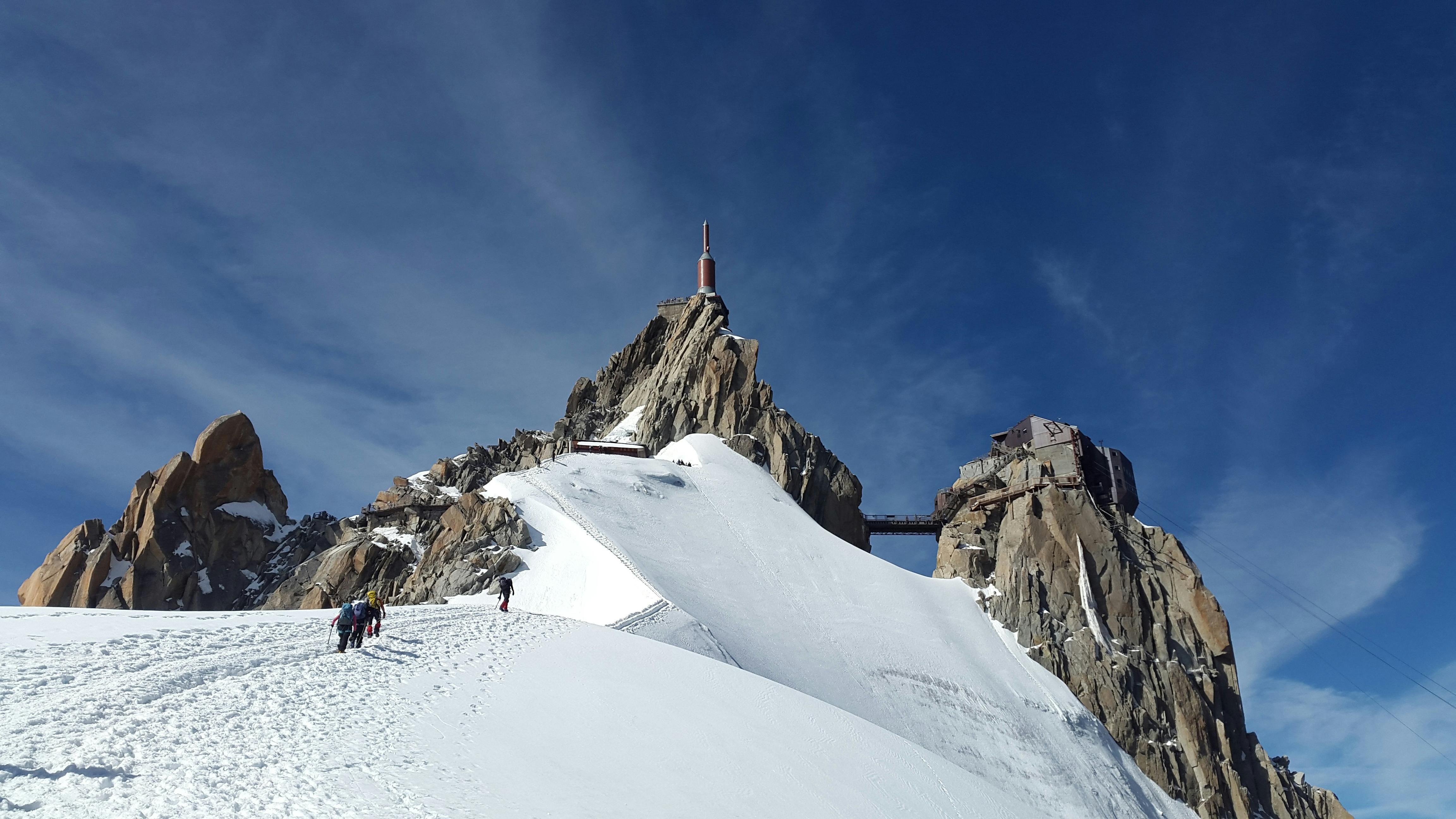
Aiguille du Midi : Heaven Meets the Mont Blanc Massif
The world falls away not with a lurch, but with silence. As the final cable car cabin glides from the mid-station into open sky, Chamonix valley dissolves into a miniature tapestry 2,800 meters below—chalets like scattered sugar cubes, the Mer de Glace glacier a frozen river of shattered glass, and the entire Mont Blanc range unfolding in a 360-degree amphitheater of ice and rock. Stepping onto the Aiguille du Midi's summit platform, you enter a realm where atmosphere thins to crystalline clarity and the only sounds are wind whistling through steel cables and your own measured breath. This is not merely a viewpoint but a threshold: at 3,842 meters, you stand on the roof of Western Europe, suspended between France and Italy, mortality and majesty. In 2026, this engineering marvel remains humanity's most breathtaking handshake with the high Alps—not by conquering the mountains, but by learning to listen to their ancient, wind-scoured language.
Why Aiguille du Midi Represents Alpine Ambition Perfected
Aiguille du Midi embodies more than engineering triumph—it represents a century-long evolution of respectful mountain access. When the first cable car ascended these slopes in 1955, it revolutionized alpinism by transporting climbers directly to the Vallée Blanche glacier without exhausting approaches. Today's two-stage system—ascending from Chamonix (1,035m) to Plan de l'Aiguille (2,317m), then to the summit (3,842m) in just 20 minutes—operates with Swiss precision while honoring the mountain's fragility. Unlike intrusive infrastructure elsewhere, the station nestles into the granite peak rather than dominating it: tunnels carved through solid rock connect viewing platforms, the iconic "Step into the Void" glass skywalk extends minimally beyond the cliff edge, and solar panels power essential operations. This delicate balance enables unprecedented access while preserving the Aiguille's wild character—where ibex still traverse the ridges at dawn and glacial silence remains unbroken except by wind. As climate change accelerates glacial retreat (the nearby Tacul Glacier has lost 40 meters annually since 2010), the Aiguille du Midi also serves as a vital observation post for scientists studying Alpine transformation.
The Best Time to Experience Aiguille du Midi
For optimal conditions—stable weather, clear summit views, and manageable queues—ascend between June 15 and July 10 or September 5–20. These windows deliver valley temperatures of 18–24°C (64–75°F) with summit conditions around -2 to +3°C—cold but not dangerously frigid. Crucially, book the first cabin of the day (8:00 AM departure) via compagniedumontblanc.fr exactly 30 days in advance; these slots sell out within hours and offer the highest probability of clear skies before afternoon clouds envelop peaks. Morning light between 8:30–10:00 AM creates ideal photography conditions—sun illuminates Mont Blanc's summit pyramid without harsh glare, while shadows accentuate the Vallée Blanche's crevasses. Avoid July 20–August 20 when queues exceed 120 minutes and afternoon haze obscures views. Winter ascents (December–March) provide dramatic snowscapes but frequent closures due to winds exceeding 100 km/h—check real-time status at montblancnaturalresort.com before traveling. Note that the summit station closes entirely for maintenance during the last two weeks of November.
Approximate Budget for a 7-Day Trip (2026)
Based on 2025 benchmarks adjusted for 4% inflation (per INSEE and Auvergne-Rhône-Alpes Tourism Board projections), here's a realistic mid-range budget for a Chamonix-based Alpine immersion:
- Accommodation: €130–€190 per night for a family-run chalet in Les Houches or Chamonix center—essential for early cable car access.
- Food: €100–€125 per day—breakfast at lodging, lunch of tartiflette at mountain refuge (€30–€38), dinner featuring Savoyard specialties like diots sausages (€55–€70).
- Transportation: €42 for a 7-day Mont Blanc Unlimited pass (covers all cable cars, trains to Italy/Switzerland, and valley buses). Geneva Airport transfers: €40 one-way via shared shuttle.
- Activities: Aiguille du Midi round-trip: €68. Step into the Void access: included. Vallée Blanche guided ski/snowboard descent (winter): €125. Mer de Glace train + ice cave: €34. Allocate €250 total.
- Miscellaneous: €70 for Beaufort cheese from La Cooperative de Chamonix, Chartreuse liqueur, or merino woolens from local artisans.
Total Estimated Cost: €1,400–€2,000 for seven days, excluding international flights.
5 Essential Aiguille du Midi Experiences
- The Summit Panorama: The 360-degree view encompassing Mont Blanc (4,807m), Grandes Jorasses, and the entire Alpine chain—best experienced within 30 minutes of arrival before clouds gather.
- Step into the Void: The glass skywalk extending 1,000m over empty space—visit between 9:00–10:00 AM when sun illuminates the abyss without glare on the glass.
- Tunnel to the Summit: The 40-meter tunnel carved through solid granite connecting stations—pause midway where a small window frames Mont Blanc perfectly without reflections.
- Vallée Blanche Access Point: The starting zone for Europe's longest ski descent (20km)—observe professional guides preparing clients even if not participating yourself.
- Sunset from the Terrace: Book the last descent cabin (4:30 PM summer) to witness alpenglow transforming the Mont Blanc massif into a rose-gold spectacle—requires advance reservation.
3 Hidden Perspectives Most Travelers Miss
- North Face Viewing Niche: Inside the main platform, a discreet archway (third opening from the tunnel entrance) frames the Aiguille's sheer north face with Mont Blanc reflected in a small ice pool—favored by photographers at 9:20 AM.
- Italian Side Overlook: Follow the unmarked path 50 meters beyond the main terrace toward Italy—requires asking a staff member for access permission—to witness the wilder, less-visited southern glaciers.
- Dawn Light on the Dômes de Miage: Take the 7:45 AM "photographers' cabin" (limited availability, book via email 60 days ahead) for exclusive access to watch sunrise illuminate the granite spires across the valley.
Cultural & Practical Tips
- Altitude Acclimatization: Spend your first 24 hours below 2,500m. Ascend gradually—take the mid-station stop to walk for 20 minutes before continuing to the summit to reduce altitude sickness risk.
- Booking Strategy: Reserve exactly 30 days ahead at 9:00 AM CET via compagniedumontblanc.fr—summer slots sell out in under 2 hours. Winter offers more availability but higher closure risk.
- Photography Protocol: Never block cabin windows during transit. Use microfiber cloth to eliminate condensation on glass skywalk. Best summit shots captured between 9:00–10:30 AM before clouds gather.
- Essential Gear: Wear layers—summit temperatures average -5°C even in summer. Gloves mandatory for skywalk (metal rails freeze bare skin). Sunglasses essential—snow glare causes temporary blindness.
- Environmental Responsibility: Never leave waste—even biodegradable items disrupt fragile alpine ecosystems above 3,500m. Use refillable bottles (water stations available at mid-station only).
Conclusion: Ascend with Reverence, Not Just a Camera
Aiguille du Midi endures not as conquest but as covenant—a promise that we may witness grandeur without diminishing it. As a conscious traveler, your presence carries responsibility: to move quietly through these thin-aired spaces, to understand that every footstep here rests on millennia of geological patience, and to recognize that the true summit lies not in altitude gained but in perspective earned. Support operators investing in sustainability (Compagnie du Mont-Blanc now offsets 100% of cable car emissions through glacial conservation projects). Sit silently on the terrace for ten minutes without photographing—let the scale recalibrate your sense of place in the world. By approaching this peak not as backdrop for achievement but as teacher of humility, you honor its deepest lesson: that mountains do not exist to be summited, but to remind us of our small, beautiful place within something infinitely greater.