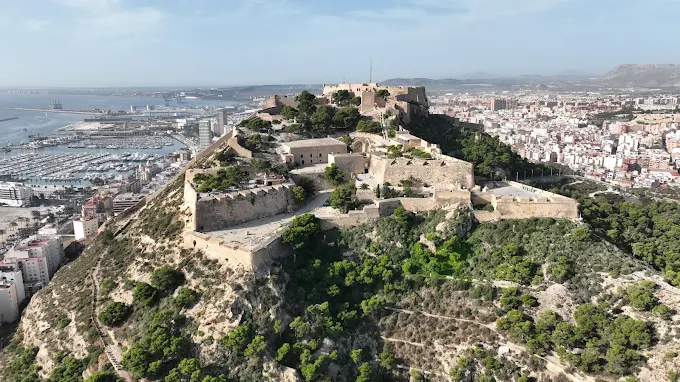
Castle of Santa Barbara: Where Medieval Stone Meets Mediterranean Horizon
I step out of the elevator at ten in the morning. The air feels sharper up here, touched by sea breeze. The lift costs 2.70 euros for a return trip. I lean against the inner wall. Sun warms the pale stone beneath my hand. The view opens fast — terracotta rooftops tumble down to blue water. A cargo ship moves slowly toward the horizon. A family spreads a cloth on a shaded terrace. They pass fruit between them. Not every part looks well kept. Some corners hold litter. Plaster flakes from walls in the outer courtyard. Still, the scale holds steady. Thick walls rise high. They have stood here longer than most cities have existed.
Why Castle of Santa Barbara Matters
This fortress crowns Mount Benacantil, 166 metres above Alicante. The first fortifications went up in the ninth century under Moorish rule. Christian forces took it on Saint Barbara’s Day in 1248 and gave the castle its name. Kings and generals modified and strengthened it across seven centuries. It saw battles, sieges, and long periods of quiet. During the Spanish Civil War it served as a prison. Afterwards it slipped into neglect. Restoration in the 1960s reopened it to the public. Today it stands as one of Spain’s largest medieval fortresses. Yet the site struggles with upkeep. Some outer sections remain unfinished. Signage in parts is worn or missing. You may find closed gates without clear explanation. Even so, the castle anchors Alicante. Locals and visitors alike orient themselves by its silhouette against the sky.
The Best Time to Experience Castle of Santa Barbara
Late April through May offers ideal conditions. Temperatures sit between 18°C and 24°C (64°F–75°F). The climb feels manageable. June through September brings heat. Days reach 28°C–34°C (82°F–93°F). Stone surfaces hold warmth well into the evening. The castle stays open until 23:00 in summer. Sunset visits work beautifully then. October and November stay mild, 20°C–25°C (68°F–77°F). Winter from December to February is quiet. Highs hover around 14°C–17°C (57°F–63°F). The site closes at 18:00. Rain falls occasionally. The upper terraces can feel exposed and windy. Weekday mornings mean fewer people. Sunday afternoons draw large local crowds.
Approximate Budget for a 7-Day Trip
- Accommodation: Mid-range hotel near the port — 80–110 euros per night. Budget guesthouse in the old quarter — 40–65 euros per night.
- Food: Lunch at a central cafe — 10–15 euros. Dinner with drink — 18–30 euros. Market sandwich or tapas — 5–9 euros.
- Transport: Elevator to castle — 2.70 euros return. Local bus — 1.50 euros per ride. Walking covers most central spots. Tram to nearby beaches — 1.85 euros.
- Attractions: Castle entry — free. MUSA museum inside — free. Special guided tours — 12–22 euros. Other city museums — 3–6 euros each.
- Miscellaneous: Drinks, snacks, small purchases — 10–15 euros daily.
Total estimated for one person, 7 days: 480–720 euros
Drinks and snacks at the castle’s upper terrace kiosk carry a heavy markup. A coffee can cost double what you pay in the old town below. Bring a filled water bottle and stop at a bakery on the way up. You will save money and avoid the long line.
Essential Castle of Santa Barbara Experiences
- Climb to La Torreta, the highest point. This is the oldest surviving section. The view stretches across the bay and inland toward distant hills. The last steps are steep. Take your time.
- Walk the full circuit of the outer walls. You see the city from every angle. Notice how the castle was positioned to overlook both land and sea approaches. Skip this if strong winds blow — exposed sections feel noticeably colder.
- Explore MUSA, the city museum inside. Artefacts span from prehistory through Roman, Moorish, and modern eras. Displays are clear and well spaced. The underground cistern stands out — deep, cool, and surprisingly intact.
- Watch sunset from the southern bastion. Light turns the stone gold. The city lights begin to twinkle below. It stays bright well after official closing time in summer.
- Walk down through Barrio Santa Cruz afterward. Narrow streets, brightly painted houses, and small plazas line the route. It feels like stepping back into an older Alicante.
- Stand where the Moor’s Face appears from below. Mount Benacantil’s profile looks like a sleeping figure from Postiguet Beach. The shape is clearer from the water than from the castle itself.
Hidden Gems Most Travelers Miss
- The Weapons Courtyard in the middle enclosure. It sits quiet and open. Benches rest in shade. Few visitors pause here long. It offers a good place to sit and process what you have seen.
- The path through Ereta Park on the western ascent. It winds upward under trees, with stone benches and shifting glimpses of the city. Far quieter than the elevator route.
- The so-called “Secret Tunnel” entrance. Guidebooks talk it up as a major highlight. It is small, partially blocked, and offers limited actual access. If you are short on time, skip it.
Cultural & Practical Tips
- Do not assume the elevator runs all day without interruption. It closes occasionally for maintenance with little advance notice posted. Have the walking route in mind as backup.
- Wear shoes with good grip. Some stone surfaces are worn smooth after centuries of use. They turn slippery when damp or dusty.
- Do not lean on low walls or climb onto battlements. Several sections show crumbling edges. Barriers are there for a reason.
- Carry water. The castle sits high. Shade is not continuous. In summer, dehydration can happen faster than you notice.
- Do not leave valuables unattended while taking photos. Isolated corners see occasional opportunistic theft.
- Visit once, not twice. Many people go up in the elevator and then walk down expecting different views. The descent route is pleasant but not distinct enough to justify extra time.
- Check closing time carefully. Staff begin ushering people out 30 minutes before the stated hour. Plan accordingly.
Essential Visitor Information
Location & Access: Mount Benacantil, Alicante, 03002, Spain. Elevator entrance near Postiguet Beach, opposite Explanada de España. Walking: 20–25 minutes from central market via Barrio Santa Cruz. Shuttle bus from near MARQ Museum — every 40 minutes, 1.45 euros. Elevator — 2.70 euros return, free downward only.
Tickets & Booking: Castle entry and permanent museum displays — free. Special guided tours — 12–22 euros, some need advance booking. Standard visit never requires reservation.
Operating Hours: 15 Nov–27 Feb: 10:00–18:00. 28 Feb–16 Jun: 10:00–20:00. 17 Jun–4 Sep: 10:00–23:00. 5 Sep–14 Nov: 10:00–20:00. Closed 24 Jun, 24–25 Dec, 31 Dec, 1 Jan, 6 Jan.
Visit Duration: Minimum 90 minutes. 2–3 hours lets you explore all three enclosures and sit at the viewpoints.
Family Suitability: Good for children. Elevator access suits strollers up to middle enclosure. Upper sections have uneven steps and no ramp. Restrooms available at two levels.
Timing: Best season — April–May and September–October. Best time of day — first thing at opening or 90 minutes before sunset.
Highlights: La Torreta highest tower, MUSA museum and cistern, southern bastion viewpoint, Weapons Courtyard, outer wall circuit.
Nearby & Day Trip: Postiguet Beach — 10 minutes down. Explanada de España promenade — 12 minutes. MARQ Archaeology Museum — 15 minutes by bus. Elche Palm Grove — 30 minutes by train, makes a comfortable half-day trip.
Conclusion: Travel with Perspective, Not Just Photos
Castle of Santa Barbara is not perfect. Some parts feel tired. The cafe prices test your patience. Yet the view from the top stays with you. It connects you to every generation that watched this coast from these same walls. Before you leave, find a quiet spot away from the crowds. Look out at the horizon. What story would you tell about this place to someone who has never seen it?
Comments
Post a Comment