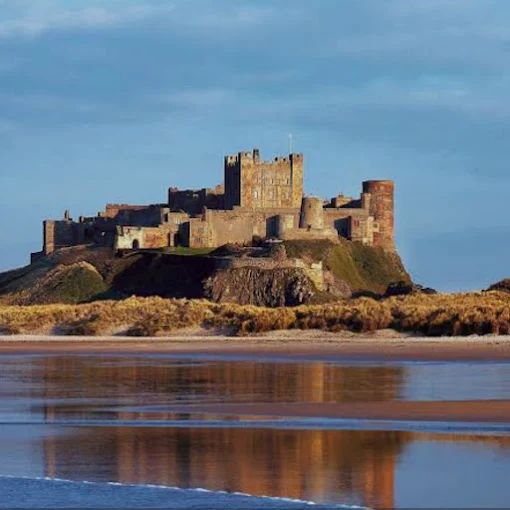
Bamburgh Castle: Where Northumbrian Crown Meets Shoreline Rock
I walk along the shore at ten past ten on a bright morning in late May. The tide has pulled back far, leaving acres of firm pale sand stretching smooth and wide. Behind me the castle rises — massive golden sandstone, square towers, walls thick and sheer — perched high on a natural rocky outcrop directly above the beach. Sunlight warms the stone from deep amber to bright gold. A few people sit on the dunes watching it stand against the blue sky. No one hurries. The building has stood here for 1,500 years. It does not need to rush.
Why Bamburgh Castle Matters
This rock has been fortified since the 6th century, when it was the capital of the ancient kingdom of Northumbria. Kings were crowned here; saints worshipped here; armies fought over it across centuries. The stone castle you see today was built mostly between the 12th and 14th centuries, then restored in the 19th century by the Armstrong family who still own it. It has never been taken by force since that great rebuilding. Today it draws visitors from across the world, yet it remains a private family home as well as a historic attraction. That dual role creates real limits. Some rooms close occasionally for private use, and the estate controls access to surrounding paths. Popular viewpoints crowd fast in summer, and the car park fills by mid-morning. The castle is magnificent, but it is not a public museum — it is a living place that balances welcome with privacy.
The Best Time to Experience Bamburgh Castle
Late April through May brings fresh green foliage and thinner crowds, temperatures between 8°C and 15°C (46°F to 59°F). Morning light hits the east-facing walls directly, turning the sandstone bright warm gold. June and July offer the longest days — sky stays light until nearly 10 p.m. — and temperatures rise to 11°C and 18°C (52°F to 64°F). This is peak season; coaches arrive every 20 minutes from 10 a.m. onward. August stays mild at 12°C to 19°C (54°F to 66°F), but sea mist drifts in by afternoon, blurring the view and softening the stone into haze. September holds steady at 10°C to 16°C (50°F to 61°F), crowds thin noticeably, and late afternoon light deepens the walls to rich honey. This is widely considered the best month to visit. October cools to 7°C and 12°C (45°F to 54°F), days shorten fast, and the castle stands vivid against storm-grey skies. November through February the site feels quieter. Temperatures sit 3°C to 8°C (37°F to 46°F), wind blows strong off the North Sea, and opening hours shorten or close on quiet days. March and April lengthen again, 5°C to 11°C (41°F to 52°F), but cold winds persist until late spring. Always check the weather forecast; the shoreline feels 3°C cooler than inland towns.
Approximate Budget for a 7-Day Trip
These figures assume a base in Seahouses, Alnwick, or Berwick, exploring the castle and surrounding coast.
- Accommodation: £60–£98 nightly. Shared hostel room or clean guesthouse room with breakfast. £420–£686 for 7 nights.
- Food & Drink: £18–£28 daily for self-prepared breakfasts and packed lunches. Evening meal out £24–£44. £294–£504 total.
- Transport: Car rental £45–£70 daily; drive 45 minutes north of Alnwick. Local bus runs but stops 1 mile from the gate. £65–£490 total.
- Attractions: Castle entry £15 adult. Holy Island crossing free, priory £9. Farne Islands boat trip £28. £55–£115 total.
- Miscellaneous: £8–£16 daily for waterproof layers, hot drinks, and supplies. £56–£112 total.
Total estimated 7-day cost: £890 to £1,907
The castle tea room charges premium prices. Walk five minutes into the village; you will find family-run cafes with generous portions and fairer prices.
Essential Bamburgh Castle Experiences
- View from the beach at low tide — Walk far out onto the sand. The castle rises directly above you, huge and complete against sea and sky. This is the iconic perspective. Skip this at high tide; the beach narrows and crowds block the best angles.
- Walk the battlements — High walls offer wide views: north toward the Scottish border, south down the coast, east out to the Farne Islands. The wind blows strong up here — hold onto hats and layers. Go early; the narrow sections bottleneck quickly.
- Explore the great hall and state rooms — Rich wood panelling, tapestries, and historic artefacts fill rooms still used by the family. Read the information; it explains how the castle changed from fortress to comfortable home.
- Stand in the outer courtyard — Open grassy space facing the sea. From here you see the full height of the gatehouse and how the entire structure sits perched above the waves. It feels quiet and spacious.
- Visit the ancient well and underground passages — Deep stone chambers show how the castle sustained itself through sieges. It is damp and dim; wear sturdy shoes. Not suitable for those with claustrophobia.
- Walk the coastal path north — A short trail leads along the clifftop toward the hidden cove. You look back at the castle from the side, a different silhouette against open water. Stay behind the fence; the edge drops away sharply.
Hidden Gems Most Travelers Miss
- West field viewpoint — A public footpath runs behind the village, rising gently across farmland. You look down on the castle from above, with the sea stretching blue behind it. Very few visitors walk this way.
- St Aidan’s Churchyard — Beside the castle gate, simple stone graves sit beneath old trees. St Aidan died here in 651 AD. It feels quiet and deeply historic. Most people walk past without entering.
- Shoreline rocks at low tide — Below the castle, exposed rock pools teem with small sea life. This spot is widely shared online now and has become overrated. Go before 9 a.m. if you want it quiet.
- Village lane approach — Instead of driving straight to the gate, walk up from the main road past stone cottages. The castle appears gradually above rooftops, growing larger as you draw near.
Cultural & Practical Tips
- Book tickets online in advance. In July and August they sell out on the day, and walk-in queues can take an hour.
- Respect private areas. The family still lives here. Signs mark closed sections — do not enter or photograph windows.
- Arrive early. The car park fills by 10.30 a.m. May through September. Latecomers park dangerously along the main road.
- Bring warm windproof layers. The shoreline offers zero shelter. Even mild days feel cold standing on exposed walls.
- Do not climb on the sandstone. The rock is soft and easily damaged. Erosion is already visible — stay on marked paths.
- Combine with a Holy Island visit. The causeway lies only 6 miles away. Plan your day around tide times to make both crossings.
Essential Visitor Information
Location & Access: Bamburgh NE69 7DF — Northumberland coast, 15 miles north of Alnwick, 30 miles south of Berwick. Three transport options: car via A1 then B1340 — 1 hour 15 minutes north of Newcastle; bus from Alnwick or Berwick — stops in village, 10-minute walk; train to Alnmouth then taxi — 20 minutes.
Tickets & Booking: Adult £15, concession £13, child £7.50. Booking recommended April through September; walk-in available but queues longer.
Operating Hours: Generally 10 a.m. to 5 p.m. April through October; 10 a.m. to 4 p.m. November through March; closed some days January.
Visit Duration: Minimum 2 hours for main rooms and walls. 3 to 4 hours including beach walk and quiet viewpoints.
Family Suitability: Grounds and most rooms accessible. Steep spiral stairs to upper towers unsuitable for strollers. Public toilets and cafe at visitor centre.
Timing: Best season May or September. Early morning at opening or late afternoon 2 hours before closing offers quietest conditions and warmest light.
Highlights: Beach perspective at low tide, battlements coastal view, great hall, ancient well chambers, sunset from outer courtyard.
Nearby & Day Trip: Seahouses & Farne Islands — 10 minutes; Holy Island — 15 minutes; Alnwick Castle & Gardens — 30 minutes; Dunstanburgh Castle — 20 minutes; Northumberland Coast — 45 minutes.
Conclusion: Travel with Respect, Not Just a View
Bamburgh Castle is not just a postcard beside the sea. It has guarded this shore for 1,500 years — kingdom capital, fortress, ruin, restored home. It belongs to a family as much as to history. When you visit, look beyond the towers. Imagine the people who lived, fought, and worshipped here. Leave it as you found it. What story will you tell about this place?
Comments
Post a Comment