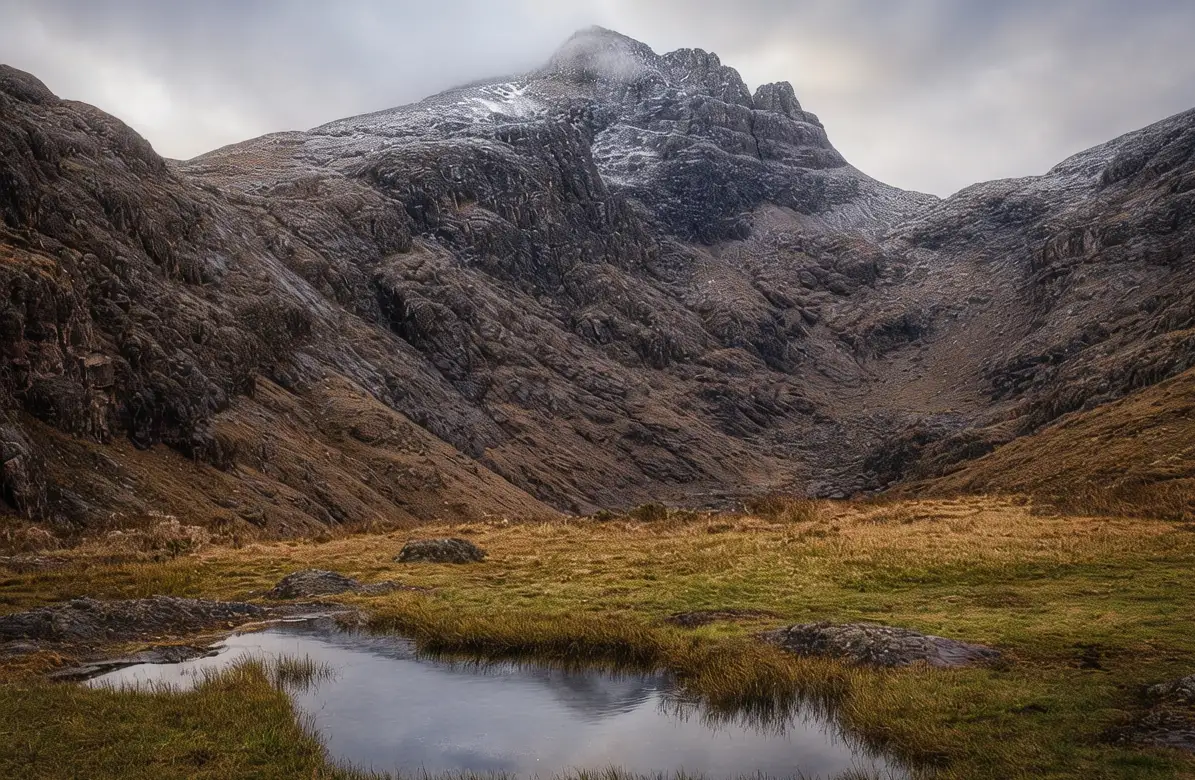
Ben Nevis: Where Britain’s Highest Peak Meets Highland History
I stand at the halfway loch at ten past ten on a clear morning in late June. The air feels thin and cool, even this far below the top. A steady wind blows down from the summit, carrying the faint metallic tang of exposed rock. Loose grey scree shifts underfoot with every step, and I pause to adjust my boot laces. The path stretches upward ahead, winding over stone and past small cairns marking the way. Other walkers move slowly, spaced out along the climb — some pushing steadily, some stopping to catch breath. The mountain rises massive and dark above, its true height hidden by the curve of the slope. It does not look like something to conquer. It looks like something to approach with care.
Why Ben Nevis Matters
At 1,345 metres above sea level, Ben Nevis is the highest mountain in Britain. Its name translates from Gaelic as mountain with its head in the clouds — a fitting description, since mist often covers the summit even when the base stays clear. The mountain is all that remains of an ancient volcano, its core exposed after millions of years of erosion and glaciation. On the summit plateau stand ruins of an observatory built in 1883, staffed continuously for nearly two decades by scientists who braved blizzards and isolation to record weather data. Today thousands of people climb here every year. That popularity brings real problems. The main Mountain Track is heavily eroded, with loose stone covering wide sections that become slippery when wet. The car park fills by 7.30 a.m. in summer, and roadside parking clogs the narrow approach road. Many first-time visitors underestimate the climb. They set out in trainers and light jackets, unprepared for how fast conditions change higher up. Every year mountain rescue teams are called out dozens of times.
The Best Time to Experience Ben Nevis
Late May through June brings the longest daylight — sun sets after 9 p.m. — and temperatures between 7°C and 15°C (45°F to 59°F) at the base. On the summit it averages 5°C to 8°C cooler, so pack accordingly. Crowds are heavy but thinner than July or August. July and August see base temperatures rise to 10°C and 18°C (50°F to 64°F), but mist forms frequently above 800 metres. The path stays busy from early morning until late evening. September holds steady at 8°C to 14°C (46°F to 57°F), most families have left, and clear crisp days become more common. This is arguably the best month to climb. October cools to 5°C and 10°C (41°F to 50°F), days shorten fast, and ice patches begin forming on upper sections. November through February the mountain becomes serious winter territory. Base temperatures sit 1°C to 6°C (34°F to 43°F), snow covers the upper half, and wind speeds regularly exceed 80 km/h. Only experienced winter walkers with proper gear should attempt the summit then. March and April lengthen again, 3°C to 9°C (37°F to 48°F), but snow persists on the plateau and in gullies well into spring. Always check the dedicated Ben Nevis weather forecast; general reports are often wrong at altitude.
Approximate Budget for a 7-Day Trip
These figures assume a base in Fort William, visiting Ben Nevis alongside other Highland attractions.
- Accommodation: £40–£70 nightly. Shared hostel room or clean guesthouse room with breakfast. £280–£490 for 7 nights.
- Food & Drink: £14–£22 daily for self-prepared breakfasts and packed lunches. Evening meal out £18–£32. £224–£378 total.
- Transport: Car rental £40–£65 daily; drive 2 miles from Fortree to the Glen Nevis car park. Local bus runs to the trailhead. £45–£455 total.
- Attractions & Gear: No entry fee. Guided mountain walks £30–£45 per person. Waterproof gear rental £15–£25 daily. £40–£100 total.
- Miscellaneous: £8–£15 daily for hot drinks, snacks, and spares. £56–£105 total.
Total estimated 7-day cost: £645 to £1,528
Some cafes near the trailhead charge premium prices for basic sandwiches and hot drinks. Pack your own food and water; you will save money and have exactly what you need on the mountain.
Essential Ben Nevis Experiences
- Climb the Mountain Track to the summit — The most accessible route, roughly 17 kilometres there and back with 1,345 metres of ascent. Allow 6 to 9 hours. Skip this if you lack proper waterproof boots, warm layers, map, and compass. Mist can cover the plateau in minutes and the path vanishes.
- Walk the lower glen paths — From the car park, flat and easy trails run beside the River Nevis through woodland and open meadow. You see the mountain rising full height ahead without climbing a metre. Perfect for half a day or rest days.
- Reach the halfway lochs only — If the summit looks cloudy or you feel tired, stop at Lochan Meall an t-Suidhe. It sits at 570 metres and offers wide views back down the glen. Turning back is never a failure; it is the wise choice.
- Visit the summit observatory ruins — Once on the plateau, the stone walls stand close to the trig point. Read the small information plaque; it puts your visit in perspective. The final few hundred metres are deceptively flat but exposed to wind.
- Watch sunrise from the lower shoulder — Start walking before dawn in summer. The sun rises over the Grey Corries and lights up the face of Ben Nevis in gold and deep red. It stays quiet until mid-morning.
- See the mountain from Corpach — A short drive west. From the canal basin you look back across Loch Linnhe and see the full bulk of the peak clear against sky. Best viewed late afternoon when light hits the western face.
Hidden Gems Most Travelers Miss
- Allt a’ Mhuilinn waterfall — A short walk up a side path before the main climb steepens. The water drops in a wide clear fall over dark rock. Very few people pause here on their way up.
- The North Face viewpoint — Reached from a different minor road off the A82. It looks directly at the dramatic crags and cliffs most visitors never see. This is not a route to the top — just a viewpoint.
- Meall an t-Suidhe west slope — A faint path branches off the main loop below the loch. It offers quieter views up to the summit. This spot is now widely shared online and has become overrated. Go early to avoid crowds.
- Old military road above Fort William — A gentle climb from the town centre leads to an ancient track. It looks straight up Glen Nevis with Ben Nevis dominating the horizon. Suitable for most walkers.
Cultural & Practical Tips
- Check the summit weather forecast before starting. The forecast at the base tells you nothing about conditions at the top.
- Carry more water than you think you need. There is no reliable safe drinking water on the route. Two litres minimum per person.
- Turn back in good time. If you have not reached the halfway loch by 11 a.m., abandon the summit attempt. You will not make it safely before dark.
- Do not rely on phone signal. It fails above 600 metres and vanishes entirely on the plateau. Carry a paper map and compass, and know how to use them.
- Respect the mountain rescue teams. Do not call them for tiredness or blisters — but do call if someone is lost or seriously hurt. Their time saves lives.
- Park only in designated car parks. Roadside parking damages verges, blocks access for residents, and gets clamped. Arrive early or use the bus.
Essential Visitor Information
Location & Access: Glen Nevis, near Fort William, Highland Scotland PH33 6SF. Three transport options: car via A82 to Glen Nevis road — 2 miles from Fort William; local bus from Fort William town centre to the trailhead; train to Fort William then bus or taxi.
Tickets & Booking: No entry fee. Car park charges £5–£8 per day. No booking required for the path. Guided walks need advance booking.
Operating Hours: Path open year-round, accessible at all times. No lighting — carry a headtorch if returning after sunset.
Visit Duration: Minimum 6–9 hours for full summit return. 2–3 hours for lower glen walk. Half to full day for side paths and viewpoints.
Family Suitability: Lower riverside paths suit all ages and strollers. The summit route is not suitable for young children or unsupervised teens. Public toilets available at the main car park.
Timing: Best season May, June, or September. Start walking before 8 a.m. to avoid crowds and ensure enough daylight.
Highlights: Summit plateau & observatory ruins, Lochan Meall an t-Suidhe, lower Glen Nevis woodland, North Face viewpoint, Corpach sunset view.
Nearby & Day Trip: Fort William — 10 minutes; Glenfinnan Viaduct — 30 minutes; Eilean Donan Castle — 45 minutes; Glencoe — 40 minutes.
Conclusion: Travel with Humility, Not Just a Summit Photo
Ben Nevis does not care whether you reach the top. It has stood here for millions of years and will stand long after you leave. Some days mist wins. Some days rain stays. That is not failure. That is simply being here. Turning back is brave. Listening to the mountain is wise. What will you learn on the way up that matters more than standing on the highest point?
Comments
Post a Comment