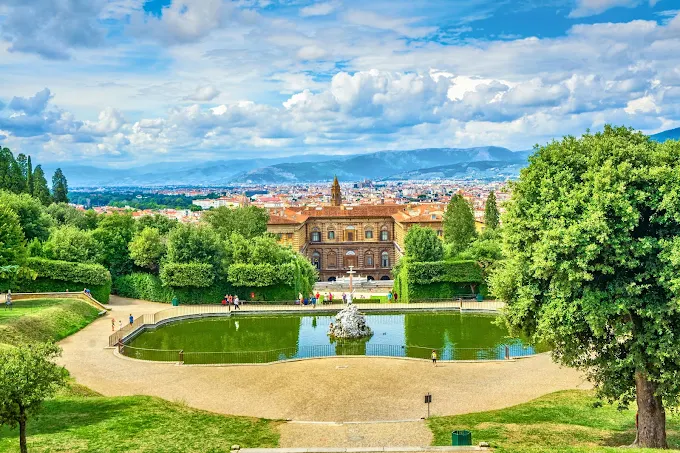
Boboli Gardens: Where Designed Landscape Meets Royal Ambition
I enter through the Pitti Palace entrance just before eight in the morning. A standard ticket costs twelve euros. The air feels cool and still. Only a few gardeners work along the nearest paths. Stone avenues stretch upward, lined with cypress and statues that stand like silent sentinels. By ten, groups will fill the central axis. Voices will echo between hedges. For now, the space feels quiet enough to hear birds and see how the light falls across terraces laid out five centuries ago.
Why Boboli Gardens Matters
These gardens were created behind the Pitti Palace in Florence, starting in the mid-16th century. The Medici family commissioned them as a private retreat and a display of power. Architects laid out a symmetrical plan that climbs the hillside — fountains, grottos, statues, and hedges positioned to frame views and guide movement. The design became a model for royal gardens across Europe, inspiring Versailles and others. Every element carries intent: slopes shaped to create drama, avenues aligned to draw the eye, and art placed to mark changes in level and direction. This is not wild nature — it is nature tamed and arranged to show authority.
It carries real flaws though. Sections of hedge and lawn show wear. Restoration work moves slowly and often closes entire zones. The central path becomes uncomfortably crowded in summer. Many visitors walk only the main avenue and miss the quieter upper slopes. You will find fewer benches than you expect and drinking fountains sit spaced far apart. The scale feels grand, but it can also feel exposed and tiring to traverse.
The Best Time to Experience Boboli Gardens
Late April through early June offers ideal conditions. Days run 14°C to 23°C (57°F–73°F). Roses bloom along the lower terraces. Shade feels pleasant and crowds stay manageable. September and early October work equally well. Temperatures hold between 15°C and 24°C (59°F–75°F). Light turns soft and golden, perfect for photographs across the city.
July and August push past 32°C (90°F) by early afternoon. Large stretches offer no shade. Stone absorbs heat and radiates it back. Queues stretch long at the entrance. Tickets sell out days ahead. Winter stays cool — 5°C to 12°C (41°F–54°F) — and rain can make gravel paths slippery. The gardens feel quiet then, but many flower beds lie dormant. Arrive by 9:00 AM to see the sunlit slopes before crowds gather.
Approximate Budget for a 7-Day Trip
Prices are per person in euros. Staying outside the historic centre cuts accommodation costs noticeably.
- Accommodation: 60–115 per night. A clean room in a neighbourhood guesthouse sits near the lower end. Something within walking distance of the historic centre runs higher. Lodging directly facing Pitti Palace costs nearly double what you find two lanes away. The gardens are easily reached on foot from anywhere in central Florence — stay farther out and save significantly.
- Food & Drink: 35–55 daily. Lunch at a family-run trattoria, dinner with wine, coffee, and snacks included. Cafés directly beside the Pitti entrance charge double normal rates. Walk five minutes across the river and prices drop to realistic levels.
- Transport: 12–22 daily. Most central sites sit within walking distance. Buses cost 1.50 euros per ride. Train connections to nearby towns run 3–15 euros one-way.
- Attractions: 30–50 total. Boboli ticket 12–14 euros. Combined passes covering Pitti Palace museums offer savings. Other major sites in Florence cost extra.
- Miscellaneous: 15–30 daily. Souvenirs, snacks, extra drinks.
Total estimated 7-day cost: 840–1,540 euros per person
Essential Boboli Gardens Experiences
- Walk the central axis from palace to horizon — The main avenue climbs steadily upward. Statues, fountains, and trimmed hedges frame every step. The view opens gradually until the city appears below. Go early. Skip if you dislike crowds — this path fills completely by mid-morning in summer.
- Enter the Buontalenti Grotto — Near the palace entrance. Stalactite-style decoration frames sculpted figures. Light filters dimly through openings. It feels cool and otherworldly. Check opening times — it closes periodically for maintenance.
- Climb to the Neptune Fountain — Perched high above the central avenue. The bronze figure stands at the top of a wide basin. The view back toward the palace and across Florence is one of the best in the city.
- Explore the Kaffeehaus terrace — An 18th-century pavilion with arched openings. It sits on a side ridge away from the main flow. The outlook stretches over the Oltrarno district toward distant hills. It feels quiet and spacious.
- Wander the Viottolone cypress avenue — A diagonal path lined with tall cypresses and alternating statues. The scale feels different here — narrower, taller, more sheltered. It connects levels that many visitors miss.
- Rest in the lower rose garden — Tucked beside the palace walls. Smaller scale, softer light, and fewer people. It blooms most heavily May through June. A quiet pause before or after the climb.
Hidden Gems Most Travelers Miss
- Bardini Gardens connection — A sloping path leads down from the upper section to the separate Bardini Gardens. These feel wilder and less formal. The combined ticket covers both. Most people never make the descent.
- Upper meadow and olive grove — Beyond the Neptune Fountain, the gardens soften into open grass and scattered trees. The atmosphere shifts entirely. You see Florence framed through branches rather than stone arches.
- Isolotto pond — A small island reached by a narrow bridge. Statues circle the water. It sits slightly off the main route and stays peaceful even on busy days.
- Central avenue — Everyone photographs it. It feels crowded by midday and offers no shade. You will share every view with dozens of others. The quieter side paths deliver equal beauty with far fewer people.
Cultural & Practical Tips
- Book timed entry at least 2 days ahead. Summer slots sell out fast. Walk-up tickets are rarely available June through August.
- Carry water. Fountains exist but sit spaced far apart. The climb upward is steady and unshaded in places. You will need more water than you expect.
- Wear sturdy walking shoes. Gravel and uneven stone cover most paths. Slopes are steeper than they appear from below. Sandals offer little support.
- Stay on marked paths. Grass and planted areas are fragile. Restoring damaged sections takes months. Do not take shortcuts across beds.
- Allow 2 hours minimum. The gardens cover 4.5 hectares. Rushing means you will see only the main avenue. Give yourself time to wander the upper slopes.
- Visit the Pitti Palace first or last. Most people enter the gardens immediately. Arriving later in the morning means thinner crowds as others leave.
- Do not touch statues or fountains. Oils accelerate deterioration. Many pieces sit exposed and unprotected — every visitor leaves a mark.
Essential Visitor Information
Location & Access: Boboli Gardens, Piazza de' Pitti 1, 50125 Florence. Entrances from Pitti Palace courtyard and Porta Romana. From Florence city centre, cross the Ponte Vecchio and walk 10 minutes south. The nearest bus stops are 5 minutes away. Santa Maria Novella train station is 25 minutes on foot. Parking nearby is extremely limited and expensive — walk or use public transport.
Tickets & Booking: Standard entry ~12 euros. Combined Pitti Palace + Boboli ~20 euros. Reduced rates for EU citizens 18–25. Under 18 free. Book ahead online. Third-party sites charge extra fees — book directly.
Operating Hours: November–February: 8:15 AM to 4:30 PM, last entry 3:30 PM. March, October: 8:15 AM to 5:30 PM, last entry 4:30 PM. April–September: 8:15 AM to 6:30 PM, last entry 5:30 PM. Closed first and third Monday of each month, plus 1 January, 1 May, 25 December.
Visit Duration: Minimum 2 hours for a basic loop. 3–4 hours lets you explore thoroughly including upper sections and the Bardini connection.
Family Suitability: Children welcome everywhere. Steep paths and gravel make stroller use difficult — use a carrier. Restrooms exist near entrances but are scarce inside. Bring water and sun protection.
Timing: Best seasons: late April–June and September–October. Arrive before 9:00 AM or after 4:00 PM for thinner crowds and softer light.
Highlights: Central avenue, Buontalenti Grotto, Neptune Fountain, Kaffeehaus view, Viottolone cypress path, Isolotto pond.
Nearby & Day Trip: Oltrarno artisan district — 5 minutes’ walk. Ponte Vecchio — 10 minutes. Uffizi Gallery — 15 minutes. Fiesole hilltop town — 20 minutes by bus. Siena — 1 hour by train. All make rewarding half or full-day outings.
Conclusion: Travel with Perspective, Not Just Photos
Boboli was not designed as a public park. It was built to impress — to show power, taste, and control over nature itself. Five centuries later, anyone can walk these paths. You can see it all in two hours and take plenty of pictures. You will remember it far better if you slow down, climb beyond the main avenue, and notice how the designers shaped every slope and view. Great design does not shout. It waits for you to look. What quiet corner will you discover away from the crowds?
Comments
Post a Comment