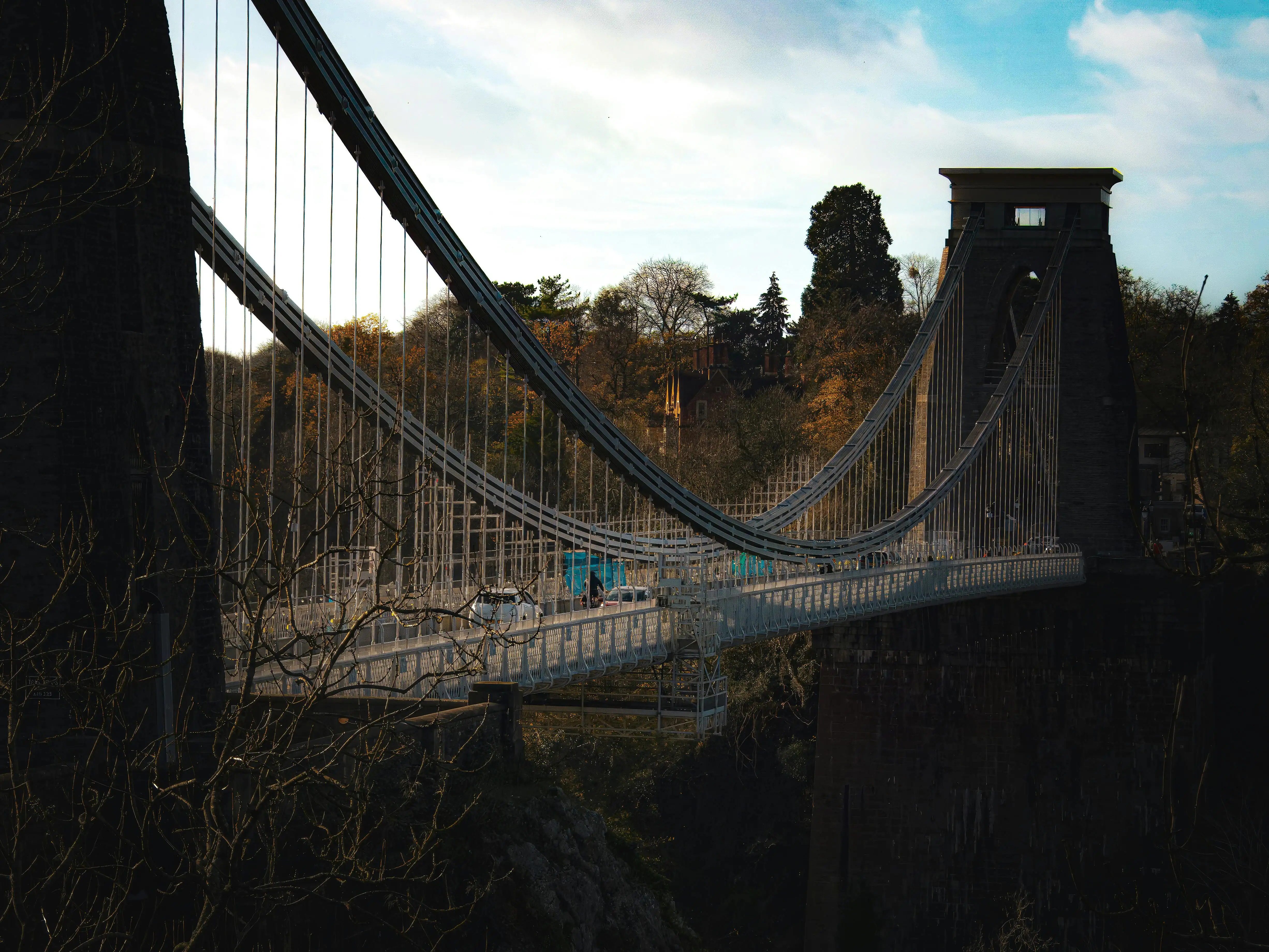
Clifton Suspension Bridge: Where Iron Span Meets Avon Gorge
I stand on the stone pavement at ten past nine on a clear Saturday morning in late September. Two massive red sandstone towers rise high above, capped with tall pointed arches like gateways to the sky. Heavy iron chains curve gracefully from top to deck, stretching across the vast green gorge. Far below, the river Avon glints silver, winding slow toward the Bristol Channel. A few early cyclists glide past; a handful of walkers pause at the rail. No crowds fill the path yet. The bridge hangs light and strong, suspended between cliff and cloud — an impossible thing, made real.
Why Clifton Suspension Bridge Matters
Planned in the 1830s by Isambard Kingdom Brunel, work began in 1836 and finished only in 1864 — five years after his death. At the time it was the longest span bridge of its kind anywhere in the world, stretching 702 feet across a deep gorge that no stone arch could ever cross. It proved suspension bridges could carry people, carts, and eventually cars reliably across great distances, reshaping how civil engineers connected landscapes. Today it remains privately owned and operated, charging a small toll to maintain its fabric. That independence brings real strain. Upkeep costs run into hundreds of thousands annually; traffic queues form on busy days; and the narrow deck struggles to carry modern volumes comfortably. The bridge survives, but it is fragile — every crossing contributes to its preservation.
The Best Time to Experience Clifton Suspension Bridge
Late April through May brings fresh foliage and thinner crowds, temperatures between 7°C and 14°C (45°F to 57°F). Trees on both gorge sides turn bright green and the bridge stands vivid against clear sky. June and July offer the longest days — sky stays light until nearly 9.30 p.m. — and temperatures rise to 10°C and 18°C (50°F to 64°F). This is peak season; the approach roads queue by midday and viewing spots fill fast. August stays mild at 11°C to 19°C (52°F to 66°F), but rain falls frequently and low cloud can wrap the towers completely. September holds steady at 10°C to 16°C (50°F to 61°F), crowds thin noticeably, and golden light turns the sandstone warm amber. This is widely considered the best month to visit. October cools to 7°C and 12°C (45°F to 54°F), days shorten fast, and autumn leaves flame bright down the gorge slopes. November through February the bridge feels exposed — temperatures sit 3°C to 8°C (37°F to 46°F), wind howls up the valley, and you may walk the full length with almost no one else. March and April thaw slowly — book early; interest picks up fast. Arrive before 10 a.m. any time of year; after that, the day shifts completely.
Approximate Budget for a 7-Day Trip
These figures assume a base in Bristol, exploring the bridge, city, and surrounding region.
- Accommodation: £75–£125 nightly. City centre or Clifton guesthouse. £525–£875 for 7 nights.
- Food & Drink: £20–£34 daily — breakfasts, harbourside lunches, evening meals. £336–£595 total.
- Transport: Bus to Clifton from centre £2 single. Car toll £1. Walkable from Clifton village. £35–£110 total.
- Attractions: Bridge crossing free for pedestrians; nearby observatory £6. SS Great Britain £21. £40–£95 total.
- Miscellaneous: £10–£18 daily — gifts, drinks, travel. £70–£126 total.
Total estimated 7-day cost: £1,006 to £1,801
Cafes directly beside the bridge charge premium prices. Walk five minutes into Clifton village — same quality costs less and queues are shorter.
Essential Clifton Suspension Bridge Experiences
- Walk the full span early — From one cliff to the other before traffic builds. The view opens slowly — gorge, river, distant hills — unfolding step by step. Skip this after 12 p.m. on weekends; pavement narrows and you cannot stop to look safely.
- See it from the Leigh Woods side — Stand on the far bank looking back. Both towers, the full curve of chains, and the town of Clifton appear together in one frame. Most visitors stay on the Bristol side — this perspective is different and unforgettable.
- Visit the Clifton Down viewpoint — Above the approach road, a grassy plateau overlooks the bridge and gorge. You see it suspended in context — the structure, the landscape, the river winding far below. Go late afternoon; the sun lights the facade perfectly.
- Explore the bridge visitor centre — Tucked near the Bristol end, displays explain Brunel’s vision, the decades of construction, and how the bridge works. It feels personal — letters, drawings, and original plans show the human effort behind the iron.
- Watch sunset from the western path — Stand halfway across facing downriver. The sun dips low, gilding the chains and turning the stone deep orange. Arrive 30 minutes early; the quietest spots fill fast.
- Walk the river valley below — A trail follows the Avon upstream through woods. The bridge appears high overhead, framed through trees. You hear traffic fade and see it as travellers once did — glimpsed from the river, huge and magnificent.
Hidden Gems Most Travelers Miss
- Leigh Woods quiet path — Beyond the bridge, a level trail runs through ancient trees along the gorge rim. Almost no one walks it. The bridge reappears again and again through branches, new angles every time.
- Observatory terrace lower level — Most visitors climb to the rooftop. The stone terrace below offers the same unobscured view with far fewer people. It feels private and peaceful.
- Riverbank upstream section — Below the Bristol side, a rough path leads past old docks and wooded slopes. This spot is widely shared online now and has become overrated. Go before 9.30 a.m. if you want it empty.
- Clifton village side streets — Behind the terraces, quiet lanes hold Georgian stone houses and small gardens. The bridge towers peek above rooftops. It feels like a secret view, not a landmark.
Cultural & Practical Tips
- Walk, don’t drive. Parking is extremely limited and fills instantly. Bus or walk from Clifton village — it saves stress and you see the bridge approach properly.
- Keep close to the inner rail. The pavement is narrow and cyclists pass regularly. Stay aware, hold children’s hands, and do not stop in the path.
- Check weather before setting out. The gorge creates its own wind — it can be calm in the city and gale-force on the bridge. Bring a warm layer even on sunny days.
- Respect private property. The bridge stands between residential areas. Keep voices low, do not block drives, and do not treat doorways as photo spots.
- Pay the toll generously if driving. Every penny goes directly to upkeep. This historic structure survives entirely through visitor support.
- Do not rush. The bridge is famous, but the gorge below and village above deserve equal time. Allocate half a day minimum to wander slowly.
Essential Visitor Information
Location & Access: Clifton Suspension Bridge, Bristol BS8 3PA — spanning Avon Gorge. Three transport options: bus from Bristol city centre to Clifton Down; car via A4 — toll £1; walk from Clifton village — 10 minutes.
Tickets & Booking: Pedestrian crossing free. Vehicle toll £1. No tickets or booking required. Nearby observatory £6.
Operating Hours: Open 24 hours daily, year-round. Visitor centre generally 10 a.m.–5 p.m.; closed Mondays winter.
Visit Duration: Minimum 1 hour crossing and viewing. Half day including village, woods, and river path.
Family Suitability: Narrow pavement — keep children close. High unrailed drops on gorge paths. Public toilets at Bristol end and village.
Timing: Best season May or September. Early morning before 10 a.m. offers quietest crossing and best light.
Highlights: Full span at opening, Leigh Woods return view, sunset from midway, river path perspective, village rooftops frame.
Nearby & Day Trip: Bristol city centre — 15 minutes; SS Great Britain — 20 minutes; Bath — 45 minutes; Cardiff — 1 hour; Cotswolds — 1 hour 15 minutes.
Conclusion: Travel with Vision, Not Just Sight
Brunel died before he saw it finished. Others completed his work, and generations since have cared for it. This bridge was built to connect — to span what divides, to bring places together. When you visit, cross gently. Respect the effort that holds it high. What will you build that outlasts you?
Comments
Post a Comment