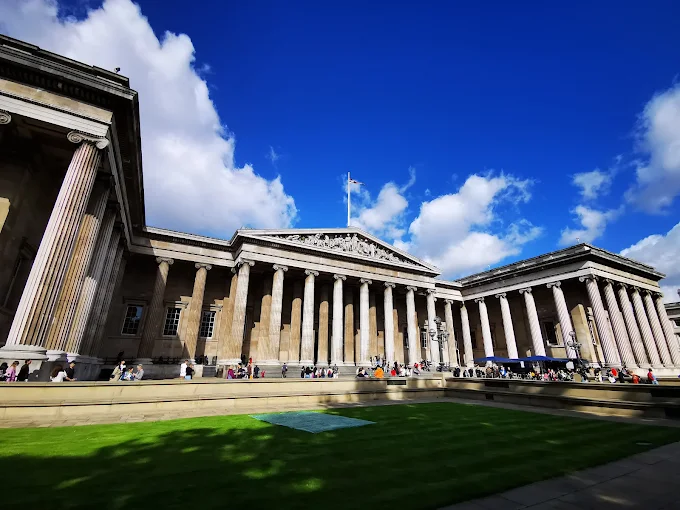
British Museum: Where Global Antiquities Meet Bloomsbury Stone
At 10:15 on a Tuesday morning, the queue at the Great Russell Street entrance is already forty people deep. I paid nothing to get in, but I did book a free timed ticket online three weeks earlier, which let me skip the longer walk-up line. Inside the Great Court, the glass roof turns the February drizzle into a soft grey light, and a school group from Croydon is eating sandwiches on the steps of the Reading Room. The Rosetta Stone sits in Room 4, just past the Egyptian sculpture gallery, and by 10:40 there are already three tour groups clustered in front of it. One guide is holding up a laminated photo of the trilingual decree from 196 BC. A child asks loudly why the stone is behind glass. Nobody answers. The British Museum holds around eight million objects, but only a fraction are on display at any time. The rest sit in storage, waiting for researchers or rotating exhibitions. You will not see it all. You should not try.
Why the British Museum Matters
The museum opened to the public in 1759, making it the world's first national public museum. Its founding collection came from Sir Hans Sloane, a physician who left 71,000 objects to the nation on condition that they be kept together and shown free to anyone who asked. Parliament paid £20,000 to Sloane's heirs, and the museum was born. For the first seventy years, visitors had to apply in writing for a ticket. Only about 120 people per day were admitted. The museum solved a specific problem: where to put the growing collections of empire. Naval officers, diplomats, and explorers brought back objects from Egypt, Greece, Assyria, and beyond, and the museum became the default storage facility. That history is also its central controversy. Greece has formally requested the return of the Parthenon Sculptures since 1983. Egypt has asked for the Rosetta Stone. Nigeria wants the Benin Bronzes. The museum's position is that it provides a unique context where world cultures can be compared side by side. Critics call that a justification for looting. You will see both perspectives represented in the gallery labels, which now acknowledge colonial acquisition in some rooms. The honest truth is that the museum is both a treasure house and a crime scene, and you have to hold both ideas at once.
The Best Time to Experience the British Museum
The museum is busiest from late March through mid-April and again during school summer holidays from late July to early September. On a Saturday in August, the Great Court can feel like a tube station at rush hour. The quietest months are January and February, excluding half-term week. Tuesday through Thursday mornings between 10:00 and 11:30 are the calmest weekday slots. Friday evenings are a different experience entirely: the museum stays open until 20:30, and after 18:00 the galleries empty out. I have stood alone in front of the Sutton Hoo helmet at 19:00 on a Friday. It is the best-kept secret in Bloomsbury. Temperatures inside are stable year-round at around 20°C to 22°C (68°F to 72°F), so a winter coat becomes a burden. The cloakroom costs £2 per item and the queue at 11:00 can take ten minutes. Bring a bag you can carry, not a suitcase. The museum is closed on 24, 25, and 26 December. On other days, opening hours are 10:00 to 17:00, with last entry at 16:45.
Approximate Budget for a 7-Day Trip
This budget assumes a seven-day London trip with the British Museum as one major focus, not the only one. Prices are in British pounds at 2026 rates. London is expensive. The museum is free, but almost nothing else is.
- Accommodation: £90 to £220 per night. A basic private room in a Bloomsbury hostel or budget hotel runs £90 to £120. Mid-range chains like Premier Inn or Ibis in King's Cross or Euston cost £140 to £180. A boutique hotel in Bloomsbury proper starts at £200. Book six weeks ahead for anything under £150.
- Food: £35 to £55 per day. Breakfast at a café: £8 to £12. Lunch at a museum café: £12 to £16 for a sandwich and drink. Dinner at a mid-range restaurant: £18 to £25 for a main course. A pint in a pub: £6 to £8. The museum cafés are overpriced for what they are. A £14 sandwich and £4 crisps adds up fast. Walk five minutes to Lamb's Conduit Street or Marchmont Street for better food at similar prices.
- Transportation: £40 to £60 for the week. A contactless card caps daily tube and bus spending at £8.90 for Zones 1 and 2. The museum is a six-minute walk from Tottenham Court Road station on the Central and Northern lines. Holborn station on the Piccadilly line is a seven-minute walk. Russell Square on the Piccadilly line is ten minutes. Do not drive. Parking in Bloomsbury costs £4 to £6 per hour.
- Attractions: £0 for the permanent collection. Special exhibitions cost £20 to £33. The Bayeux Tapestry exhibition, on loan until July 2027, costs £27 off-peak and £33 peak. Tickets sold out for the first three months within hours. Children under 16 enter free. The out-of-hours guided tour costs £35 for adults.
- Miscellaneous: £30 to £50. A museum guidebook costs £15. A decent lunch at a nearby pub costs £15. A souvenir from the excellent gift shop: £10 to £20. The gift shop is genuinely good for art history books. The café is not good for anything except sitting down.
- Total for 7 days, excluding flights: £735 to £1,225 per person.
One thing that is overpriced: the £5 donation they push you toward when booking a free ticket online. You can book without donating. The website makes it feel mandatory. It is not. If you want to support the museum, buy something from the gift shop instead, where you actually get an object in return.
Essential British Museum Experiences
- The Rosetta Stone in Room 4: This grey slab of granodiorite from 196 BC unlocked the decoding of Egyptian hieroglyphs. It is smaller than most people expect, roughly the size of a large briefcase. Go straight here at 10:00 when the doors open. By 10:30, a crowd forms and stays until closing. Stand to the left side of the glass for the best angle and the least jostling.
- The Parthenon Sculptures in Room 18: A 75-metre section of the frieze from the Parthenon in Athens, carved around 440 BC. The horses' nostrils are still visible. The detail on the riders' legs is startling. Look for the section where a centaur is wrestling a Lapith, hidden on the back-left frieze. Most visitors walk past without noticing it.
- The Egyptian Mummies in Rooms 62 and 63: The mummy galleries are dimly lit and quiet, a contrast to the noise of the Great Court. The painted coffins from the Roman period in Egypt are the most striking: portraits of the deceased painted on wood, staring out at you from 2,000 years ago. Skip if you have young children who are scared of dark rooms and bodies. The atmosphere is genuinely eerie.
- The Sutton Hoo Ship Burial in Room 41: A 7th-century Anglo-Saxon helmet, shield, and gold purse lid from a burial mound in Suffolk. The helmet's face mask is reconstructed, but the original eyebrow pieces are real. The goldwork is finer than anything you will see in most jewellery shops. Stand on the left side to see the helmet's profile clearly.
- The Reading Room in the Great Court: The domed circular room at the centre of the museum was once the British Library reading room. Karl Marx, Oscar Wilde, and Virginia Woolf worked here. It reopened to the public in 2024. Entry is free. It is often empty in the late afternoon. Sit in one of the original wooden chairs and look up at the dome. No photography inside.
- The Lewis Chessmen in Room 40: Ninety-three chess pieces carved from walrus ivory and whale teeth in the 12th century, found on the Isle of Lewis in Scotland. They are smaller than you expect, and the faces are funny. One piece looks like a warrior biting his shield in panic. Children love these. Adults who play chess love them more.
- The Merman in Room 1: A fake. A monkey's head and torso sewn onto a fish tail by 18th-century sailors and sold as a curiosity. It is in the Enlightenment Gallery, in a case near the entrance. Almost nobody stops to look at it. It is grotesque and absurd and entirely worth five minutes of your time.
Hidden Gems Most Travelers Miss
- Room 10: Ancient Syria: Carved stone reliefs from Tell Halaf, dating to the 9th century BC. The room is almost always empty. The reliefs show mythological creatures and banquet scenes. The lighting is poor, but the space is quiet. Sit on the bench in the corner and look at the winged sun disc for ten minutes without another person entering.
- Room 50: European Prehistory: Bronze Age gold cups, Iron Age torcs, and a 3,000-year-old wooden boat dugout. Most visitors skip this room on the way to the Sutton Hoo gallery. The gold artefacts are as impressive as anything in the Egyptian rooms, and you can get within a foot of the glass.
- The Russell Square Phone Box Art Gallery: A five-minute walk from the museum, a red phone box on Russell Square has been converted into a tiny free art gallery. It holds one or two small works at a time, changed monthly. The phone box is easy to miss. Look for the one with a small sign taped to the glass. It is open whenever the square is open.
- The Reading Room back entrance: The main entrance to the Reading Room is through the Great Court, and it is often roped off. The back entrance, through Room 2, is usually open and has no queue. Ask a steward if the rear door is unlocked. It usually is.
One thing that is overrated: the audio guide. It costs £7 and covers less than 5 percent of the collection. The free museum map is barely better. Download the free British Museum app before you arrive. It has a better map, more object descriptions, and it works offline.
Cultural & Practical Tips
- Book your free timed ticket online before you go. Walk-up entry is possible but depends on capacity, and on busy days the queue snakes around the block. The ticket is free. You do not need to print it.
- Security checks are mandatory. Large bags, wheeled suitcases, and umbrellas are not allowed. The bag search queue at the main entrance takes 5 to 15 minutes depending on time of day.
- Do not touch the objects. This sounds obvious, but the number of people who lean on glass cases or tap them with rings is surprising. The stewards will ask you to stop. It happens every few minutes.
- The museum cafés are a tourist trap. A sandwich, a bag of crisps, and a bottle of water costs around £18. Walk to Marchmont Street or Lamb's Conduit Street for a proper lunch at half the price. The museum allows you to bring your own food and eat it in the Ford Centre for Young Visitors on the lower floor.
- Friday evenings are the best time to visit. The museum stays open until 20:30. After 18:00, the tour groups leave and the galleries become genuinely peaceful. The Great Court at 19:30 on a Friday is one of London's quietest large public spaces.
- If you have children, pick up a free family trail from the Families Desk near the main entrance. The trails are age-appropriate and turn the museum into a scavenger hunt. The backpacks at weekends include binoculars and a magnifying glass. They are free to borrow.
- The museum is fully accessible for wheelchairs and pushchairs. Lifts reach all floors. Baby changing facilities are on the lower floor. The Great Court is flat and easy to navigate. Some of the older galleries have uneven floors and narrow doorways, but staff will direct you to step-free routes.
Essential Visitor Information
Location and Access: Great Russell Street, London WC1B 3DG. The nearest tube stations are Tottenham Court Road (6-minute walk, Central and Northern lines), Holborn (7-minute walk, Piccadilly line), and Russell Square (10-minute walk, Piccadilly line). Bus routes 1, 8, 19, 25, 38, 55, 98, and 242 stop nearby. King's Cross and Euston rail stations are a 20-minute walk or a £10 taxi ride away.
Tickets and Booking: General admission is free. Booking a free timed ticket online is recommended for busy periods but not strictly required. Special exhibitions cost £20 to £33. The Bayeux Tapestry exhibition runs until 11 July 2027 and costs £27 off-peak, £33 peak. Tickets for September to December 2026 sold out on the first day. More tickets for January to March 2027 will be released on 21 October 2026. Children under 16 enter free.
Operating Hours: Daily 10:00 to 17:00, with last entry at 16:45. Fridays 10:00 to 20:30, with last entry at 20:15. Closed 24, 25, and 26 December. Occasionally galleries close at short notice for events or maintenance. Check the website on the morning of your visit.
Visit Duration: Minimum two hours for the highlights. Three to four hours for a solid overview. A full day is not enough for the entire collection. Most visitors spend around three hours. If you are short on time, the museum publishes a free three-hour highlights route.
Family Suitability: Excellent for children of all ages. Free family trails and activity backpacks are available at weekends. Baby changing facilities are on the lower floor. Prams and pushchairs are welcome but must stay with you. The museum is crowded on weekends and school holidays, which can be stressful with toddlers. Tuesday and Wednesday mornings are calmer.
Best Timing: Tuesday to Thursday, 10:00 to 11:30. Friday evenings after 18:00. Avoid weekends and school holidays. January and February are the quietest months. The museum is busiest from late March to mid-April and during summer holidays.
Highlights: The Rosetta Stone (Room 4), Parthenon Sculptures (Room 18), Egyptian Mummies (Rooms 62-63), Sutton Hoo Helmet (Room 41), Lewis Chessmen (Room 40). The Reading Room in the Great Court is a quiet spot most visitors miss.
Nearby and Day Trip: The Charles Dickens Museum is a 12-minute walk away on Doughty Street. The Foundling Museum is 15 minutes on foot in Brunswick Square. Covent Garden and the Royal Opera House are a 15-minute walk south. The National Gallery at Trafalgar Square is a 20-minute walk or a short bus ride. All are feasible as half-day add-ons. A day trip to Oxford or Cambridge by train from King's Cross takes around an hour each way.
Conclusion: Travel with Curiosity, Not Just a Checklist
The British Museum is too big to conquer. You will not see the Benin Bronzes, the Mesopotamian lions, the Chinese jade, the Korean ceramics, and the Roman silver in one visit. You will not see half of it. Pick three rooms. Sit down in each one. Look at one object for five minutes instead of thirty objects for five seconds. The museum rewards patience, not speed. It also demands discomfort: the objects here were taken, bought, and borrowed in ways that are still being argued about. Sit with that. Then go get a coffee on Lamb's Conduit Street and think about what you saw.
Comments
Post a Comment