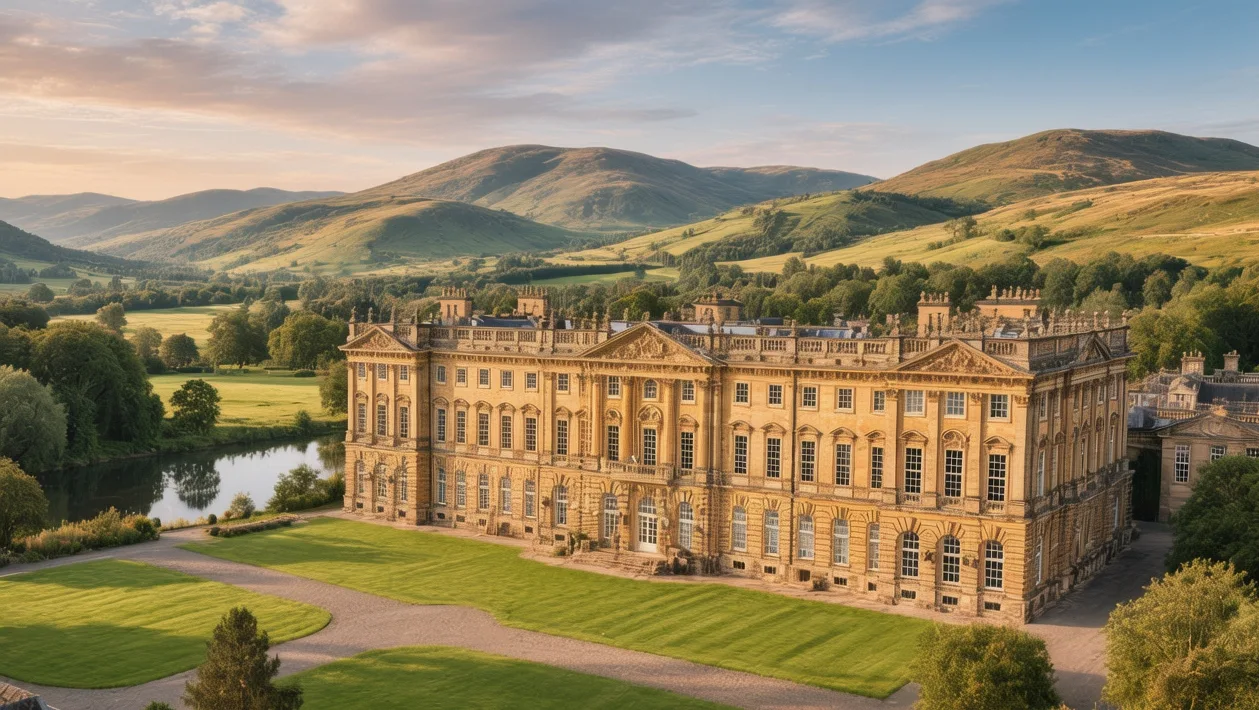
Chatsworth House: Where Baroque Grandeur Meets Derwent Valley
I stand on the broad lawn at ten past ten on a bright morning in late May. The house rises golden and symmetrical — warm ashlar stone, tall sash windows, classical columns, a central dome gleaming soft in sunlight. Fountains play gently in the curved canal before it, water shooting high then falling back with quiet splash. The river Derwent flows fast and clear beyond the ha-ha, and wooded hills frame the whole estate. A few deer graze slow and distant. No crowds fill the terraces yet. It feels grand, yes — but also rooted, settled, at home in the valley it has occupied for centuries.
Why Chatsworth House Matters
An estate has stood here since the 16th century, but the present house began in 1687 — built by the 4th Earl of Devonshire in bold Baroque style as a statement of power and taste. It was never a fortress; it was designed to impress, to entertain, to display. The Cavendish family, later Dukes of Devonshire, have lived here continuously for over 450 years, rebuilding, extending, and filling the rooms with art, furniture, and books collected across generations. Capability Brown reshaped the park in the 18th century; Joseph Paxton built the conservatory in the 19th. Today Chatsworth remains a private family home as well as one of Britain’s most visited historic houses. That dual role brings real strain. Conservation costs run into millions annually; visitor numbers wear floors and fade textiles; and balancing public access with quiet family life grows harder each year. The beauty is undeniable, but so is the cost — this house survives only through constant care.
The Best Time to Experience Chatsworth House
Late April through May brings blooming gardens and fresh foliage, temperatures between 7°C and 14°C (45°F to 57°F). The rose garden and rockery come alive, and the house feels bright before summer crowds. June and July offer the longest days — sky stays light until nearly 9.30 p.m. — and temperatures rise to 10°C and 18°C (50°F to 64°F). This is peak season; timed tickets sell out days ahead and rooms fill quickly. August stays mild at 11°C to 19°C (52°F to 66°F), but rain falls frequently and low cloud can hide the hills. September holds steady at 10°C to 16°C (50°F to 61°F), crowds thin noticeably, and golden light turns the stone warm amber. This is widely considered the best month to visit. October cools to 7°C and 12°C (45°F to 54°F), days shorten fast, and autumn trees frame the house deep red and gold. November through March the house closes; the park remains open but quiet. Temperatures sit 3°C to 8°C (37°F to 46°F), and the estate feels vast and empty. Book timed tickets well in advance; walk-in entry is rarely possible in summer.
Approximate Budget for a 7-Day Trip
These figures assume a base in the Peak District, exploring Chatsworth and surrounding dales and villages.
- Accommodation: £75–£120 nightly. Shared room or family-run guesthouse. £525–£840 for 7 nights.
- Food & Drink: £20–£32 daily — breakfasts, village lunches, pub dinners. £322–£560 total.
- Transport: Car rental £45–£70 daily — recommended. Bus runs from nearby towns but limited. £60–£490 total.
- Attractions: House & garden £24 adult. Park free. Haddon Hall £14. Bakewell markets free. £55–£120 total.
- Miscellaneous: £10–£18 daily — supplies, local produce, warm drinks. £70–£126 total.
Total estimated 7-day cost: £1,032 to £2,136
The estate restaurants charge premium prices. Pack a picnic — there are beautiful designated spots — and dine in nearby villages for better value.
Essential Chatsworth House Experiences
- Walk the south front at opening — Approach from the garden gate before rooms fill. The facade stretches wide and perfect, sunlight catching every detail. Skip this after 11 a.m. in summer; crowds block the view and break the atmosphere.
- Stand in the Great Hall — High ceiling, tapestries, stone staircase sweeping upward. It sets the tone — grand but welcoming. Pause and imagine the generations who have passed through here.
- Explore the gardens slowly — Cascade, fountain, rockery, maze, arboretum — each area feels distinct. Most visitors rush through in an hour. Allow half a day; the gardens equal the house in beauty and interest.
- Walk the river path — Follow the Derwent through the park. The house appears framed through trees and across meadows from unexpected angles. It feels wild and peaceful, far from the entrance crowds.
- Visit the sculpture gallery — A long skylit room filled with classical and modern work. Light falls soft and even. It stays quiet while the main house buzzes. You can linger undisturbed.
- Climb the estate hill viewpoint — A short walk above the lake offers the iconic full panorama — house, lake, bridge, hills all in one frame. Go late afternoon; the sun sits low and lights the stone perfectly.
Hidden Gems Most Travelers Miss
- West end quiet path — Beyond the formal gardens, a tree-lined walk runs beside the river. Very few visitors venture this far. The house appears framed through branches with no one else in sight.
- Arboretum spring corner — Tucked away at the edge of the garden, rare trees spread new leaves. Benches sit empty. It feels like a secret garden within the garden.
- Deer park early morning — Before most visitors arrive, the herd grazes close to the drive. This spot is widely shared online now and has become overrated. Go before 9.30 a.m. if you want it quiet.
- Bridge view at golden hour — The stone bridge across the Derwent frames the house beautifully. Return late afternoon when day-trippers leave; the light is warm and the path nearly empty.
Cultural & Practical Tips
- Book timed tickets weeks ahead. Summer slots vanish fast. Early morning entry offers the best experience.
- Wear comfortable shoes. The estate covers 1,000 acres. Paths slope, grass stays damp, and distances feel longer than they look on the map.
- Respect private areas. The family still lives here. Signs mark closed sections — do not enter or photograph windows.
- Keep voices low inside. Rooms are intimate and shared. Many visitors come to see, not be seen — quiet enhances the experience for everyone.
- Do not touch anything. Wood, fabric, and stone fade and wear with every contact. Ropes and barriers protect — please stay behind them.
- Visit the park separately. The wider estate is free and open all year. Return on a quiet season day to walk, watch wildlife, and see the house from outside.
Essential Visitor Information
Location & Access: Chatsworth House, Bakewell DE45 1PP — Peak District National Park. Three transport options: car via A619 then estate drive — 15 minutes from Bakewell; train to Chesterfield then bus/taxi — 30 minutes; bus from Sheffield — 1 hour.
Tickets & Booking: House, garden & farmyard £24 adult. Park free. Book online in advance. Timed entry only.
Operating Hours: Generally 10 a.m.–5 p.m. Sunday–Friday; closed Saturdays; closed November–March. Park open dawn to dusk year-round.
Visit Duration: Minimum half day for house & main garden. Full day including wider park walks and quiet corners.
Family Suitability: Ground floor accessible; upper floors have stairs. Keep children close in rooms and near unfenced river edges. Toilets and cafe near entrance.
Timing: Best season May or September. First entry slot of the morning offers quietest rooms and best light.
Highlights: South front at opening, Great Hall, river path walk, sculpture gallery, late afternoon viewpoint.
Nearby & Day Trip: Bakewell — 15 minutes; Haddon Hall — 10 minutes; Castleton — 30 minutes; Hardwick Hall — 30 minutes; York — 1 hour 30 minutes.
Conclusion: Travel with Stewardship, Not Just Wonder
Chatsworth was built by one family, passed down through centuries, and opened to the public so all might see it. It is grand, yes — but it is also fragile. Every generation has cared for it. When you visit, walk gently. Leave nothing behind. What will you do to help this house stand for the next 450 years?
Comments
Post a Comment