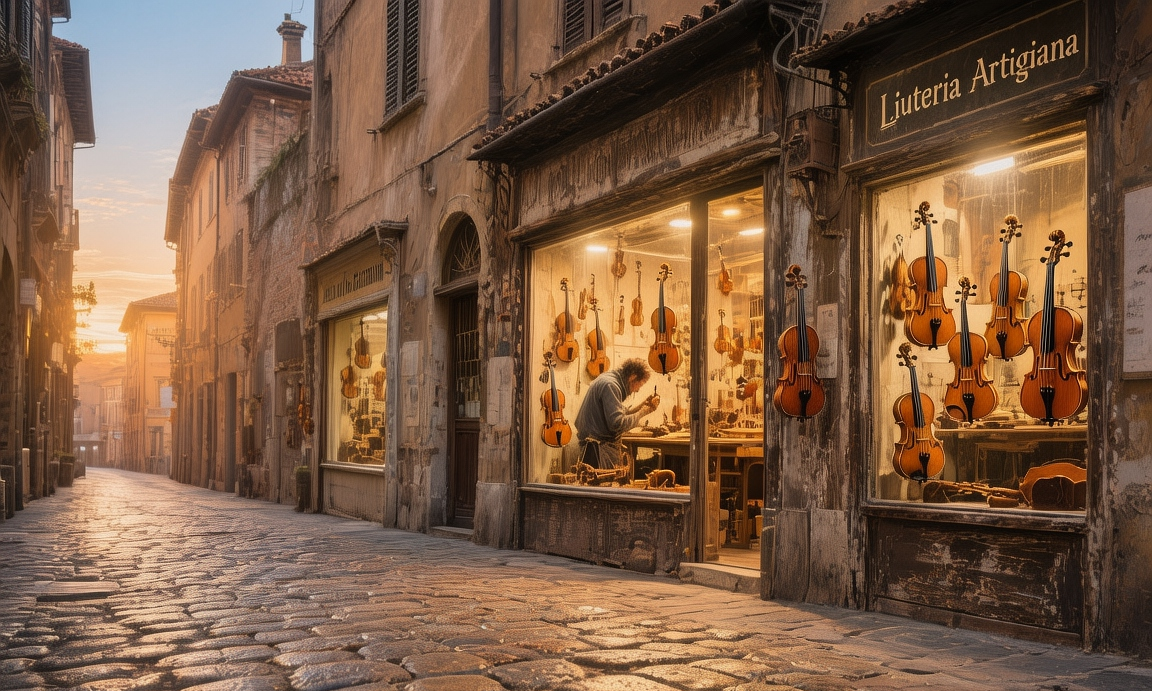
Cremona: Where Wood Meets Sound
I stand beside the cathedral at 8:00 on a June morning. The air feels still and clear. An espresso costs one euro thirty at a small bar tucked beneath an arcade. I look down the quiet lane beside the apse — workshop doors stand slightly open, the faint scrape of a plane carries from within, and sunlight falls on ancient brickwork that has watched over this craft for four centuries. Cremona sits in the Po Valley, in northern Italy, a city where music is not just performed — it is built, by hand, one instrument at a time. People come for the famous names. They find something quieter — a living tradition where patience is the only shortcut and every violin carries the maker’s handprint.
Why Cremona Matters
By the 16th century, this city had become the world’s greatest centre of violin making. The Amati family perfected the form; Stradivari and Guarneri del Gesù raised it to heights no one has since matched. Hundreds of luthiers worked here, passing skills from parent to child, guild rules protecting standards. When the great families passed, the craft did not vanish — it endured, taught in workshops and a dedicated school. Today Cremona remains the global capital of violin making. That distinction carries weight. The most famous museums fill quickly. Some newer workshops feel rushed. Balancing reverence with renewal — keeping the craft alive, not just preserved — is the quiet daily challenge.
The Best Time to Experience Cremona
Late April through June brings warm days, cool evenings, and thin crowds. Temperatures sit between 11°C and 24°C (52°F–75°F). Morning light falls soft on the cathedral and reveals fine wood details without glare. July and August warm to 19°C and 32°C (66°F–89°F). The valley holds heat and the quietest lanes feel still. September offers golden light and settled weather — 14°C to 26°C (57°F–79°F). Visitors thin out and the atmosphere feels gentle. Early October remains pleasant — 11°C to 21°C (52°F–70°F) — but evenings cool fast. Winter holds quiet, crisp days: 3°C to 10°C (37°F–50°F). Many workshops keep shorter hours and the city feels entirely its own. Arrive before 9:30 AM any time of year — that is when the workshops open and the streets feel most peaceful.
Approximate Budget for a 7-Day Trip
Prices below are per person, in euros, based on staying in Cremona.
- Accommodation: 7 nights in a guesthouse or apartment — €65–155 per night. Total: €455–1,085. Staying in nearby Mantua or Parma costs 25–35% more; driving or taking a train in takes 30–45 minutes longer.
- Food & Drink: Breakfast, two meals daily — €28–52 daily. Total: €196–364. Restaurants right on the main square charge premium prices; walk one lane back for tortelli di zucca, slow-cooked meat, and local Lambrusco at fair rates.
- Transport & Tickets: Train from Milan — €8–15 return; train from Bologna — €10–18 return; violin museum — €10–16; workshop visit — free or small donation. Parking near the centre is limited — park below the walls and walk in.
- Activities: Cathedral, music events, countryside day trips — €25–55.
- Miscellaneous: Water, hat, comfortable shoes — €12–22.
Total estimated 7-day cost: €700–1,644
"Exclusive masterclass" and "private Stradivari viewing" packages are often overpriced. Standard museum tickets include the same great instruments. Visiting independent workshops costs far less and often feels more personal.
Essential Cremona Experiences
- Violin Museum and Auditorium — Stand before the great instruments. A Stradivari, a Guarneri, an Amati — quiet, glowing, and powerful even in stillness. You do not need to be a musician to feel it. They are alive, waiting to speak. Skip if you arrive late; crowds gather and the hush vanishes.
- Working Workshop Visit — Step into a luthier’s studio. Wood shavings cover the floor, clamps line the walls, and a half-finished violin rests in soft light. The maker planes, scrapes, and fits by hand — no machines, no shortcuts. It takes months to finish one. You leave understanding the cost of every instrument.
- Cathedral and Piazza — Climb the broad steps of the striped Romanesque cathedral. The square feels grand but human — built over centuries, steady and enduring. It was here when Stradivari walked past every morning.
- Via dell’Antica Strada — Wander the lane where the master lived. Small workshops, quiet doorways, and faint reminders of the families who built this city’s fame. It is not a museum — people still work here.
- Sound Test — If invited, listen to a new instrument being played. Clear, warm, and alive — different from the old ones, beautiful in its own right. The tradition does not just preserve; it creates.
- Local Lunch — Eat pumpkin ravioli, braised beef, and mostarda. Simple, rich food suited to this northern plain. It tastes honest — no frills, just care.
Hidden Gems Most Travelers Miss
- The eastern workshop district runs parallel to the main tourist route. Families have worked here for generations — smaller, quieter, and less visited. Walk slowly and you will see craft in action through open doorways.
- The small church beside the former music school has a plain stone interior and perfect acoustics. Almost empty, it offers a peaceful pause. No ticket needed.
- The riverside path beyond the old walls stretches quiet and tree-lined. Luthiers walk here at midday — away from work, just people. Very few visitors follow it.
- The "Cremona VIP Private Studio & Master Collection Tour" is overpriced. Every significant instrument and genuine workshop is accessible on standard routes. Arrive early, walk the quieter lanes, and ask politely — that is how you truly experience the city.
Cultural & Practical Tips
- Arrive before 9:30 AM. The best light, quietest streets, and genuine atmosphere happen early. After 11:00 AM the dynamic shifts noticeably.
- Respect workshop spaces. Do not touch tools, wood, or unfinished work. Ask before photographing — some makers prefer privacy. Silence is part of the craft.
- Do not expect to buy a violin in an hour. Good instruments take years to make and cost thousands. Appreciate the process — that is the real visit.
- Wear comfortable shoes. The city centre is compact and best explored on foot. Cobblestones are worn but gentle.
- Look beyond the famous names. Every street holds skilled makers — their work deserves attention too. Greatness does not belong only to the dead.
- Book museum tickets 1–2 weeks ahead. Weekends sell out fastest.
- Stay for evening. Day-trippers leave, music drifts from practice rooms, and Cremona feels most itself — quiet, proud, and alive.
Essential Visitor Information
Location & Access: Cremona, Lombardy, Italy. Coordinates roughly 45.13° N, 10.02° E. Three ways to arrive: train from Milan — 1 hour; train from Bologna — 1 hour 20 mins; drive from Venice — 2 hours.
Tickets & Booking: City streets free. Violin museum — €10–16; cathedral — donation; workshops — free or small donation. Book museum tickets ahead; no booking needed for most studios.
Operating Hours: City always accessible. Museum roughly 10:00 AM to 6:00 PM; closed Monday. Workshops keep daytime hours and close Sundays.
Visit Duration: Minimum 1 full day. Recommended 2–3 days to explore museum, workshops, cathedral, and quiet lanes without rushing.
Family Suitability: Good overall. Flat streets suit strollers. Younger children may find museums quiet — workshops and sound demonstrations engage all ages.
Timing: Best seasons are late April–June and September. Best time of day is before 9:30 AM or late afternoon.
Highlights: Museum instruments at opening, working workshop, Stradivari lane, cathedral square, riverside path, eastern district.
Nearby & Day Trip: Mantua — 45 mins. Parma — 1 hour. Milan — 1 hour. Bologna — 1 hour 20 mins.
Conclusion: Travel with Silence, Not Just Applause
Cremona gives you beauty that takes months to build and centuries to mature. You can see the museums and leave. Or you can walk softly, keep your voice down, respect the quiet work still happening, and remember — the greatest instruments were not made for crowds. They were made to be heard. Honouring that silence is the finest gift you can give. What is the one quiet, patient craft you would visit promising to watch and wait?
Comments
Post a Comment