Dartmoor National Park: Where Ancient Granite Meets Wild Moorland
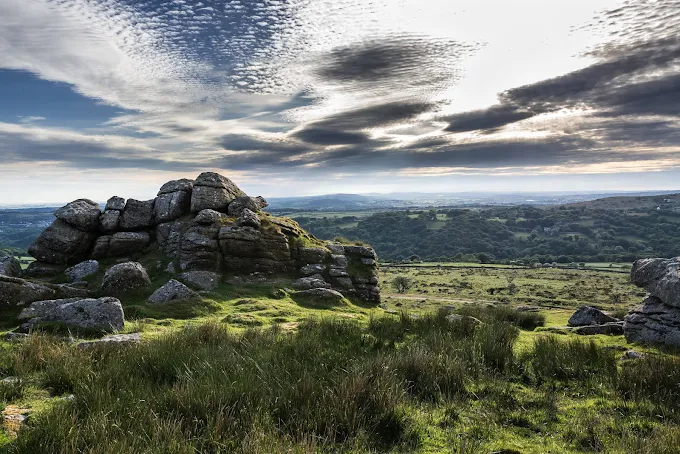
I stand beside a weathered granite tor at ten past nine on a crisp Tuesday morning in late September. Grey boulders stack high and jagged against pale blue sky — shaped by ice and wind over millions of years. Purple heather stretches endless downslope, falling into shadowed valleys where mist still clings to the ground. A stream runs clear and shallow over stones far below. No roads cut across the view. No buildings break the horizon. The wind blows steady and clean. It feels raw, unpolished, entirely itself — a landscape that existed long before us and will remain long after we leave.
Why Dartmoor National Park Matters
This is one of Britain’s oldest inhabited landscapes. Stone circles, standing stones, and ancient hut circles dot the moor — traces of people who lived, farmed, and worshipped here 4,000 years ago. Medieval forests gave way to open grazing; tin miners dug deep into the valleys from the 12th century onward, leaving quiet ruins scattered across the hills. Today Dartmoor remains a working landscape — sheep and cattle graze open moorland, farmers tend fields, and small communities hold isolated valleys together. It was designated a National Park in 1951 to protect this wild heart. That status brings real tension. Access disputes have limited where people can walk; military training areas restrict large sections; and wildfires started by careless visitors scar fragile peat and heather. The moor survives, but it is fragile — every visitor shapes what happens here.
The Best Time to Experience Dartmoor National Park
Late April through May brings fresh green and wildflowers, temperatures between 7°C and 14°C (45°F to 57°F). Days lengthen fast and the moor feels alive after winter. June and July offer the longest daylight — sky stays light until nearly 9.30 p.m. — and temperatures rise to 10°C and 18°C (50°F to 64°F). This is peak season; popular tors fill by midday and remote parking spots vanish fast. August stays mild at 11°C to 19°C (52°F to 66°F), but rain falls frequently and low cloud can cover the highest ground in minutes. September holds steady at 10°C to 16°C (50°F to 61°F), crowds thin noticeably, and purple heather blooms across thousands of acres. This is widely considered the best month to visit. October cools to 7°C and 12°C (45°F to 54°F), days shorten fast, and golden light turns granite warm amber. November through February the moor feels exposed — temperatures sit 3°C to 8°C (37°F to 46°F), wind howls unimpeded, and you may walk for hours without seeing another person. March and April thaw slowly — paths stay boggy — and spring visitors begin returning. Arrive before 10 a.m. any time of year; after that, cloud can roll in and visibility vanish.
Approximate Budget for a 7-Day Trip
These figures assume a base in a Dartmoor village, exploring tors, valleys, and nearby coast.
- Accommodation: £75–£130 nightly. Guesthouse or cottage in village centre. £525–£910 for 7 nights.
- Food & Drink: £20–£34 daily — breakfasts, village lunches, pub dinners. £336–£595 total.
- Transport: Car recommended — £45–£70 daily. Limited bus service between villages. £50–£490 total.
- Attractions: Open moor free. Castles and historic sites vary — average £8. £25–£60 total.
- Miscellaneous: £12–£20 daily — supplies, maps, local produce. £84–£140 total.
Total estimated 7-day cost: £1,020 to £2,195
Tea rooms directly beside popular parking spots charge premium prices. Walk five minutes uphill into the village — same homemade food costs less and supports local families directly.
Essential Dartmoor National Park Experiences
- Climb a tor early — Pick one before the crowds arrive. The view stretches endless — rock, heather, sky, nothing else. Skip this if cloud covers the top; you will see nothing and the descent becomes dangerous.
- Walk beside a moorland stream — Follow water down through valleys. Ferns, moss, and wild flowers line the banks; ancient trees shelter the path. It feels quiet and green, a world away from the open hilltops.
- Find a prehistoric site — Stone circles stand silent on quiet slopes, unmarked and unguarded. People gathered here millennia ago. Sit and imagine it — the connection feels real and immediate.
- Explore a ruined tin mine — Chimneys, engine houses, and stone shafts dot the valleys. They tell of industry that reshaped the landscape and sustained communities. Stay behind barriers — old workings remain unstable.
- Walk across open moor at golden hour — As the sun dips low, long shadows stretch across the heather. Granite glows warm gold. Every boulder and bank takes on new shape. Arrive 45 minutes early; light fades fast on the high ground.
- Visit an isolated village — Stone cottages, one pub, no crowds. Life moves slow here. Stop, eat, and speak to people — the moor belongs to them as much as to anyone.
Hidden Gems Most Travelers Miss
- Valley of the Rocks quiet stretch — Beyond the main viewpoint, a level path follows the stream past old woodland. Very few walk this far. You hear water and wind, not voices.
- Minor tor without a name — Leave the main path and climb a smaller, unmarked outcrop. The view feels entirely your own. No signposts, no crowds, just rock and horizon.
- Ancient track across open moor — A grassy way runs between settlements, used for centuries. This spot is widely shared online now and has become overrated. Go before 9.30 a.m. if you want it quiet.
- Wooded river walk — Beside one main waterway, a path runs through trees that turn deep red and gold in autumn. The moor feels softer here — green, sheltered, secret.
Cultural & Practical Tips
- Check weather and visibility before setting out. The forecast can change in an hour. Carry a map, compass, and warm layer even on bright days.
- Park responsibly. Narrow lanes become blocked instantly. Use designated spaces — never block gates, farm access, or passing places.
- Close every gate behind you. Sheep and cattle roam freely across open moorland. A left-open gate can lose a farmer their livelihood.
- Stay on firm ground. Bog lies hidden beneath grass and heather. Stick to paths and firm ground — sinking deep is dangerous and damages fragile peat.
- Respect live-fire zones. Red flags mean danger — never cross the boundary. It is not just a rule; it keeps you safe.
- Leave no trace. Everything you carry in must come out. This landscape feeds rare birds, insects, and plants — litter harms more than just the view.
Essential Visitor Information
Location & Access: Dartmoor National Park, Devon — south-west England. Three transport options: train to Exeter then bus/taxi; car via A30/A38; bus from Plymouth — limited routes.
Tickets & Booking: Open moor access free. Individual sites and visitor centres charge separately. No park pass required.
Operating Hours: Open access dawn to dusk, year-round. Some areas close occasionally for military training.
Visit Duration: Minimum 1 day for highlights. 3–4 days to explore tors, valleys, and quiet corners properly.
Family Suitability: Uneven terrain — sturdy shoes essential. Keep children close; streams and bogs have hidden depth. Public toilets at main car parks and villages.
Timing: Best season September during heather bloom. Early morning before 11 a.m. offers clearest visibility and quietest paths.
Highlights: Tor at sunrise, prehistoric circle at dusk, ruined mine walk, valley woodland, village pub lunch.
Nearby & Day Trip: Exeter — 30 minutes; Plymouth — 45 minutes; North Devon coast — 50 minutes; Cornwall border — 1 hour; Jurassic Coast — 1 hour 15 minutes.
Conclusion: Travel with Care, Not Just Footprint
Dartmoor does not exist for our entertainment. It feeds families, shelters wildlife, and holds stories older than any city. When you visit, walk light. Leave nothing behind. What will you do to help this wild place stay wild?
Comments
Post a Comment