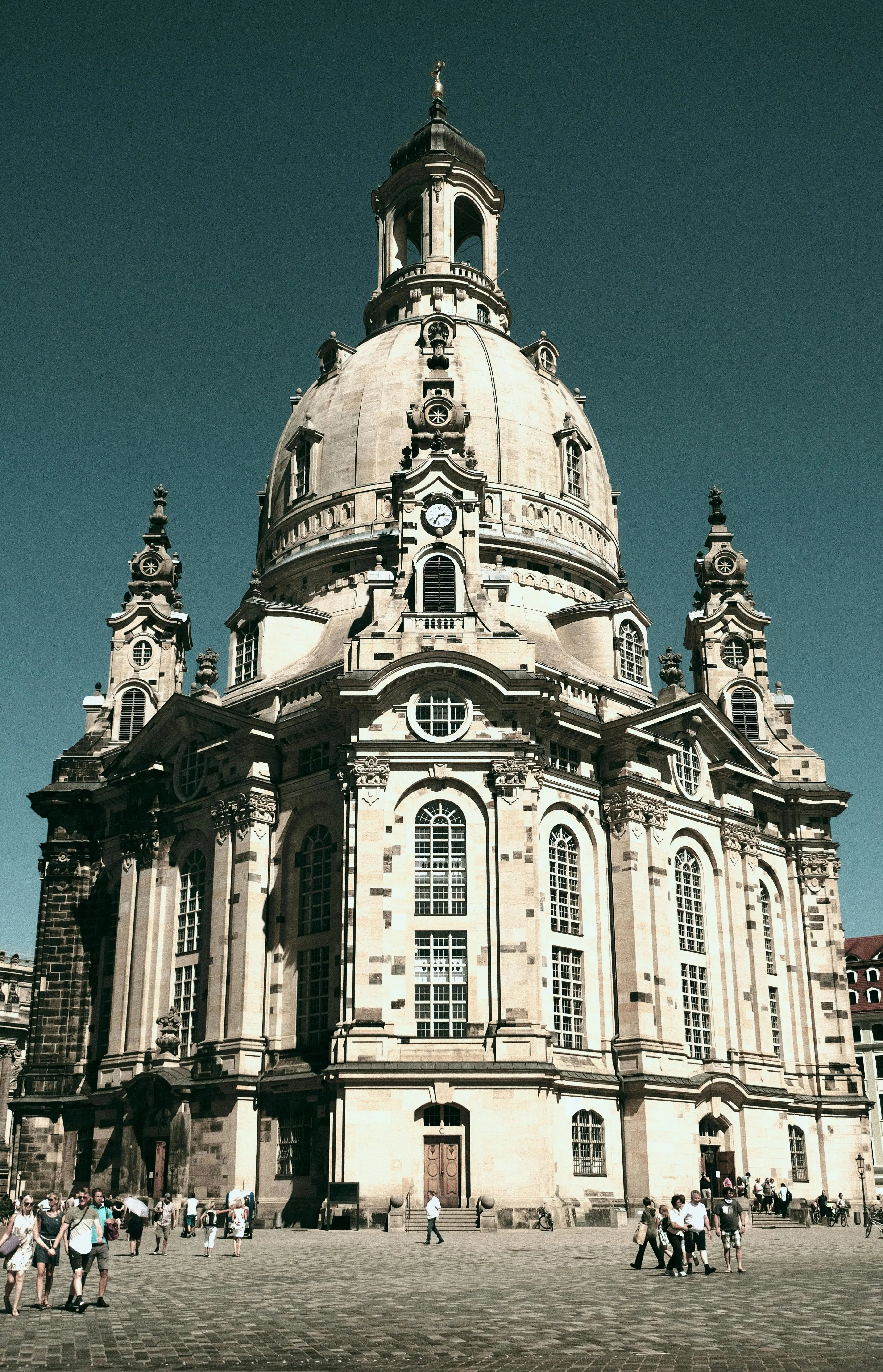
Dresden Frauenkirche: Where Stone Silence Meets Living Hope
I stepped into the inner courtyard at ten past ten on a Friday morning. Sunlight filtered through the great dome, falling soft and even across pale sandstone. I paid eight euros to enter. The air felt still and cool — a quiet pause amid the city. I expected a rebuilt copy of something lost. What I found feels like something deeper: a church, a memorial, and a promise kept. Every stone tells two stories — one of destruction, one of return. Not every wall matches perfectly. Darker blocks sit beside lighter ones, marking where original fragments were set alongside new stone. That visible difference is not a flaw. It is the truth.
Why Dresden Frauenkirche Matters
The original church stood completed in 1743, built from local sandstone with a soaring dome that defined Dresden's skyline for two centuries. On the night of 13 February 1945, it collapsed into rubble after firebombing. The pile of stones remained untouched for nearly fifty years — a deliberate monument to loss. After reunification, citizens and donors worldwide funded reconstruction. The church reopened in 2005, built as closely as possible to the original design, using thousands of recovered fragments alongside matching new stone. It stands today as one of the world's most powerful symbols of reconciliation and renewal. One honest criticism: the surrounding square fills rapidly with day groups after 11:00. Finding quiet space outside grows harder as the morning goes on. The dome climb is steep, narrow, and unsuitable for anyone with mobility or claustrophobia concerns.
The Best Time to Experience Dresden Frauenkirche
April through June brings 8°C to 18°C / 46°F to 64°F. Morning light falls through the dome windows beautifully. Arrive before 10:00; the interior stays peaceful and voices carry softly without echoing. July and August warm to 13°C to 23°C / 55°F to 73°F. Concerts and evening services happen regularly. September holds 10°C to 19°C / 50°F to 66°F. Crowds thin and golden light warms the sandstone exterior. October through March the church feels calm and sheltered. Christmas services draw visitors in December; otherwise you will often find space to sit undisturbed. Mondays the dome viewing platform closes; the main church remains open.
Approximate Budget for a 7-Day Trip
Costs below are per person based on staying in central Dresden.
- Accommodation: 497 euros — Clean room within walking distance. Hotels directly facing the church charge 250 euros or more per night and feel overpriced; stay one lane back for half the cost and equal comfort.
- Food: 294 euros — Saxon potato dishes, hearty soups, and Eierschecke, the local cream cake.
- Transport: 91 euros — City tram pass. The church sits in the historic centre; most major sites are walkable.
- Attractions: 84 euros — Church entry, dome climb, and nearby museum visits.
- Miscellaneous: 70 euros — Drinks, snacks, and small purchases.
Total: 1036 euros. Souvenir shops facing the main entrance mark up every item. Walk five minutes toward the river; identical handcrafts and books cost roughly 40 percent less.
Essential Dresden Frauenkirche Experiences
- Interior and Central Space — Stand beneath the dome. The scale feels open and light, not heavy. The design draws your eye upward without overwhelming you. Sit quietly for a few minutes. Skip if you need to move quickly; many people pause and the flow slows naturally.
- Dome Climb and View — Spiral steps lead to an open platform high above the rooftops. Dresden spreads below — river, spires, and green hills beyond. The climb is steady and the reward is wide. Skip if you dislike confined spaces or steep stairs; the passage narrows and there is no lift.
- Original Stones Walk — Notice the darker blocks set into walls and columns. These are fragments recovered from the rubble, cleaned and placed where they fit. Guides point them out; look closely and you see weathering, cracks, and fire marks. They connect this building directly to the one that stood here before.
- Evening Light and Silence — After day groups leave, the church stays open. Light softens and the space feels deeper. No crowds hurry past. It is the best time to feel the peace at the heart of the building.
- Service or Concert — Choral and instrumental performances sound clear and resonant beneath the dome. Acoustics are warm and balanced. Check schedules; dates are limited and tickets sell out fast.
- Sunrise from the Square — Early light hits the dome first. The church glows warm against pale sky before most streets wake up. No ticket needed; just stand and watch from across the empty square.
Hidden Gems Most Travelers Miss
- South Side Quiet Bench — Away from the main entrance, a stone bench sits in partial shade. It faces the curve of the dome and catches morning light. Almost no one pauses here. The so-called "famous photo spot" nearby is often overrated; it stays crowded and groups block the view constantly.
- Foundation Memory Stone — Set into the ground near the side doorway, a simple plaque marks where the rubble lay for decades. It sits low and easy to miss. Pause and read it; the whole story shifts into focus.
- Upper Window Glimpse — Halfway up the dome stairs, a narrow window frames the Semperoper and river bend in the distance. Most people hurry past without looking. It is a small, perfect connection between two landmarks that rose from the same loss.
- Quiet Courtyard Corner — Tucked between the church and an adjacent building, a sheltered corner holds a single bench. It feels completely separate from the bustle outside. You can sit and rest without being disturbed.
Cultural & Practical Tips
- Respect the atmosphere. This is first a place of worship, then a landmark. Keep voices low and silence when others are reflecting.
- Book dome tickets early. The climb sells out days ahead. Same-day spots are extremely rare.
- Wear comfortable shoes. The spiral steps are uneven and worn smooth in places. You will walk upward for some time.
- Look for the dark stones. They are not mistakes. They are the most honest part of the building — the original fragments returned home.
- Visit twice if you can. Once in daylight to see the detail, once in evening to feel the peace. The two experiences are different and equally memorable.
- Check service times. On Sundays and holy days, entry may be limited during worship. Plan accordingly so you do not find doors closed unexpectedly.
Essential Visitor Information
Location & Access: Dresden Frauenkirche, Neumarkt, 01067 Dresden, Germany. GPS 51.0498, 13.7385. Train from Berlin 1 hour 45 minutes. Leipzig 1 hour 45 minutes. Prague 2 hours. Walk from Dresden main station 15 minutes; trams stop nearby.
Tickets & Booking: Church entry free. Dome climb roughly 8 euros adult. Combined tickets with nearby sites available. Booking recommended online for the dome, especially weekends and holidays.
Operating Hours: Daily 10:00 to 18:00; shorter hours in winter. Dome platform generally 10:00 to 17:00; closed Mondays. Services and concerts may restrict access at times.
Visit Duration: Minimum 1 hour. Two hours lets you enter, sit, climb the dome, and walk slowly around the outside without rushing.
Family Suitability: Children welcome. Stroller access is possible but limited; steps inside are unavoidable. The dome climb is not recommended for very young children or anyone uncomfortable in narrow spaces.
Timing: September offers best light and thinner crowds. Arrive before 10:00.
Highlights: Dome interior, original stones, climb and view, evening silence, sunrise square, service or concert.
Nearby & Day Trip: Zwinger Palace 10 minutes walk. Semperoper Opera House 8 minutes. Saxon Switzerland National Park 40 minutes by train. Meissen porcelain town 30 minutes; makes a rewarding half-day trip.
Conclusion: Travel with Truth, Not Just Perfection
The Frauenkirche will not look uniformly new everywhere. Some stones will always show age and damage. That is not something to overlook. That is the reason it stands. Great monuments do not exist to pretend nothing ever went wrong. They exist to show that things can be made whole again. What will you help rebuild in your own life?
Comments
Post a Comment