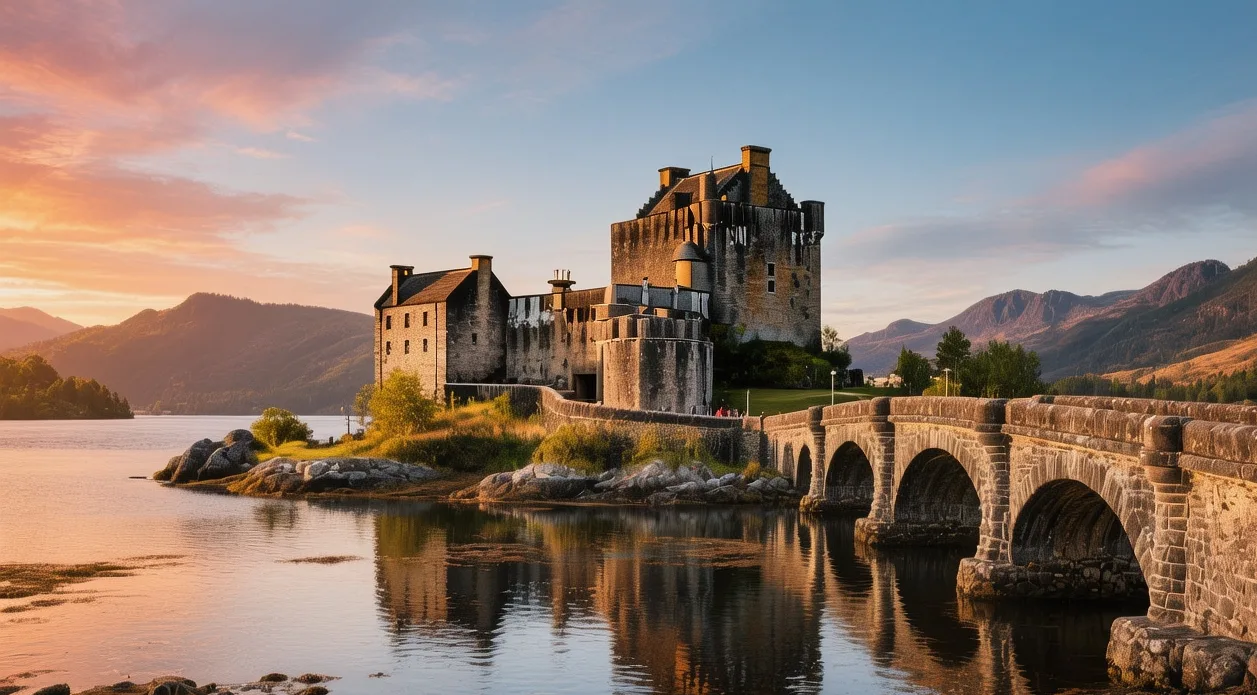
Eilean Donan Castle: Where Three Lochs Meet Restored Highland Heritage
I stand on the stone bridge at ten past nine on a clear morning in late May. The tide is high, and water surrounds the island on every side, deep blue and still enough to hold faint reflections of the tower walls. A light breeze carries the sharp, clean scent of salt and pine down the loch. I count the arches overhead — three distinct spans linking land to island — and run a hand along the cold, damp stone of the parapet. No other visitor has arrived yet. The castle stands quiet, grey and solid against rising ground. It looks ancient, and parts of its story stretch back eight centuries, but the building before me is younger than most people realise. That does not make it less impressive. It just means you should know what you are actually looking at.
Why Eilean Donan Castle Matters
The first stronghold here went up in the 1200s, guarding the meeting point of Loch Duich, Loch Long, and Loch Alsh. For centuries it served as a key defensive position and seat for Clan Mackenzie, with Clan MacRae acting as hereditary protectors. Its end came in 1719, when Royal Navy frigates bombarded it into rubble during a Jacobite uprising. For nearly two hundred years only broken walls stood. Then in 1912, John MacRae-Gilstrap, a descendant of the MacRaes, began rebuilding from the ground up. Work finished in 1932. What you see today is a faithful recreation, not an original medieval structure. That fact disappoints some visitors who arrive expecting untouched ancient stone. The interior is compact and the rooms few, so the experience feels brief once you step inside. The castle draws huge crowds, and in summer the bridge and viewpoints fill before mid-morning. Yet for all that, the vision and effort behind its restoration are real. It stands as a reminder that heritage is not just about preservation — it is also about people choosing to care enough to rebuild.
The Best Time to Experience Eilean Donan Castle
Late May through early June brings long bright evenings, temperatures between 9°C and 16°C (48°F to 61°F), and thinner crowds than mid-summer. Rain falls in short bursts rather than steady downpours, though mist can cling to the surrounding hills. July and August see temperatures rise to 11°C and 18°C (52°F to 64°F), but coach tours arrive by 10 a.m. daily. September holds steady at 8°C to 14°C (46°F to 57°F), with softer light and fewer people. October brings richer colours in the woodland along the loch, temperatures 5°C to 11°C (41°F to 52°F), and shorter opening hours. November through February the castle closes or runs limited days. Temperatures sit 2°C to 8°C (36°F to 46°F), paths can be icy, but you often have the viewpoints almost to yourself. March and April see daylight lengthen and daffodils appear along the shore, 4°C to 10°C (39°F to 50°F), though interior spaces may still be closed for annual maintenance.
Approximate Budget for a 7-Day Trip
These figures assume a base in nearby Dornie or Kyle of Lochalsh, visiting Eilean Donan alongside other Highland and Isle of Skye sights.
- Accommodation: £40–£70 nightly. Budget bunkhouse or clean guesthouse room. £280–£490 for 7 nights.
- Food & Drink: £14–£22 daily for self-catered breakfasts and packed lunches. Evening meal out £18–£32. £224–£378 total.
- Transport: Car rental £40–£65 daily. Local bus from Fort William or Kyle of Lochalsh £8–£16 return. £56–£455 total.
- Attractions: Castle entry £11 per adult. Nearby viewpoints free. Three-day Isle of Skye side trips £30–£60. £45–£90 total.
- Miscellaneous: £7–£14 daily for hot drinks, snacks, and waterproof layer replacements. £49–£98 total.
Total estimated 7-day cost: £654 to £1,508
The castle cafe charges premium prices for basic sandwiches. Walk to the village shop instead; you will pay half as much and get better ingredients from local suppliers.
Essential Eilean Donan Castle Experiences
- Walk across the bridge at high tide — Water surrounds the island completely, and the approach feels like crossing into another world. Arrive when the water covers the mudflats. Skip this if you visit at low tide; the land bridge looks less dramatic and the waterline drops far below the walls.
- Tour the restored interior — Rooms include the banqueting hall, bedrooms, and displays telling the full story of destruction and rebuilding. The audio guide is included in your ticket. The layout is compact, so the visit takes about an hour.
- Watch the light change from the roadside viewpoint — From the A87 pull-off you see the full profile of the castle framed by hills and loch. Morning light hits the front face best; evening turns the stone warm gold.
- Follow the woodland trail above the loch — A short loop climbs through trees behind the visitor centre. It opens to higher ground with a different angle across the water. The path has some steep uneven sections; wear sturdy shoes.
- Walk the shoreline toward the village — Head left from the car park along the edge of Loch Alsh. You look back at the castle from a distance, and the curve of the bridge stands out clearly. The path is flat and accessible for most visitors.
- Visit at dawn or dusk — The castle grounds close to entry, but the external viewpoints stay accessible. The place falls quiet, and reflections hold steady in still water. Carry a torch if you stay after sunset.
Hidden Gems Most Travelers Miss
- The old parish church — A short walk toward Dornie village. Simple stone building from the 19th century, quiet interior, and graveyard with views across the loch. Very few visitors step inside.
- Shore path to the boathouse — Follows the inlet opposite the main viewpoint. You see the castle from water level, and the bridge arches frame the tower perfectly. The path is narrow and can be muddy. li>Cluanie ridge viewpoint — A short drive north along the A87. It sits higher and looks down over the meeting of all three lochs. This spot is becoming overrated in online guides; go before 8 a.m. if you want it empty.
- Dornie village waterfront — Just past the castle turn-off. Small harbour with fishing boats and quiet benches. Locals sit here most evenings; it feels like a real community rather than a tourist stop.
Cultural & Practical Tips
- Do not fly drones over the castle or grounds. They are banned and disturb wildlife and residents across the glen.
- Stay on marked paths. The hillsides here are fragile, and vegetation takes years to regrow once trampled.
- Check opening times before travelling. The castle closes January and occasionally for private events throughout the year.
- Do not expect a full medieval ruin. Most people leave satisfied, but knowing it was rebuilt sets realistic expectations.
- Arrive before 9.30 a.m. in summer. Coach tours turn up from 10 a.m. onward, and both parking and viewpoints fill quickly.
- Respect local traffic. The A87 is narrow and busy; do not stop in the road to take photos. Use designated pull-offs only.
Essential Visitor Information
Location & Access: Dornie, Western Highlands — where Loch Duich, Loch Long, and Loch Alsh meet. Three transport options: car via A87 — 2 hours from Inverness, 45 minutes from Fort William, 10 minutes from the Skye bridge; bus from Inverness or Fort William to Dornie, then 10-minute walk; tour bus from major cities — convenient but limits your time on site.
Tickets & Booking: Adult £11, senior £10, child £6, family £29. Booking recommended July and August; walk-in tickets available outside peak season. External viewpoints cost nothing.
Operating Hours: Generally 10 a.m. to 5 p.m. March through October; shorter hours November and December; closed January. Last entry roughly one hour before closing.
Visit Duration: Minimum 1 hour for external views and bridge walk. 2 hours lets you tour inside and walk one nearby trail. Half a day if combining with longer shoreline paths.
Family Suitability: Grounds and bridge suit all ages; stroller access is limited due to steps and uneven surfaces. Interior has narrow spiral staircases not safe for unsupervised young children. Public toilets at visitor centre.
Timing: Best season May, June, or September. Early morning before 9.30 a.m. or late afternoon after 4.30 p.m. gives you quiet and clear light.
Highlights: Bridge approach at high tide, banqueting hall, roadside viewpoint, woodland trail, three-loch meeting point.
Nearby & Day Trip: Isle of Skye — 10 minutes across the bridge; Kyle of Lochalsh — 15 minutes; Glencoe — 45 minutes south; Loch Ness — 1 hour 30 minutes east.
Conclusion: Travel with Understanding, Not Just Photos
Eilean Donan Castle is not a perfectly preserved medieval relic. It is a labour of love — one man’s vision, a community’s effort, and twenty years of careful work returning something lost. That story matters as much as the stones themselves. When you visit, look past the postcard image. Notice the joins in the masonry, the care taken to match what stood before, and the fact that people chose to rebuild rather than walk away. What is one story from this place you will remember long after you leave?
Comments
Post a Comment