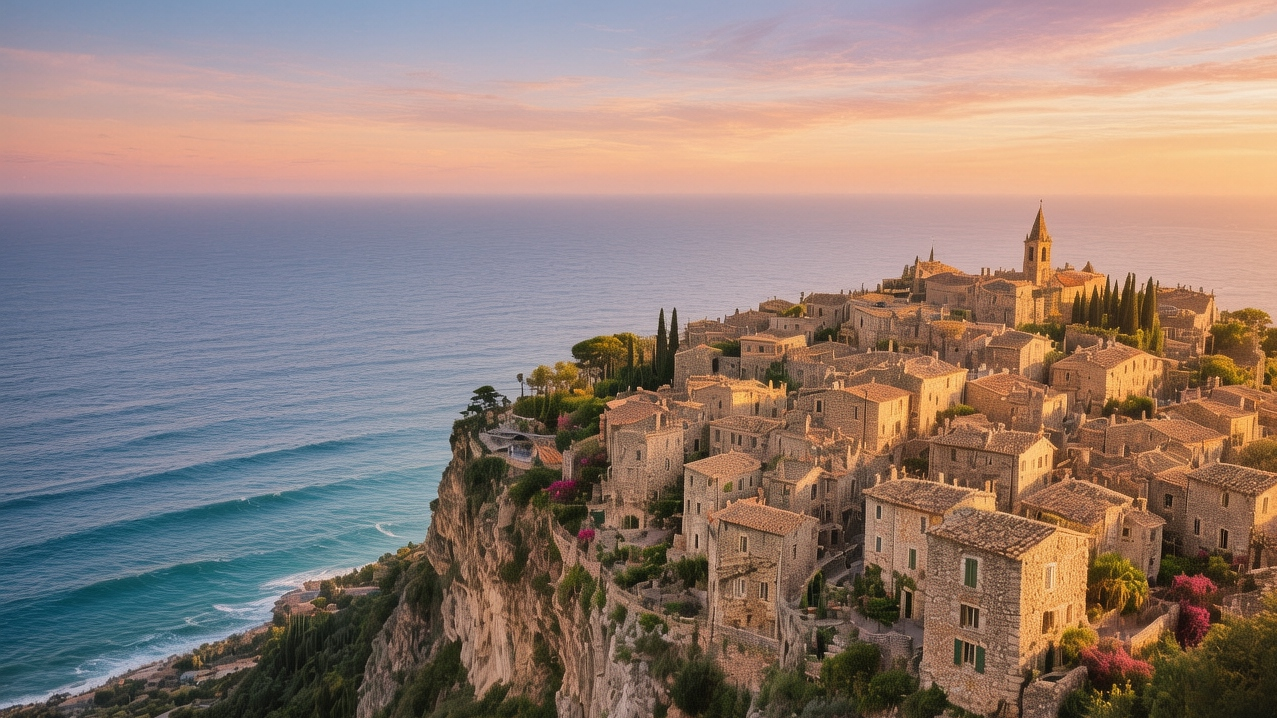
Èze Hilltop Village: Where Medieval Stonework Meets Mediterranean Blue
I stand near the highest point just after nine in the morning. The air still carries a cool edge even in July. A short walk from the main gate, I pause and look down. The sea stretches out below, deep and bright, and the sun hits the limestone walls. A slice of croissant costs three euros at the small bakery near the entrance. It is buttery and fresh. The view shifts as I move; houses stack upward like a carefully arranged puzzle. The breeze brings salt and wild herbs growing in crevices. I pass an older woman tending flowers outside her door. She nods. The village feels lived-in, not just a place people visit and leave.
Why Èze Matters
Èze sits high on a rocky peak between Nice and Monaco. Parts of its core date back to the thirteenth century, built when people chose height for safety over ease of access. Narrow lanes wind upward and outward, following the land rather than a drawn plan. The village changed hands between powers over centuries, yet kept its own quiet character. It draws visitors from everywhere now, and that brings real downsides. In summer, the streets fill by midday. You will wait in line to enter some small shops, and voices echo off stone walls until late. The charm can feel stretched thin when crowds pack every passage. Still, the layout itself remains untouched in its bones. You walk where people walked eight hundred years ago, and the shape of the land has not shifted.
The Best Time to Experience Èze
Mid-September through mid-October and mid-April through mid-May offer the best balance. Daytime temperatures sit around 18°C to 22°C (64°F to 72°F). Nights drop to 12°C to 14°C (54°F to 57°F), so bring a light jacket. July and August see highs near 28°C to 30°C (82°F to 86°F) — pleasant near the sea but noticeably warmer up top with little shade in the lanes. Winter from December to February stays mild at 11°C to 15°C (52°F to 59°F), though some places close and rain can fall quickly. Arrive before 9:30 AM if you visit in summer. You will have quiet light and empty streets for a few hours. Afternoon brings heat and crowds. Weekdays are quieter than weekends throughout the year.
Approximate Budget for a 7-Day Trip
Here is what you can expect to spend per person, based on staying in the area and visiting Èze repeatedly or using it as a base for nearby travel.
- Accommodation: €70–€110 per night for a clean double room outside the immediate village center; closer to the heart expect €130–€220. Staying in Beaulieu-sur-Mer or Saint-Jean-Cap-Ferrat and taking a short bus up costs less overall and offers more space.
- Food: €12–€18 for a solid lunch; €25–€40 for dinner. Coffee runs €2.50–€4.50 in the village. Buy bread, cheese, and fruit at the market in Beaulieu for half the price.
- Transport: €1.50 per local bus ride; train between Nice and Beaulieu around €3 one way. Walking up from the station costs nothing but takes forty minutes.
- Attractions: Garden and site entry €6–€9. Most lanes and viewpoints cost nothing to enjoy.
- Miscellaneous: €15–€25 daily for drinks, small supplies, and occasional extras.
Total estimated 7-day cost: €630–€950 per person. The most overpriced choice is eating dinner at one of the restaurants right inside the main gate — portions are small and prices run double what you find five minutes away. Walk down toward the lower village for better value.
Essential Èze Experiences
- Walk the full upper loop. Follow the outer lanes all the way around the crest. You find shifting views of sea and coast on every side. Allow one hour at a slow pace.
- Climb to the ruined keep at the very top. Stone steps lead to the highest point. The wind picks up there. You see the curve of the coast toward Italy and west toward Nice. Skip if you have bad knees — the final stretch is steep and uneven.
- Visit the exotic garden. Plants from dry climates grow against the old ramparts. The setting is striking and well maintained. Go early before groups arrive.
- Stop at the church of Our Lady of the Assumption. Built in the eighteenth century, it sits near the center. The interior is simple and quiet. Light falls through narrow windows.
- Walk down the Nietzsche path. A stone-lined trail descends from the village to the shoreline road. It takes about forty-five minutes. The way is steep in places and uneven underfoot.
- Watch the light change over the rooftops. Late afternoon turns the stone warm gold. Find a quiet bench away from the main path and stay awhile.
Hidden Gems Most Travelers Miss
- The small square near the church’s rear side. It has a single bench and almost no foot traffic. Locals pass through but rarely stop long.
- Place de la Croix on the western edge. A stone cross marks the spot. You look straight down to the water with almost no one else around.
- Èze-sur-Mer below. People visit the top and leave without seeing the lower village by the station. It feels like a different place entirely — quiet, with old villas and pine trees. The famous botanical garden near the top is beautiful but often crowded; it is overrated if you prefer quiet over curated views.
- Chemin des Muriers. A residential lane running parallel to the main approach. It has the same architecture without the shopfronts and noise.
Cultural & Practical Tips
- Wear sturdy walking shoes. Cobblestones are uneven and slippery when damp. Flip-flops are a mistake here — you will regret it by the second turn.
- Do not treat private doorways or courtyards as photo spots. People live here. Ask before you frame someone’s home.
- Cash works best at small bakeries and stalls. Some places do not take cards at all.
- Carry a reusable water bottle. You walk constantly and climb. Sun and heat catch people off guard. Fountains exist but are not everywhere.
- Do not trust every “best view” sign. Some lead to private terraces where you are expected to buy a drink to stay. Good views exist freely — keep walking.
- Bus times tighten in the off-season. Check the posted schedule before you head up; the last bus down can leave earlier than you expect.
- Keep voices low after 10 PM. Residents remain, and sound carries far between stone walls.
Essential Visitor Information
Location & Access: Èze sits on the French Riviera, 12 kilometers east of Nice and 7 kilometers west of Monaco. GPS coordinates roughly 43.72° N, 7.36° E. Reach it by bus from Nice or Monaco directly to the village stop; by train to Èze-sur-Mer station then walk or take the connecting bus; or by car with paid parking at the base — spaces fill fast by mid-morning.
Tickets & Booking: Village entry is free. The exotic garden costs €8 per adult. No booking needed for the garden most months; reserve online in July and August.
Operating Hours: Streets remain open all day and night. The garden opens 9 AM to 7 PM in summer; 9 AM to 5:30 PM October through March. It closes only on Christmas Day and January 1st.
Visit Duration: Minimum two hours for a quick loop. Three to four hours lets you climb, rest, and explore without rushing.
Family Suitability: Children are welcome. Strollers work on main paths but struggle on narrow side lanes and steep steps. No dedicated play areas, but open spaces exist near the entry and church.
Timing: Best months May, June, September, early October. Best time of day: before 9:30 AM or after 4:30 PM.
Highlights: The rampart walk, the keep at the summit, the exotic garden, the church, and the Nietzsche descent path.
Nearby & Day Trip: Saint-Jean-Cap-Ferrat lies 4 kilometers away, walkable along the coast path in about ninety minutes. Beaulieu-sur-Mer is 3 kilometers down with a waterfront and market. Nice is twenty minutes by train or bus. Monaco is thirty minutes east. All make comfortable half-day or full-day outings from Èze.
Conclusion: Travel with Presence, Not Just Photos
Èze rewards those who slow down more than those who rush every landmark. You do not need to capture every angle to know the place. Walk the same lane twice. Notice how light changes the stone between morning and afternoon. Stop at the bakery early and claim a quiet spot before the day builds. What stays with you is not a single view, but the feel of the village as it shifts through the hours. When will you plan your first visit?
Comments
Post a Comment