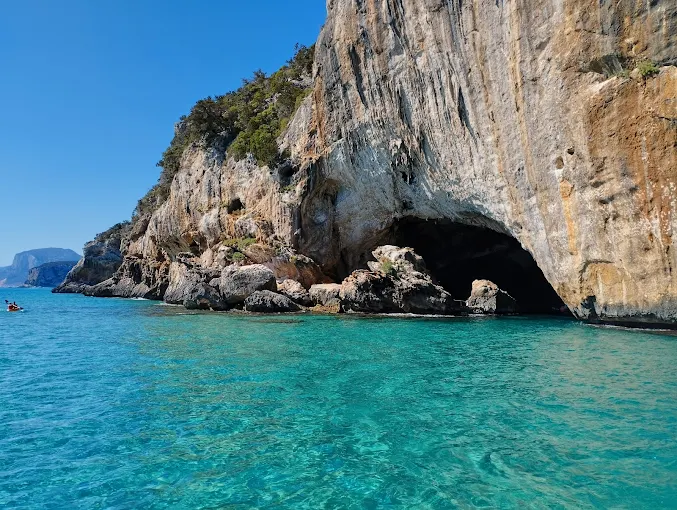
Grotta del Bue Marino: Where Underground River Meets Sea Cave
I stand before the great arched entrance at 8:30 on a July morning. Cool, damp air flows out from the darkness, carrying the faint sound of dripping water. An espresso costs one euro fifty at the small bar just uphill from the ticket office. I look down at the river that still runs through the lower chambers — clear, dark, and steady, carving stone as it has for thousands of years. Grotta del Bue Marino lies along the eastern coast of Sardinia, not far from the town of Dorgali. It is one of the longest accessible sea caves in Europe, formed where underground water systems meet the Mediterranean. People come for the dramatic formations. They find a place where time moves at the pace of dripping stone.
Why Grotta del Bue Marino Matters
The cave system formed over millions of years as rainwater dissolved limestone and sea levels rose and fell, shaping both dry and flooded passages. Its name means "Sea Ox Cave" — a reference to monk seals that once sheltered here, their low breathing mistaken for the sound of an animal. Today the cave is recognised as one of the most significant hydrogeological sites in the Mediterranean, with active formations, permanent underground rivers, and distinct chambers that show changing sea levels across geological time. That protection brings real trade-offs. Temperatures inside stay around 16°C year-round — refreshing above ground, but cold after standing still. Pathways are narrow in sections and lighting is kept low to protect the ecosystem. Groups move slowly and bottlenecks form. This is not a high-speed attraction — it demands patience.
The Best Time to Experience Grotta del Bue Marino
Late April through June brings fresh green foliage and moderate visitor numbers. Temperatures sit between 15°C and 25°C (59°F–77°F). The contrast between warm sunshine outside and cool cave air feels striking. July and August warm to 22°C and 32°C (72°F–90°F). Groups are largest and queues can stretch for forty-five minutes or more. September offers thinner crowds and golden coastal light — 18°C to 28°C (64°F–82°F). The cave feels peaceful and the air outside stays pleasant. October remains mild — 15°C to 24°C (59°F–75°F) — and tours run less frequently. Winter holds quiet days: 8°C to 16°C (46°F–61°F). Some tours may be suspended after heavy rain. Arrive before 9:30 AM any time of year to avoid queues and experience the cave with fewer people.
Approximate Budget for a 7-Day Trip
Prices below are per person, in euros, based on staying in Dorgali or nearby Cala Gonone.
- Accommodation: 7 nights in a guesthouse or apartment — €70–135 per night. Total: €490–945. Staying further inland costs 25–35% less; driving to the cave entrance takes 20–30 minutes.
- Food & Drink: Breakfast, two meals daily — €32–55 daily. Total: €224–385. The small café at the car park charges premium prices; drive five minutes into Dorgali for simpler meals at fairer rates.
- Transport & Tickets: Standard guided tour €12–18; extended deeper tour €20–28; car rental €35–55 daily; local bus pass €12–20. Parking near the entrance is limited and fills fast — arrive early or use the designated area downhill and walk up.
- Activities: Coastal boat trip, beach visit, nearby Gole Su Gorropu gorge — €35–75.
- Miscellaneous: Warm layer, sturdy shoes, water — €15–25.
Total estimated 7-day cost: €795–1,495
Rooms with direct sea or cliff views in Cala Gonone carry a very large premium. Similar accommodation in Dorgali costs 40–50% less and the cave is still a short drive away. The "Bue Marino Exclusive Extended Tour" is overpriced; the standard route covers the most spectacular and accessible chambers at a fraction of the cost.
Essential Grotta del Bue Marino Experiences
- Main Entrance & River Chamber — Step through the natural arch into the first vast hall. The river glides silently below. Sunlight slants in from above, catching floating dust and turning the water pale gold. Skip if you dislike enclosed spaces; passages narrow further in and the roof feels low in places.
- Columned Gallery — Follow the path past massive stalactite and stalagmite formations. Some have joined to form thick columns reaching from floor to ceiling. Each one takes thousands of years to grow even a few centimetres. Standing beside them feels like standing beside time itself.
- Underground Lake View — Reach the calm, still pool deep inside. The water is so clear the bottom seems within reach, yet it extends far below. Formations reflect perfectly on the surface. The guide pauses the group so silence returns — that is when the cave feels most alive.
- Return Walk in Soft Light — Walk back toward the entrance as light from outside grows gradually brighter. The formations change appearance as daylight reaches further in. It feels different from the way in — new details emerge and familiar shapes shift.
- Coastal Drive Beforehand — Travel to the cave along the winding coastal road. Cliffs drop steeply to the blue sea. The landscape prepares you — wild, ancient, and water-worn. It connects the cave to the island above ground.
- Quiet Post-Visit Reflection — Sit outside after the tour. The cool air still clings to your clothes. Give yourself time to process what you have seen. Rushing away immediately means missing the lingering feeling of depth and stillness.
Hidden Gems Most Travelers Miss
- The short viewpoint trail uphill from the ticket office looks back across the valley entrance. You see the great arch framed by limestone crags and Mediterranean scrub. Most visitors head straight to their cars and never look back.
- The lower path along the river just outside the cave entrance follows the water for a short distance. It loops back toward the car park through trees. The sound of flowing water carries you gently away from the crowds.
- The quieter morning tour groups before 10:00 AM move more slowly and the guide has more time to answer questions. The cave feels genuinely still. Later groups fill the space with voices and movement.
- The "Photography & Private Access" ticket is overpriced. Tripods and extra lighting are not permitted inside anyway. The best moments come when you stand quietly and let your eyes adjust naturally.
Cultural & Practical Tips
- Wear a warm layer. It stays around 16°C inside year-round. After standing still for an hour and a half, you will feel cold even on the hottest day outside. A light jacket is essential.
- Wear sturdy non-slip shoes. Paths are paved but stay damp and polished smooth by thousands of feet. Flip-flops and smooth soles are unsafe and will not be permitted.
- Do not touch formations. Oils from skin stop mineral growth and can damage centuries of development in an instant. Keep hands to yourself and stay behind railings.
- Arrive early. The car park fills completely by 10:30 AM in summer and tours sell out. Booking ahead online is strongly recommended — same-day tickets are rarely available after mid-morning.
- Keep voices low. Sound carries far in enclosed chambers. Quiet also lets you hear the cave itself — dripping water, the flowing river, and the stillness that belongs here.
- Check conditions ahead. Heavy rain can close sections or delay tours. Confirm the day before travelling if there has been wet weather.
- Respect wildlife. The cave was named for the monk seals that once lived here. They are rare now but still return occasionally — keep your distance and do not disturb any resting animal.
Essential Visitor Information
Location & Access: Grotta del Bue Marino, near Dorgali, Eastern Sardinia, Italy. Coordinates roughly 40.2700° N, 9.6200° E. Three ways to arrive: drive from Dorgali — 15 mins; drive from Olbia — 1 hour 30 mins; drive from Nuoro — 1 hour 10 mins. No direct public transport — bus to Dorgali then taxi or walk — 30 mins uphill.
Tickets & Booking: Standard guided tour €12–18. Extended deep route €20–28. Booking recommended 1–2 days ahead in summer.
Operating Hours: Summer roughly 9:00 AM to 6:00 PM, tours every 30–45 mins; winter hours reduce to 10:00 AM to 4:00 PM with fewer tours. Closed one day weekly — typically Monday.
Visit Duration: Minimum 1.5 hours for standard tour. Recommended half day including approach, quiet walk, and nearby coastal viewpoints.
Family Suitability: Good for older children. Paths are safe but narrow and cool — keep younger ones close. Strollers will not fit inside. No baby-changing facilities at the site.
Timing: Best seasons are late April to June and September. Best time of day is before 9:30 AM.
Highlights: Great arched entrance, underground river, columned galleries, crystal-clear pool, soft returning light, coastal approach road.
Nearby & Day Trip: Cala Gonone beaches — 20 mins. Gole Su Gorropu gorge — 30 mins. Dorgali town — 15 mins. Nuoro — 1 hour 10 mins. Olbia — 1 hour 30 mins.
Conclusion: Travel with Patience, Not Just Speed
Grotta del Bue Marino gives you something rare — a place that moves to a timescale far beyond our own. You can snap photos and hurry back to the car. Or you can stand quietly, feel the steady cool air, and remember these formations have been growing since long before any human walked this shore. The cave does not hurry. Neither should you. What is the one slow, ancient place you would visit promising to take your time?
Comments
Post a Comment