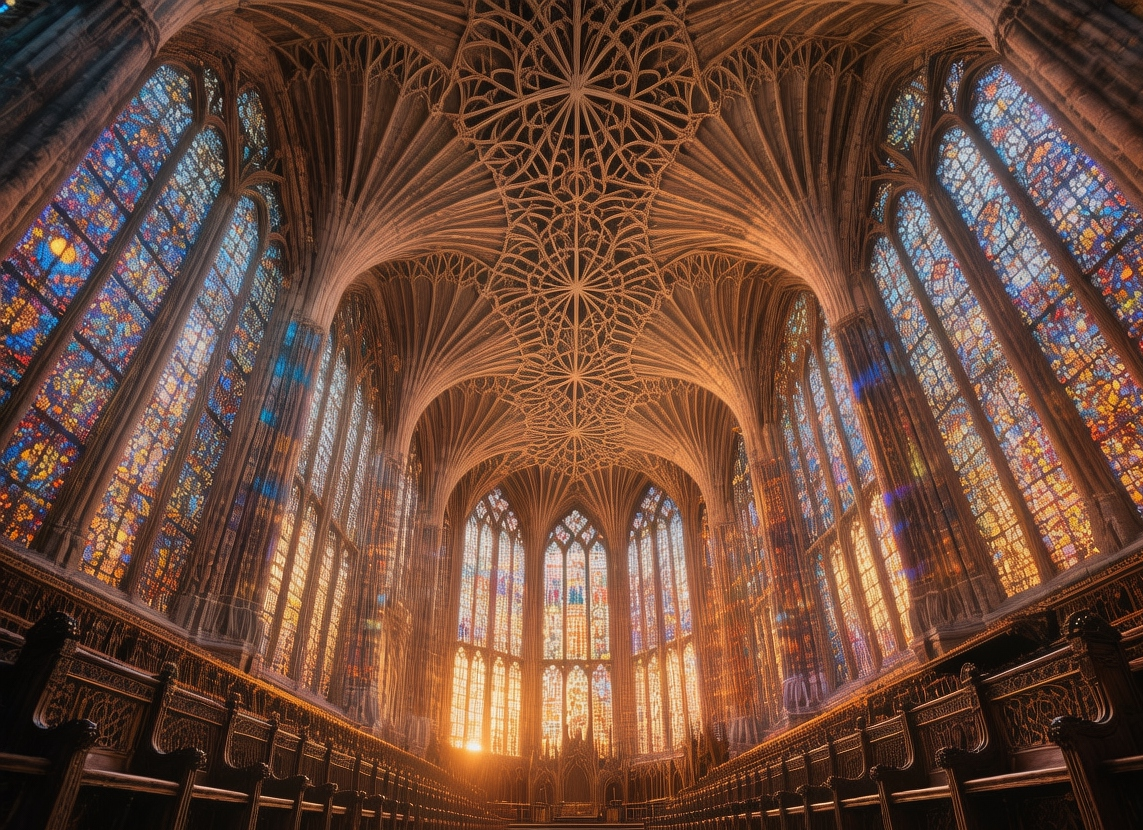
King's College Chapel: Where Stone Vault Meets Scholar's Square
I stand in the Great Gate at 9:45 on a crisp Tuesday in late November. The air smells of damp stone and fallen beech leaves. Admission costs twelve pounds for an adult. Sun slants low through the west window, laying long coloured patterns across the floor. The chapel stands taller than every surrounding roofline—pure, pale, symmetrical. It feels like something drawn rather than built. You step inside and the world outside falls away.
Why King's College Chapel Matters
Henry VI laid the foundation stone in 1446, and work finished 66 years later under Henry VIII. The fan-vaulted ceiling spans 28 metres at its highest point—the widest unsupported stone vault in the world. Every curved surface was cut and fitted by hand, with no central pillar holding it up. Twenty-four immense stained glass windows line the walls, installed between 1515 and 1531. The building also holds a rare survival: the original medieval choir stalls and organ screen carved from solid oak. That said, the experience changes with the crowd. In summer, groups move slowly single file along marked paths. You may feel herded rather than free to look. Information is minimal in places; without reading every panel you leave knowing little about the people who worshipped, sang, and studied here across centuries.
The Best Time to Experience King's College Chapel
January through March stay quiet but days are short; opening hours shift and sections close for rehearsals. Late April through June brings longer light but also exam season—access becomes restricted and prices rise. July and August see longest opening hours but also the heaviest crowds; queues form before doors open. September offers the sweetest balance—11°C (52°F) to 19°C (66°F), fresh light through clear glass, and student return means fewer tourists. October and November feel atmospheric—mellow golden light, thin crowds, and the famous Advent and Christmas concerts approaching. December books solid months ahead. Arrive exactly at opening time or in the final hour before closing to see the space with room to breathe.
Approximate Budget for a 7-Day Trip
These figures cover one person based in or near Cambridge:
- Accommodation: £420 – £630 for a clean central room. Stay outside the ring road to cut rates by roughly one third.
- Food & Drink: £195 – £280. College cafés and market stalls offer fair value; King’s Parade spots charge premium prices.
- Local Transport: £25 – £45. The city centre is compact; walking or cycling works best.
- Attractions & Entry Fees: £45 – £75. Chapel plus other colleges and museums.
- Miscellaneous: £40 – £80 for gifts, books, and incidental expenses.
Total estimated budget: £725 – £1,110
The on-site gift shop charges high prices for chapel-themed items. Skip the £16 illustrated guidebook there. Buy the same title from the market square bookshop for £9 instead.
Essential King's College Chapel Experiences
- Stand beneath the centre of the vault. Look straight up. The stone curves overhead like a canopy. No pillar supports it. Skip this if you dislike heights or enclosed spaces; the scale can feel overwhelming.
- Walk the length of the nave toward the altar. Light shifts as you move—deep blue, crimson, gold—each window casting a different tone. The floor slopes gently upward; you notice the incline only on the return walk.
- Examine the choir stalls and screen. Carved oak figures and patterns cover every surface. The screen was built to keep the public from the choir; it still divides the space visually and acoustically.
- Listen to the choir rehearse. Evensong is open to all and free of charge. The sound fills the vault in a way recorded music never does. Arrive early—seats fill fast. Not on during university holidays.
- Step out to the river terrace. The chapel rises above lawns and willows with the Cam curving below. This is the view seen on cards and calendars, but it feels different in person—solid, graceful, perfectly placed.
- Notice the stone itself. Pale limestone from Northamptonshire shows faint grey and brown streaks. Some blocks bear masons’ marks—small carvings left by the people who laid them. Look closely and you see individual hands at work.
Hidden Gems Most Travelers Miss
- The side chapels along the north and south aisles hold quiet corners and small altars. Most visitors walk straight past without turning in. Each feels like a miniature room within the vast building.
- Backs Lane runs along the river opposite the college grounds. You see the east end and tall windows without paying entry. Best viewed in late afternoon when light hits the glass.
- The nearby chapel of St Edward King and Martyr sits hidden behind the market square. It is older than King’s, smaller, and entirely free. Few tourists find it.
- The King’s College entrance on Trumpington Street draws crowds and feels overrated for photos. Walk ten yards along the river path instead; the same facade appears framed by trees and empty of people.
Cultural & Practical Tips
- Do not touch any surface—wood, stone, glass. Even light contact damages ancient carvings and stained glass.
- Keep voices low. Sound carries intensely in this space; a whisper echoes across the nave.
- Check the website before travelling. Closures happen without notice for exams, rehearsals, or events.
- Photography rules change frequently. Some periods allow non-flash photos; others ban cameras entirely. Read signs at the entrance.
- Respect service times. If a choir practice or prayer is taking place, stand quietly at the back or return later.
- Wear soft-soled shoes. Stone floors are uneven and slippery when polished; heels click loudly and disturb others.
Essential Visitor Information
Location & Access: King’s College, King’s Parade, Cambridge CB2 1ST. 80 minutes by train from London King’s Cross; 20 minutes’ walk from Cambridge station; park at Grand Arcade or Grafton multi-storeys; no on-site visitor parking.
Tickets & Booking: Adults £12; concessions available; under 12s free. Booking recommended in July and August. Evensong entry is free but ticketed; reserve seats online in advance.
Operating Hours: Generally 10:00 to 17:00, but reduced during university terms—check daily updates. Closed to visitors during services and events.
Visit Duration: Allow a minimum of one hour. Two hours lets you study windows, carvings, and the river terrace without rushing.
Family Suitability: Children welcome. Pushchairs work on main routes; narrow side chapels may be tight. Restrooms near the porter’s lodge.
Timing: Arrive at opening or within the final hour. Midday in summer is busiest and brightest.
Highlights: Central vault, west window, choir stalls and screen, east end altar, and river terrace view.
Nearby & Day Trip: Trinity College and Wren Library are five minutes away. Fitzwilliam Museum is 15 minutes’ walk. Audley End House is 25 minutes by train. London is 80 minutes south.
Conclusion: Travel with Attention, Not Just Admiration
King’s College Chapel was built over lifetimes. It was not finished in a year or a reign. It carries the marks of every generation that tended it—scratches, repairs, changes. That is not imperfection. That is endurance. Look up slowly. Notice how light moves across the floor. Listen for the quiet between sounds. What small detail will you remember—the curve of a stone, the colour of light, or the echo of a voice?
Comments
Post a Comment