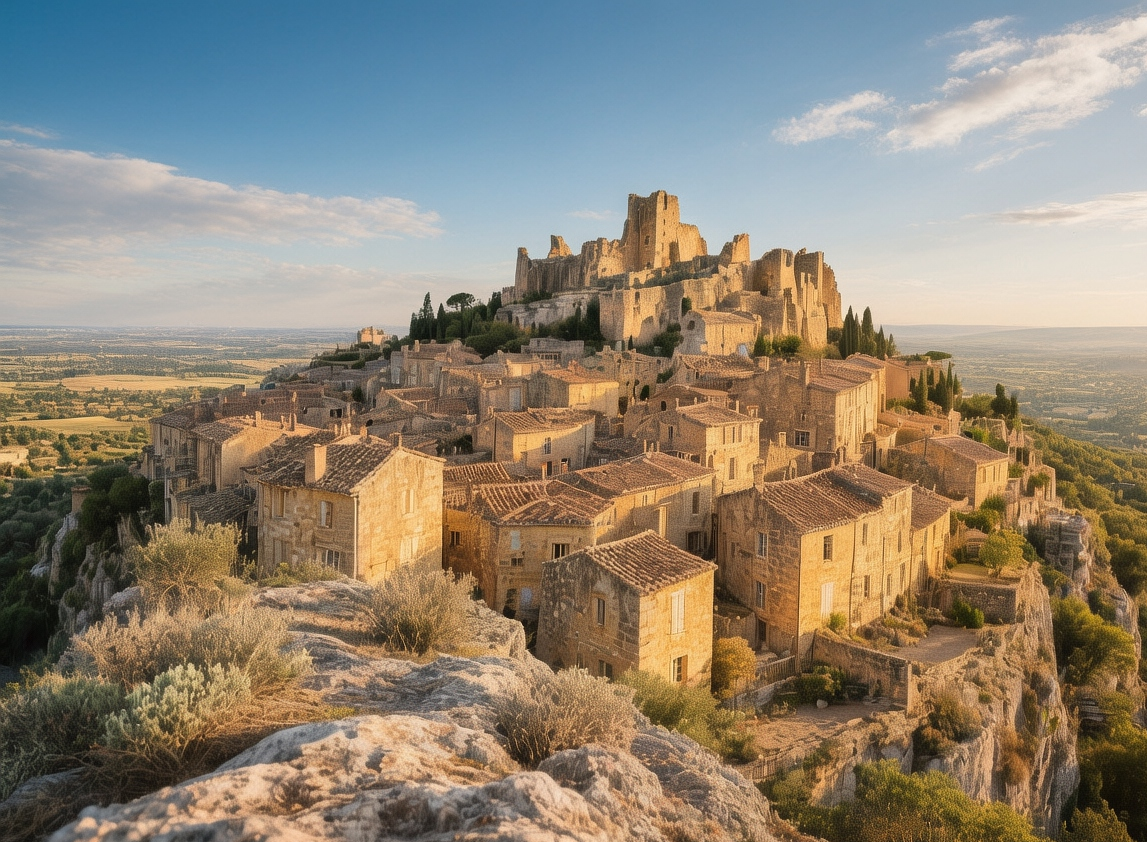
Les Baux-de-Provence: Where Medieval Stonework Meets Alpilles Landscape
I walk through the main gate just after nine in the morning. A coffee costs three euros fifty at the first terrace. The sun hits the limestone plateau and warms the air fast even in late May. I pass a stone house with olive branches leaning against its wall. An older woman opens heavy wooden shutters and nods. The lane climbs steadily. Every few steps a new view unfolds — across dry stone terraces, olive groves, and distant peaks. The wind carries thyme and rosemary from the hillsides. I pause near the old church doorway. The stone feels worn smooth by centuries of hands and feet. It is quiet now. By eleven, the tone will shift completely.
Why Les Baux-de-Provence Matters
People have lived on this rocky spur since Neolithic times. The village rose to power in the Middle Ages under the Lords of Baux, who held sway across Provence and beyond. Their fortress stood strong until Cardinal Richelieu ordered its dismantling in 1632 to end local rebellion. The mineral bauxite, the source of aluminium, was discovered here in 1821 and takes its name from the place. Today it stands among the officially listed Most Beautiful Villages of France, drawing visitors from every continent. That attention brings real strain. Parking costs five euros per hour year-round and fills before mid-morning in summer. Prices in the village shops and restaurants run noticeably higher than in nearby Saint-Rémy or Arles. The charm remains genuine, but you pay a premium to experience it here.
The Best Time to Experience Les Baux-de-Provence
Late April through June and mid-September through mid-October work best. Daytime temperatures sit 19°C to 25°C (66°F to 77°F). Nights cool to 11°C to 14°C (52°F to 57°F). July and August see highs 28°C to 32°C (82°F to 90°F). Stone reflects heat and there is little shade on the plateau. The Mistral wind can blow hard and dry for days at a time, pushing dust and sharpening the sun. Winter from November through March stays mild at 10°C to 15°C (50°F to 59°F), but some restaurants and smaller galleries close for weeks. Arrive before 9 AM in summer. You will walk empty lanes and catch soft light on the facades. After 10:30 AM, tour buses arrive and the pace changes.
Approximate Budget for a 7-Day Trip
These figures are per person, based on sharing a room and exploring the surrounding region.
- Accommodation: €90–€140 per night inside Les Baux; stay in Saint-Rémy-de-Provence or Maussane-les-Alpilles and pay €65–€100. Savings add up fast over a week.
- Food: Lunch €16–€24 inside Les Baux; €12–€18 in nearby villages. Dinner €32–€50 here. Buy bread, cheese, olives, and fruit from the market in Saint-Rémy and picnic at a viewpoint.
- Transport: Car rental €35–€50 daily; limited local bus from Arles or Avignon €3.50 one way; parking at Les Baux €5 per hour or €18 per full day.
- Attractions: Château des Baux €10 adult; Carrières des Lumières €16.50; combined ticket €16.50. Nearby Abbaye de Montmajour and Glanum archaeological site €7–€8 each.
- Miscellaneous: €18–€30 daily for drinks, supplies, and small stops.
Total estimated 7-day cost: €720–€1,050 per person. The full-day parking rate at €18 is overpriced when you can park in Saint-Rémy for free or much less and take the bus up. It saves money and the stress of finding a space.
Essential Les Baux-de-Provence Experiences
- Explore Château des Baux ruins. Walk the outer walls and climb the keep. The view stretches across olive groves and the Alpilles range. On clear days you see toward the Camargue and the Mediterranean. Skip if you have vertigo — the drop is steep and unguarded in places.
- Visit Carrières des Lumières. An old stone quarry turned immersive art space. Light and sound fill the cavern walls. It stays cooler than outside in summer. Allow forty-five minutes.
- Wander the full village loop. Follow the lanes from gate to plateau edge. Notice the old stone doorways, vaulted passages, and small squares. It takes about an hour without rushing.
- Step into Église Saint-Vincent. Built across the twelfth to fourteenth centuries, it sits halfway up the main lane. The interior stays quiet and dim. Few visitors pause inside.
- Walk down to the lower village. Quieter streets with older homes and fewer shops. The pace slows noticeably. Look for the old washbasin near the stream.
- Watch sunset from the eastern edge. Find a spot away from the main viewpoint. The limestone turns deep gold and shadows stretch long across the valley below.
Hidden Gems Most Travelers Miss
- Place de l'Église rear terrace. A small open space behind the church. It has benches and shade trees. Almost no one stops here even in peak season.
- Chemin de la Baronne. A footpath running below the main plateau edge. It offers the same wide views without the crowds. You approach from the lower village.
- Les Carrières des Lumières is famous; it is overrated if you prefer quiet history over spectacle. The quarry itself is impressive, but the show draws large groups and feels rushed.
- Jardin des Vestiges. A small garden with old foundations and stone fragments tucked between buildings. Marked but easily passed by. It holds wild herbs and old stonework in quiet combination.
Cultural & Practical Tips
- Wear sturdy walking shoes. Stone lanes are uneven, worn smooth, and slippery when damp. Heels or smooth soles are unsafe.
- Do not photograph private courtyards or doorways without asking. People still live here, not just work here.
- Carry at least one litre of water. There are few fountains once you pass the lower gate. Heat builds fast on the plateau.
- Do not trust every “best view” sign. Some lead to restaurant terraces where you are expected to buy a drink to stay. Good free views exist — keep walking.
- Book Carrières des Lumières online ahead in July and August. Walk-ups often wait over an hour or find sessions fully sold.
- Learn a few basic French words. A bonjour when you enter goes far with locals who deal with crowds all day.
- Leave before late afternoon if you can. The road down narrows in places and traffic jams form at closing time.
Essential Visitor Information
Location & Access: Les Baux-de-Provence, 13520 France. GPS roughly 43.74° N, 4.79° E. 20 km northeast of Arles, 30 km south of Avignon, 65 km north of Marseille. Reach it by car — best option, with paid parking at the village base; by bus from Arles (35 min) or Saint-Rémy-de-Provence (20 min) — service limited on Sundays; or by taxi from nearby towns — €25–€35 one way.
Tickets & Booking: Village access free. Château des Baux €10 adult, €7 ages 7–17, under 7 free. Carrières des Lumières €16.50 adult. Combined ticket €16.50. Booking recommended for Carrières in summer.
Operating Hours: Village open all day every day. Château: 9 AM–6 PM daily, extended to 7 PM July–August. Carrières: 9 AM–7:30 PM summer, 10 AM–6 PM winter. Closed 25 December and 1 January.
Visit Duration: Minimum half a day. A full day lets you explore the plateau, village, and nearby paths without rushing.
Family Suitability: Very family-friendly overall. Strollers work on main lanes but struggle on narrow stepped side paths. No dedicated play areas, but open spaces exist near the castle and lower village.
Timing: Best months May, June, September, early October. Best time of day: before 9:30 AM or after 4:30 PM.
Highlights: Château des Baux ruins and keep, Carrières des Lumières, Église Saint-Vincent, village lanes, plateau edge viewpoints.
Nearby & Day Trip: Saint-Rémy-de-Provence 7 km away with markets and Roman remains. Abbaye de Montmajour 12 km — striking medieval abbey on a rocky hill. Glanum Roman site 10 km. Arles 20 km with amphitheatre and Van Gogh connections. All make comfortable half-day or full-day outings.
Conclusion: Travel with Presence, Not Just a List
Les Baux-de-Provence rewards those who slow down. You do not need to see every single spot to know the place. Walk the same lane twice. Notice how light changes the stone colour between morning and afternoon. Sit on a quiet bench and breathe in the wild herbs on the wind. The real value lies not in ticking landmarks, but in feeling the weight of history mixed with living daily life. What season will you choose to visit?
Comments
Post a Comment