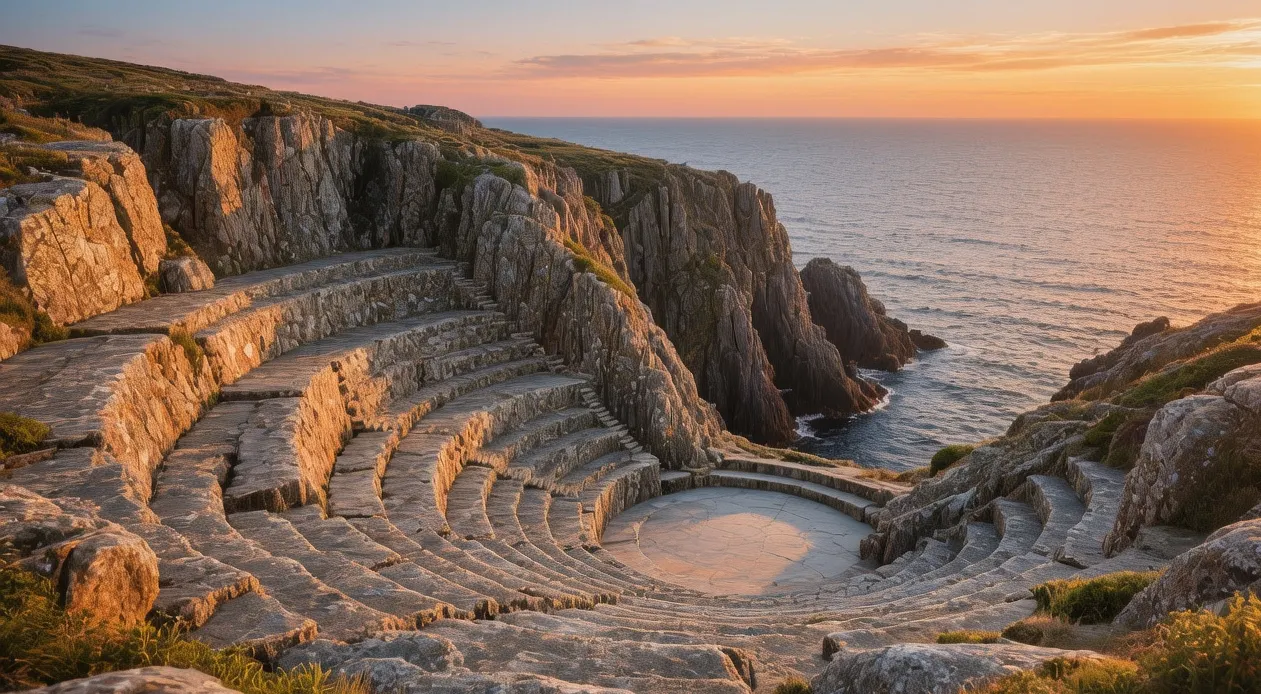
Minack Theatre: Where Carved Granite Meets Atlantic Stage
I sit in a rough-hewn granite seat at ten past nine on a clear Thursday morning in early June. The sun climbs bright over the horizon, turning the blue Atlantic deep and vivid. Below, the stage slopes open to the waves — no roof, no curtain, just rock, sky, and ocean stretching endless beyond. Seats curve in sweeping arcs up the cliff face, every one chiselled from the headland itself. A few early visitors run fingers along weathered stone. No crowds fill the rows yet. It feels impossible — carved by hand into solid rock, built not to dominate the view but to belong within it.
Why Minack Theatre Matters
Rowena Cade discovered this granite headland in the 1920s and imagined something no one else saw — an open-air theatre hewn directly from the cliff. With her family and a small team, she began blasting and carving in 1931, working through winter storms and wartime shortages. The granite tiers, stage, and dressing rooms took decades to complete, shaped entirely by hand. Today it stands as one of the world’s most remarkable performance spaces — plays, concerts, and operas unfold with real waves as backdrop. That beauty brings real strain. Salt air eats at stone and timber; storms damage the lower tier regularly; and fragile cliffside ecosystems suffer under heavy footfall. Every penny from tickets goes straight to upkeep — this place survives because people love it enough to care.
The Best Time to Experience Minack Theatre
Late April through May brings softer light and thinner crowds, temperatures between 9°C and 16°C (48°F to 61°F). Days lengthen fast and the ocean stays calm and blue. June and July offer the longest evenings — sky stays light until nearly 10 p.m. — and temperatures rise to 12°C and 19°C (54°F to 66°F). This is peak season; matinee and evening performances sell out months ahead. August stays mild at 13°C to 20°C (55°F to 68°F), but fog rolls in suddenly — it can obscure the horizon completely then lift within minutes. September holds steady at 12°C to 18°C (54°F to 64°F), crowds thin noticeably, and golden sunlight turns granite warm amber. This is widely considered the best month to visit. October cools to 9°C and 14°C (48°F to 57°F), evenings grow crisp, and autumn storms bring dramatic swell. November through February the site quiets — daytime visits only — temperatures sit 6°C to 10°C (43°F to 50°F) — and you may sit almost alone gazing out to sea. Arrive before 10 a.m. any time of year; after that, tour groups fill the rows and the quiet vanishes.
Approximate Budget for a 7-Day Trip
These figures assume a base in west Cornwall, exploring Minack, Land’s End, and coastal villages.
- Accommodation: £95–£170 nightly. Guesthouse or cottage within 20 minutes drive. £665–£1,190 for 7 nights.
- Food & Drink: £24–£42 daily — breakfasts, village lunches, pre-show dinners. £360–£630 total.
- Transport: Car recommended — narrow lanes, limited buses. £45–£70 daily. £50–£140 total.
- Attractions: Day visit £9 adult. Evening performance £25–£42. Nearby sites vary. £45–£95 total.
- Miscellaneous: £12–£22 daily — gifts, drinks, warm layers. £84–£154 total.
Total estimated 7-day cost: £1,204 to £2,209
The theatre cafe charges premium prices — expected given the remote cliffside location. Pack a picnic and sit on the upper terrace; the view costs nothing extra.
Essential Minack Theatre Experiences
- Walk the tiers before crowds arrive — Sit in different rows, feel the granite beneath you. The perspective shifts subtly with every level — ocean, stage, horizon aligning in new ways. Skip this if a performance is being set up; some areas close to visitors.
- Watch a sunset evening show — The sun dips below the ocean edge as the performance begins. Lights rise, waves glow pink, and the boundary between stage and sea dissolves. Book months ahead — popular dates vanish fast.
- Explore the subtropical gardens — Tucked between the tiers and the cliff edge, exotic plants cling to sheltered slopes. They thrive here in mild salt-kissed air. Most visitors hurry past — slow down and notice the blooms.
- Stand on the stage when open — Look back up at the carved granite rows curving toward the sky. You see what the cast sees — stone, audience, and ocean as one. It feels humbling and magnificent.
- Walk the coastal path east — A cliffside trail leads above and beyond the theatre. Minack reappears again and again through gorse and heather — a granite wonder half-hidden in the headland. It stays quiet and wild.
- Return at low tide — Rocks and coves below reveal themselves. The theatre rises from exposed reef like a castle built by the sea. Check tide times; the view changes completely between high and low water.
Hidden Gems Most Travelers Miss
- Upper terrace quiet seats — Above the main entrance, simple stone benches look down over the whole site. Almost no one sits here. You can watch light change across the granite without being part of the crowd.
- Coastal path west viewpoint — A short walk toward Land’s End brings you level with the stage. Minack frames perfectly against open ocean. This spot is widely shared online now and has become overrated. Go before 9.30 a.m. if you want it empty.
- Lower garden corner — Beneath the bottom row, a small sheltered nook holds ferns and wild flowers. It feels private and lush. Very few visitors find their way down.
- Quarry remnant path — Beside the access road, a short trail runs past old workings where stone was originally cut. You see the raw granite that built everything — rough, unpolished, powerful.
Cultural & Practical Tips
- Book everything early. Day visits and performances sell out weeks ahead in summer. Arriving without a ticket almost always means disappointment.
- Bring warm layers even on hot days. The Atlantic breeze cools fast once the sun dips. Shawl, jacket, and blanket are standard evening kit.
- Respect the granite. No leaning on low walls, no climbing on unmarked rock. The cliff drops away sharply and stone crumbles in places.
- Stay on designated paths. Rare plants cling to these slopes — stepping off destroys years of growth in seconds. Stick to the waymarked routes.
- Arrive early for evening shows. Parking is limited and queues move slow. Give yourself 45 minutes minimum to walk in, find your seat, and settle.
- Do not expect silence. Real waves crash, real birds call, real wind blows. Aircraft and boats pass close by — these are not interruptions, they are part of the performance.
Essential Visitor Information
Location & Access: Minack Theatre, Porthcurno TR19 6JU — West Cornwall. Three transport options: train to Penzance then bus/taxi — 30 minutes; car via A30 then coastal lane; bus from Penzance — limited service.
Tickets & Booking: Day visit £9 adult. Evening performance £25–£42. Book online in advance — essential May–September.
Operating Hours: Generally 9.30 a.m.–5 p.m. daytime; evening performances separate slots. Closed some winter days.
Visit Duration: Minimum 1.5 hours daytime. 3–4 hours including evening show and pre-show walk.
Family Suitability: Uneven stone steps — keep children close. Unrailed cliff edges in gardens. Public toilets at visitor centre.
Timing: Best season September — warm seas, thinner crowds, golden evening light. Early morning before 10 a.m. offers quietest site and clearest views.
Highlights: Morning light on granite, sunset performance, low tide coastal view, upper terrace perspective, garden nook discovery.
Nearby & Day Trip: Porthcurno Beach — 5 minutes; Land’s End — 15 minutes; St Ives — 45 minutes; St Michael’s Mount — 50 minutes; Tintagel — 1 hour 15 minutes.
Conclusion: Travel with Creation, Not Just Camera
Rowena Cade and her helpers did not just build a theatre — they worked with the land, carving gently rather than conquering. Stone, sea, and sky remain the real stars here. When you visit, sit quiet. Let the ocean speak. What will you create that belongs as beautifully to its place?
Comments
Post a Comment