
Orgosolo Murals Political Paint Meets Barbagia Stone
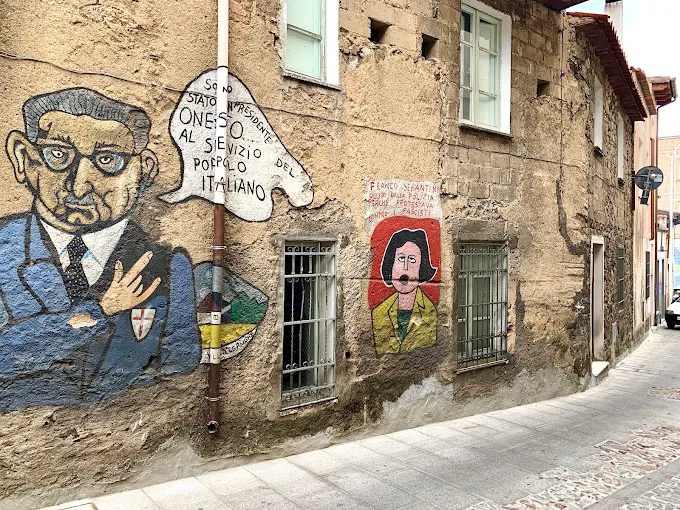
Dawn in the Barbagia highlands arrives with a crispness that carries the scent of wild myrtle and woodsmoke—your footsteps echo on cobblestones still damp from mountain dew as you round Via Belvì. Before you, a three-story mural erupts across weathered limestone: a Sardinian shepherd stands defiant against riot police, his traditional sa berritta hat casting a shadow over the date "1969," while above him, doves morph into ballot boxes. The paint—acrylics mixed with local pigments—has seeped into the very pores of the 18th-century casa campidanese walls, creating a palimpsest where ancient masonry meets urgent modern commentary. Since the first mural appeared in October 1969 by the Milanese anarchist collective Dioniso [[6]], over 250 artworks have transformed this village of 2,100 souls into Europe’s most potent open-air gallery of dissent. You run your fingers along a crack in the plaster beneath a depiction of the 1971 Pratobello Revolt [[8]]—feeling not just paint, but the grit of a community that refused silence when Italy’s central government marginalized its pastoral economy. In 2026, as global tourism grapples with authenticity versus commodification, Orgosolo matters precisely because its murals remain uncurated, uncensored, and unapologetically alive—a testament to art as civic dialogue rather than decorative backdrop.
Why Orgosolo Murals Embodies Defiant Dialogue
Orgosolo’s murals solve a profound cultural problem: how to preserve Sardinian identity while confronting systemic neglect. Born from the island’s complex history—first as a Nuragic stronghold, then a Byzantine outpost, later a feudal fiefdom resistant to Spanish and Piedmontese rule—the village developed a fierce autonomy that crystallized in visual form during Italy’s turbulent 1960s. When the anarchist group Dioniso painted their inaugural mural condemning police brutality during a 1969 demonstration [[6]], they ignited a movement that transformed blank walls into communal newspapers. By 1973, local artists like Francesco Del Casino institutionalized the practice through the Circolo Giovanile Dioniso, establishing protocols: murals must address social justice, anti-fascism, or Sardinian sovereignty; use weather-resistant acrylics; and cover no more than 70% of any building facade to respect architectural integrity. The technical execution is precise—artists sketch grids using chalk lines snapped at 1.2-meter intervals, then apply paint in layers calibrated for Sardinia’s intense UV index (up to 9 in summer). Subjects range from hyperlocal (the 1971 Pratobello land rights protest [[8]]) to global (Nelson Mandela’s release, Palestinian solidarity), yet all share a visual grammar: bold outlines, symbolic color palettes (red for blood/struggle, green for pastoral hope), and text in both Italian and Sardinian logudorese dialect. Unlike commissioned street art elsewhere, Orgosolo’s murals require no permits—only community consensus—making them a rare democratic art form where every resident is curator, critic, and potential collaborator.
The Best Time to Experience Orgosolo Murals
For optimal mural viewing and comfortable exploration, visit between May 25–June 20 or September 10–October 5, 2026—when daytime temperatures average 20–25°C (68–77°F) with low humidity and minimal rainfall [[12]]. Begin your mural tour at 8:30 AM when the angled morning light reveals intricate details in paintings like the 1982 "Women of Orgosolo" mural on Via Cagliari, and conclude by 11:00 AM before crowds arrive via day-trip buses from Nuoro. Avoid July 15–August 25 when temperatures exceed 32°C (90°F) [[13]], causing paint surfaces to become uncomfortably hot to touch and forcing locals indoors during peak afternoon hours—diminishing chances for authentic conversations about mural meanings. Winter visits (November–February) offer solitude but present challenges: shorter daylight hours (sunset at 17:15), frequent rain that obscures pigment vibrancy [[11]], and many agriturismo accommodations closing seasonally. For current event schedules—including the annual Mural Festival in late May—and any road closures affecting access, verify with the Comune di Orgosolo’s official portal at comune.orgosolo.nu.it two weeks before travel, as mountain weather can trigger last-minute changes.
Approximate Budget for a 7-Day Trip (2026)
This budget reflects mid-range cultural travel based in Orgosolo with day trips to Nuoro and Gennargentu National Park, using 2026 projected pricing with 3.8% inflation adjustment from 2024 baseline figures per ISTAT regional data. All costs in euros (€).
- Accommodation: €75–€110 per night for agriturismo or B&B in Orgosolo village center (e.g., Sa Zia Mele or B&B Su Nodu); options include traditional stone rooms with mountain views and homemade breakfast featuring pecorino cheese
- Food: €38 per day average—breakfast €7 (fresh ricotta and pane carasau at guesthouse), lunch €12 (panino with roast suckling pig at Bar Centrale), dinner €19 (primo of culurgiones pasta with mint, secondo of lamb stew at family-run trattoria)
- Transportation: €210 total—Cagliari Elmas Airport to Orgosolo via ARST bus line 502 (€12.50, 3h 20m); daily car rental from Orgosolo €50 including fuel for mountain excursions; parking free in village outskirts
- Attractions: Museo della Vita e delle Tradizioni Popolari €6; guided mural walking tour €25; Gennargentu National Park entry €5
- Miscellaneous: €55—handwoven textile souvenir €30, Sardinian wine tasting €15, donation to mural preservation fund €10
Total estimated cost: €920–€1,100 for seven days
6 Essential Orgosolo Mural Experiences
- Trace the Genesis Mural at Dawn: Stand before the reconstructed 1969 Dioniso mural on Via Roma at 8:00 AM—its depiction of a Sardinian shepherd facing Carabinieri remains the ideological cornerstone. Note how the original was destroyed by authorities but repainted in 1973 with added doves symbolizing peace; the cracked plaster beneath tells its own story of resilience.
- Decode the Pratobello Revolt Narrative: Locate the 12-meter-wide mural on Via Belvì commemorating the 1971 protest where villagers blocked military occupation of communal pastures. Arrive by 10:00 AM to photograph the interplay of light on the crowd scene; the artist embedded actual wool fibers from local sheep into the paint for texture.
- Attend a Live Mural Restoration: Visit the Circolo Giovanile Dioniso workshop (open Tuesday/Thursday 15:00–18:00) to observe artists mixing pigments with casein binder—a technique preserving vibrancy against Sardinia’s harsh sun. Ask about the 2026 restoration project for the 1985 "Women’s Strike" mural on Piazza del Popolo.
- Walk the Anti-Fascist Corridor: Stroll Via Cagliari between 9:30–11:00 to view the densest concentration of political murals, including the 1992 "Never Again" series depicting Mussolini’s fall. Bring binoculars to examine the tiny resistance symbols hidden in window frames—a tradition dating to WWII.
- Taste History at Bar Centrale: Order a caffè corretto (espresso with mirto liqueur) at this mural-covered café where artists have debated compositions since 1975. The owner keeps a ledger of every mural’s creation date and artist—request to see it after your third coffee.
- Hike to the Mountain Panorama Mural: Take the 45-minute trail from Piazza San Antonio to the overlook where a 2019 mural depicts Orgosolo nestled in the Supramonte mountains. Visit at sunset (19:45 in June) when the golden light makes the painted village below appear to merge with the real one.
3 Hidden Gems Most Travelers Miss
- Museo della Vita e delle Tradizioni Popolari’s Mural Archive: Beyond its ethnographic exhibits, this museum (Via Roma 22) houses unpublished sketches by Francesco Del Casino in a climate-controlled room. Access requires emailing museo@comune.orgosolo.nu.it 72 hours ahead; the curator offers 30-minute viewings at 11:00 on weekdays.
- Sa Oche e Su Para Shepherd Cooperative: Located 3 kilometers east of town, this working farm displays murals by local youth groups on barn walls—depicting transhumance routes and cheese-making techniques. Visit during milking hours (7:00–9:00 AM) for demonstrations; purchase pecorino directly from shepherds (€8/500g).
- Fonte de Sos Laranzos Spring Murals: Follow the marked trail 1.2 kilometers south of Piazza San Antonio to this natural spring where hikers’ rest area walls feature rotating student artworks. The current 2025 installation uses glow-in-the-dark paint visible only at night—bring a headlamp after 21:00 for the full effect.
Cultural & Practical Tips
- Never photograph murals with flash—it accelerates pigment fading on already sun-stressed surfaces; use natural light only between 8:00–11:00 or 16:00–18:00 for best results.
- Greet residents with "Sa die d’e sòccussu" (SAH dee-eh deh SOH-koo-soo)—Sardinian for "good health"—rather than standard Italian greetings; elders especially appreciate the linguistic recognition.
- Wear layered clothing even in summer—the village sits at 580 meters elevation, causing temperature drops of 8°C (14°F) between sun and shade.
- Ask permission before interviewing mural subjects or residents; many depictions reference real people who still live nearby and may share personal stories if approached respectfully.
- Carry cash in small denominations—most bars and souvenir stalls don’t accept cards, and ATMs are scarce (nearest in Desulo, 18 km away).
- Respect siesta hours (13:00–16:00) when village activity pauses; this is prime time for quiet mural contemplation without background noise.
- Support preservation by purchasing postcards from the Circolo Giovanile Dioniso—proceeds fund archival-quality paint for new commissions.
Conclusion: Travel with Discernment, Not Just Documentation
To witness Orgosolo’s murals is to stand at the intersection of art and activism—a place where every brushstroke answers centuries of marginalization with unflinching visibility. In 2026, as overtourism threatens to flatten complex narratives into Instagram backdrops, your presence here carries ethical weight: the €25 guided tour fee sustains the very artists maintaining these fragile histories, yet your gaze must move beyond surface aesthetics to engage with the uncomfortable truths they depict. Slow down to read the Sardinian inscriptions; linger where paint has blistered from mountain storms; understand that these walls are not canvases but chronicles. True appreciation means recognizing that Orgosolo’s power lies not in its photogenicity but in its refusal to be decorative—each mural a demand for dialogue, each crack in the plaster a reminder that justice is ongoing work. Leave your assumptions at the village edge; depart with questions, not just photographs. For in honoring the murals as living documents rather than static attractions, you become part of their continuing story—a witness to how art, rooted in place and principle, can indeed move mountains.