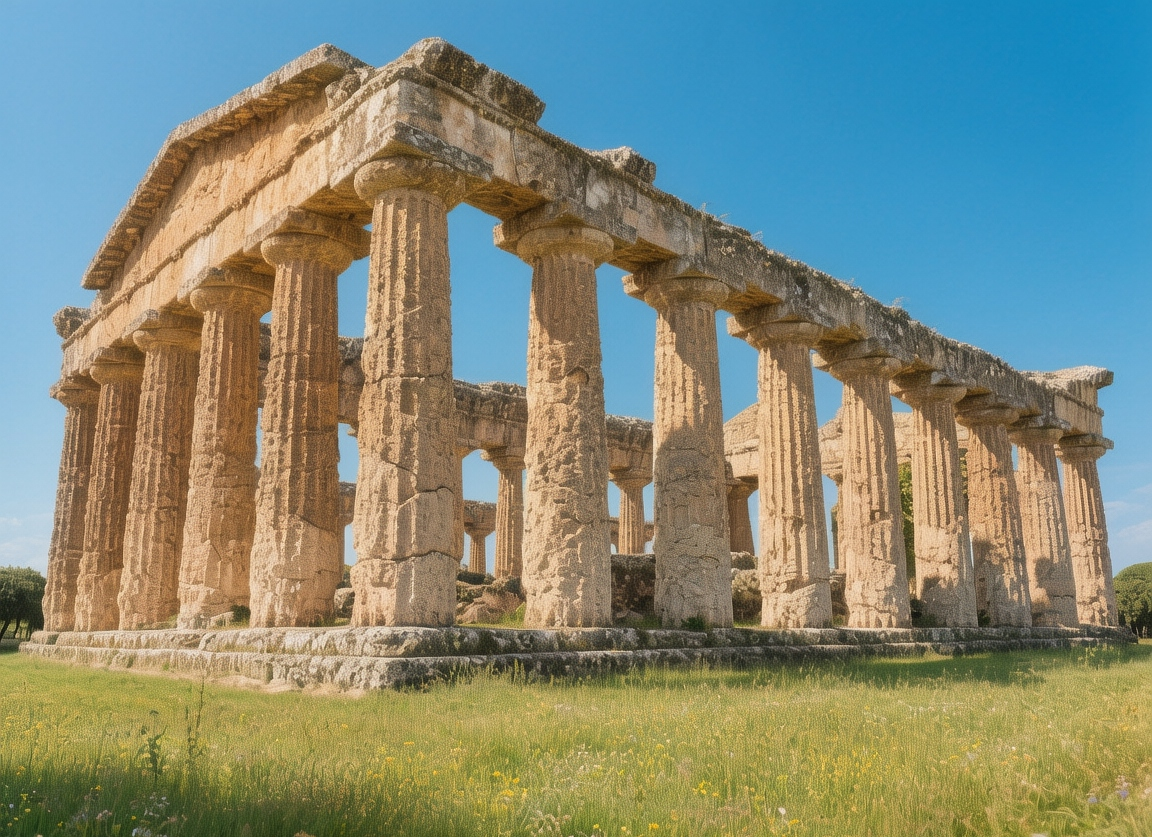
Paestum: Where Golden Columns Meet Quiet Plain
I stand between the second and third temples at 8:00 on a June morning. The limestone still holds the night’s cool. An espresso costs one euro thirty at the small bar just inside the northern gate. I look upward — three great Doric temples rise in a line across the grassy plain, their columns thick and graceful, almost entirely intact, standing where they have stood for twenty-five centuries. Paestum lies on the southern Campania coast, a place where Greek settlers built monuments that survived empires, earthquakes, and abandonment. People come for the best-preserved temples outside Greece. They find a quiet open space where the past feels present, vivid, and unhurried.
Why Paestum Matters
Founded as Poseidonia by Greek settlers in the 6th century BCE, the city passed to Samnites and then Romans before being abandoned during the early Middle Ages. Marshes spread, roads shifted, and the temples sank from memory — until rediscovery and excavation centuries later. Today three structures remain: the Temple of Hera, the Temple of Apollo, and the Temple of Athena — each distinct in proportion, each built without mortar, stone fitted to stone with extraordinary precision. They form one of the most complete ancient sanctuaries in the Mediterranean. That fame brings real pressure. The central path wears smooth under heavy footfall. Signage is uneven and some areas lack clear guidance. The site balances protection with public access — and that balance is delicate.
The Best Time to Experience Paestum
Late April through June brings fresh green grass, wildflowers, and thin crowds. Temperatures sit between 14°C and 25°C (57°F–77°F). Morning light hits the columns perfectly and shadows stretch long across the turf. July and August warm to 22°C and 33°C (72°F–91°F). The plain holds heat and there is almost no shade. September offers golden light and softer days — 18°C to 28°C (64°F–82°F). The air stays clear and the pace slows. October remains mild — 15°C to 24°C (59°F–75°F) — but rain becomes more frequent. Winter holds quiet, misty mornings: 9°C to 16°C (48°F–61°F). You may share the site with only a handful of others. Arrive before 9:00 AM any time of year — the light is kind and the atmosphere peaceful.
Approximate Budget for a 7-Day Trip
Prices below are per person, in euros, based on staying in Paestum or nearby Agropoli.
- Accommodation: 7 nights in a guesthouse or farm stay — €60–130 per night. Total: €420–910. Staying in a hill village 15 minutes inland costs 30–40% less; driving to the site takes a little longer.
- Food & Drink: Breakfast, two meals daily — €28–50 daily. Total: €196–350. Restaurants directly facing the main entrance charge premium prices; walk one lane back for home-made pasta, grilled vegetables, and local buffalo mozzarella at fair rates.
- Transport & Tickets: Combined archaeological zone and museum entry €10–15; train from Naples or Salerno — €8–15 return; local bus — €1.50 per ride. Parking near the site is limited — use train or bus where possible.
- Activities: Cilento Coast day trip, buffalo farm visit, coastal walk — €25–55.
- Miscellaneous: Water, hat, sturdy shoes — €15–25.
Total estimated 7-day cost: €671–1,455
Private guided tours marketed as "exclusive early access" are overpriced. Every temple, wall, and museum gallery is fully visible with standard entry. Wandering slowly at your own pace shows you far more than keeping up with a group.
Essential Paestum Experiences
- Temple of Hera Morning Visit — Stand before the largest and oldest structure. Nine broad columns run along each side, the entablature still intact, the whole building solid and enduring. It feels as close to complete as any ancient temple can be. Skip if you arrive late; after 10:30 AM crowds fill the open space and quiet vanishes.
- Temple of Athena Perspective — Walk around the northern building. Shorter, stouter columns and simpler proportions show a different architectural era. It sits slightly apart, watching over the plain — graceful, balanced, and distinct.
- Ancient City Walls Walk — Follow the original ramparts that once enclosed the whole settlement. Grass-grown and quiet, they trace the full outline of the city. You see how the temples sat within a living, working place — not isolated monuments.
- Museum Fresco & Artefact View — Step into the on-site gallery. Frescoes, painted vases, and carved stelae show the faces, beliefs, and daily lives of the people who lived here. They turn columns into a community — vivid, human, and long gone.
- Buffalo Mozzarella Meal — Eat at a family-run farm nearby. Fresh, soft, creamy cheese made from the milk of buffalo grazing these same fields. It tastes rich and mild — nothing like what you find elsewhere.
- Sunset Among Columns — Return late in the day. The stone turns deep amber and long shadows stretch across the grass. Most visitors have left. The site feels calm, ancient, and entirely yours.
Hidden Gems Most Travelers Miss
- The southern stretch of the city walls runs through open meadow with almost no visitors. Wide views across the plain and distant hills unfold. It feels like a secret walk — no ticket extra needed.
- The small roadside viewpoint just west of the main gate looks back across all three temples in one line. Very few cars stop there. Early morning light hits the full group perfectly.
- The quiet path between the middle temple and the city wall leads past scattered foundation stones and old olive trees. It is not marked on most maps. Sit there for a moment and the silence returns.
- The "Paestum VIP Guided Tour & Reserved Entry" is overpriced. Every column and wall is open to standard ticket holders. Arrive early, walk slowly, and stay late — that is the true secret to experiencing it well.
Cultural & Practical Tips
- Wear sturdy closed shoes. Ancient stone is uneven, worn smooth in places, and loose fragments lie scattered. Sandals are unsafe and damage the site surface.
- Carry twice as much water as you think you need. There are very few fountains or shaded areas across the site. Dehydration comes faster than you expect.
- Do not climb on walls or touch columns. Every handprint and footprint slowly wears the stone away. Stay on marked paths — they exist to protect what you came to see.
- Check opening times individually. The museum may close earlier than the outdoor area. Plan your visit accordingly — museum first or last.
- Take the train. The station sits steps from the main gate. Driving means searching for scarce parking and navigating narrow lanes. Public transport is straightforward and convenient.
- Book tickets 1–2 days ahead in July and August. Morning slots sell out fastest. Same-day entry may involve long queues.
- Book accommodation 2–3 months ahead in July and August. Paestum grows popular and rooms sell out fast.
Essential Visitor Information
Location & Access: Paestum, Capaccio, Province of Salerno, Campania, Italy. Coordinates roughly 40.42° N, 14.99° E. Three ways to arrive: train from Naples — 1 hour; train from Salerno — 45 mins; drive from Salerno — 1 hour 15 mins.
Tickets & Booking: Full archaeological zone + museum — €10–15. No booking needed for individuals; reserve accommodation ahead.
Operating Hours: Outdoor site roughly 9:00 AM to 7:00 PM in summer; shorter hours off-season. Museum closes 1 hour earlier. Some areas close one day weekly — typically Monday.
Visit Duration: Minimum 2 hours. Recommended half day to explore all three temples, city walls, and museum without rushing.
Family Suitability: Good for older children. Wide open spaces and grassy areas suit running and playing. Uneven stone makes strollers difficult — carriers are better.
Timing: Best seasons are late April to June and September. Best time of day is before 9:00 AM or late afternoon.
Highlights: Temple of Hera at dawn, Temple of Athena proportions, southern wall walk, museum frescoes, farm mozzarella, sunset columns.
Nearby & Day Trip: Cilento Coast — 20 mins drive. Agropoli — 15 mins. Salerno — 45 mins. Naples — 1 hour 30 mins.
Conclusion: Travel with Silence, Not Just Cameras
Paestum gives you columns that stood while empires rose and fell. You can photograph every face and leave. Or you can arrive early, walk slowly, speak softly, and remember — these stones have watched twenty-five centuries pass. Honouring that stillness is the finest gift you can give. What is the one ancient place you would visit promising to keep it quiet and intact?
Comments
Post a Comment