Château de Pierrefonds: Where Medieval Ruins Meet an Architect's Bold Reimagination
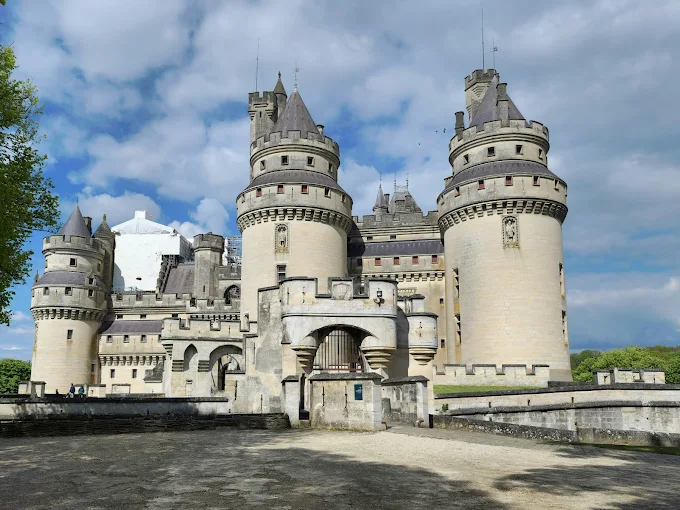
It is 10:15 a.m. on a gray Wednesday morning in October. I hand 9 euros to the cashier at Château de Pierrefonds and receive a small paper ticket. A cold breeze cuts through the open courtyard as I step through the main gate. The dry moat below the walls surprises me. Every photograph online shows water. A school group of about thirty children streams past me, their voices bouncing off the stone. Above me, carved gargoyles lean over the parapets. Their stone faces look too sharp, too clean for anything from the Middle Ages. That is because the castle I am looking at is not truly medieval. It was rebuilt from scratch in the 1800s on ancient foundations by order of Napoleon III. Château de Pierrefonds sits about 85 kilometers north of Paris in the Oise department. Most Paris day-trippers head to Versailles or Fontainebleau instead. I find this surprising. The castle has more stories per square meter than most grand châteaux in France, and on a Wednesday morning, the crowds are thin.
Why Château de Pierrefonds Matters
Château de Pierrefonds began life as a fortress in the late 1300s, commissioned by Louis, Duke of Orléans. It served as a military stronghold for decades. By 1617, Cardinal Richelieu had ordered the walls pulled down so the castle could never rise against the crown. For over 200 years, the ruins lay in the forest near the town of Pierrefonds. People forgot about the place.
Then Napoleon III picked it up. In 1857, he hired architect Eugène Viollet-le-Duc to rebuild the castle entirely. Viollet-le-Duc did not restore the original medieval design. He imagined what a perfect 15th-century castle should look like and constructed that instead. The building you see today is part real history, part creative invention. Norman arches sit next to Gothic spires. Decorative carvings cover the walls in ways no medieval mason would have executed. A bronze statue of a monkey holding its own skull stands in the courtyard, which is not exactly period-accurate.
The honest criticism? Château de Pierrefonds is more of a 19th-century romantic fantasy than a genuine medieval monument. Purists dismiss it as a theatrical reconstruction. I disagree. The castle shows how every century reshapes history to fit its own vision. It also served as the shooting location for the BBC television series Merlin, which brought young fans to these walls. Whether you call it restoration or reinvention, the result is a place that stays in your memory.
The Best Time & Budget for Château de Pierrefonds
Late May through mid-July is ideal. Temperatures settle between 17°C and 25°C (63°F to 77°F). The castle grounds stay green and the surrounding forest paths dry out after spring rain. September and early October also work well. Temperatures run 12°C to 20°C (54°F to 68°F), and the crowds thin out considerably. I visited on a Wednesday in October and had the inner courtyard nearly to myself before 11:00 a.m.
July and August bring French families on holiday. Lines at the ticket office grow long by 11:30 a.m. and guided tours feel rushed. Winter, from November through February, means 2°C to 8°C (36°F to 46°F). The château stays open, but surrounding trails get muddy and some exterior areas close during bad weather. The quietest time any day is a weekday morning before 11:00 a.m. Saturday afternoons are the worst. Avoid the last weekend of August, when a regional festival clogs the roads and parking fills up by 9:00 a.m.
Approximate Budget for a 7-Day Trip
- Accommodation: Small hotels and guesthouses in Pierrefonds and Compiègne charge 55 to 95 euros per night for a double room. Seven nights cost 385 to 665 euros.
- Food: Local bistros, boulangeries, and market stalls. Plan 30 to 50 euros per day. That comes to 210 to 350 euros for the week.
- Transport: Round-trip train from Paris Gare du Nord to Compiègne, plus local bus connections or a rental car for two days. Budget 60 to 120 euros.
- Attractions: Château de Pierrefonds at 9 euros, Château de Compiègne at 11 euros, the Armistice Clearing memorial at 4 euros, and small local museums around 5 euros each. Total for a week of sightseeing: 30 to 45 euros.
- Miscellaneous: Parking at forest lots, extra snacks, souvenirs, and laundromat visits. Expect 40 to 80 euros.
Total: 725 to 1,260 euros per person.
The café across the road from the Château de Pierrefonds entrance serves a reheated slice of quiche for 16 euros. It is not worth it. Walk five minutes down Rue de Paris into the town and buy a fresh sandwich at the boulangerie near the church for 4.50 euros. Better food, a fraction of the price.
Essential Château de Pierrefonds Experiences
- Walk the Grand Courtyard and Inspect the Gargoyles. The courtyard is the first thing you see after the entrance. Look up. Dozens of carved stone figures lean over the parapets. Some represent real animals. Others look like nightmares carved by someone with a strange sense of humor.
- Climb the Main Tower for the Roof View. The climb involves 225 stone steps and a narrow spiral staircase. It is not for anyone afraid of heights or enclosed spaces. The view from the top covers the forest of Compiègne and the town below.
- Study the Viollet-le-Duc Decorative Work. Every door frame, every window arch, every ceiling beam was designed by Viollet-le-Duc. Look closely at the painted ceilings in the main hall. The patterns draw from medieval manuscripts but are entirely his own creation.
- Visit the Crypt and Chapel Below the Courtyard. The underground spaces are cool and dim. Romanesque columns support the vaulted ceiling. This is one of the few parts of the castle that retains original medieval stonework.
- Walk Around the Dry Moat on the Outside Path. The path runs along the base of the castle walls and offers the best angle for photographs. The moat has no water, which catches some visitors off guard.
- Skip the 6-Euro Audio Guide if You Read the French and English Placards Carefully. The audio guide adds little beyond what the wall panels already explain. Save the money for lunch in town.
- See the Bronze Monkey Statue in the Courtyard. A sculpture of a monkey holding a skull sits on a fountain. It is one of the most photographed objects at Château de Pierrefonds and it makes almost no historical sense. That is exactly why people love it.
Hidden Gems & Cultural Tips Most Travelers Miss
- The Forest Trail from Pierrefonds to Béthisy-Saint-Martin, a quiet 4-kilometer walk that passes old charcoal burners' huts.
- The Église Saint-Sulphice de Pierrefonds, a small Gothic church on the town square that most visitors walk past without entering.
- Viollet-le-Duc's Study Room on the third floor, which has draft sketches and tools displayed in a glass case. Most people skip the upper floors.
- The Medieval Garden behind the Château, planted with herbs and vegetables that would have existed in the 1400s.
- Overrated gem: The Souvenir Shop inside the castle. Prices are double what you would pay at the small craft stall on Place de la Mairie in town. Same quality. Half the cost.
Cultural & Practical Tips
- Start every interaction with "Bonjour." Shopkeepers and café owners in this region expect it. Walking in without greeting feels rude.
- Warning: Do not assume the château is a quick 30-minute stop. Visitors who rush through in half an hour miss the underground rooms, the tower climb, and the decorative details that make the place special. Set aside at least two hours.
- Warning: Parking near the castle fills up by 10:30 a.m. on weekends. Use the free lot behind the town market on Rue de Paris and walk 8 minutes to the entrance.
- The region speaks French almost exclusively. A few basic phrases go a long way. English menus exist at cafés near the castle but disappear quickly once you walk into town.
- Many shops and bakeries close from 12:30 to 14:30 for lunch. Plan your food shopping in the morning.
- Bring a light jacket even in summer. The stone rooms inside the château stay cold, and the tower gets windy at the top.
- Tap water is clean and safe. Carry a reusable bottle. The fountains near the castle entrance are decorative and not connected to drinkable water.
Essential Visitor Information
Location & Access: Château de Pierrefonds, Rue du Château, 60350 Pierrefonds, France. GPS coordinates are approximately 49.3528° N, 2.9806° E. The castle sits about 85 kilometers north of Paris and 15 kilometers from Compiègne. Three transport options: (1) Train from Paris Gare du Nord to Compiègne, then local bus or taxi to Pierrefonds (about 75 minutes total). (2) Rental car via the A1 autoroute and D332 road (about 1 hour 15 minutes). (3) Regional bus from Compiègne station to Pierrefonds town square, a 25-minute ride.
Tickets & Booking: Adults pay 9 euros. Children under 6 enter free. Students with valid ID pay 5.50 euros. Booking is not required for standard entry. Advance booking is recommended for guided weekend tours.
Operating Hours: The château opens daily from 10:00 a.m. to 6:00 p.m. from April through September. From October through March, hours shift to 10:00 a.m. to 5:00 p.m. Closed December 25, January 1, and the first week of January for maintenance.
Visit Duration: Minimum two hours. Recommended three to four hours if you climb the tower, explore the crypt, and walk the moat path.
Family Suitability: Children are welcome. The main courtyard and ground floor rooms handle strollers, but the tower climb involves 225 narrow steps and is not stroller-friendly. Public toilets are available near the ticket office. A small playground sits in the park across the street.
Timing: Best season is May through June or September. Best time of day is between 10:00 a.m. and 12:00 p.m., before midday tour groups arrive.
Highlights: The Grand Courtyard gargoyles, the underground crypt and chapel, the main tower rooftop view, Viollet-le-Duc's decorative ceilings, and the bronze monkey fountain.
Nearby & Day Trip: Château de Compiègne is 15 kilometers away and makes an easy half-day addition. The Clairière de l'Armistice lies inside the Compiègne Forest, 18 kilometers away. Pierrefonds town center and its lake are within walking distance. The village of Vieux-Moulin offers forest walks and a small café. A full day trip from Paris is very feasible.
Conclusion: Travel with Historical Depth, Not Just Photo Opportunities
Château de Pierrefonds is not a pure medieval castle. It is something more interesting: a 19th-century architect's bold reimagining of what a castle should be. Stand in the courtyard and look up at those gargoyles. Think about who carved them and why. The castle rewards visitors who slow down and pay attention to the layers of history and invention. Set aside a full morning. Skip the audio guide. Walk five minutes into town for a real lunch. When was the last time a building challenged your idea of what is real and what is imagined?
Comments
Post a Comment