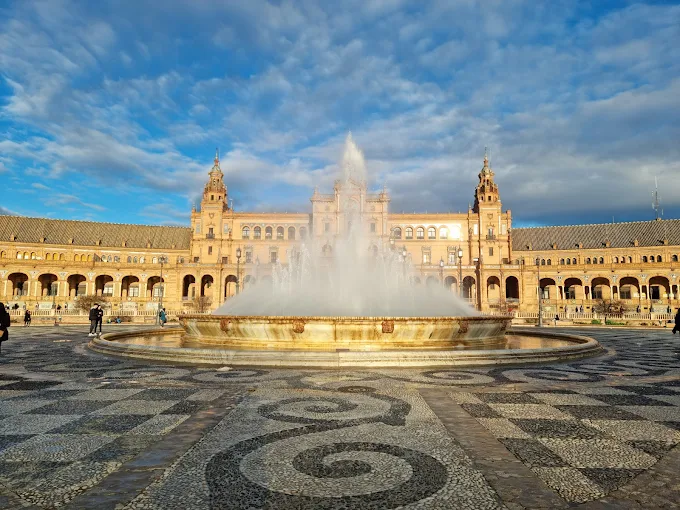
Plaza de España: Where History Meets Andalusian Soul
I stood at the edge of the plaza just after nine in the morning. The air felt cool, still holding a faint night chill that would burn off by midday. A bench sat empty near the canal. I paid nothing to walk in, nothing to linger. Sunlight touched the curved brickwork and tiled balustrades slowly, as if testing the warmth before committing fully. A few locals crossed the space quickly, heads down, moving to work. Tourists had not yet filled the walkways. Water in the canals stayed perfectly still, catching arches and sky like a quiet mirror. It felt large enough to get lost in, yet small enough to feel like home.
Why Plaza de España Matters
This plaza rose for the 1929 Ibero-American Exposition, built to celebrate ties between Spain and its former overseas territories. Every detail carries meaning. Tiled alcoves represent provinces across the country, each with its own colour palette and scenes from local history. Bridges span narrow canals, connecting the central square to outer walks. It sits within Maria Luisa Park, part of a much larger green space that stretches through central Seville. It is not ancient, despite how it looks. It is a deliberate, proud statement of identity from nearly a century ago.
It is not perfect, though. The scale can feel overwhelming when crowds press in. You will find very little seating for such a wide area, and what exists fills fast. Some sections show clear wear—chipped tiles, faded paint—that local authorities have been slow to repair. It feels loved but not always carefully tended.
The Best Time to Experience Plaza de España
Late September through early November works best. Days hover around 24°C to 28°C (75°F to 82°F), evenings drop to 14°C to 17°C (57°F to 63°F). Sun stays bright but does not scald. Spring, from mid-March to late May, runs nearly identical and draws bigger crowds.
July and August bring punishing heat—35°C to 40°C (95°F to 104°F) by afternoon. Most sensible people stay indoors between three and six. December through February stays mild, 15°C to 18°C (59°F to 64°F) in the day, but rain comes often and strong winds can sweep across the open space. Arrive before ten in the morning whenever you visit. You will have the place mostly to yourself. After eleven, tour buses arrive.
Approximate Budget for a 7-Day Trip
- Accommodation: €420 – €630. Mid-range rooms within walking distance. Expect to pay more in spring and autumn.
- Food & Drink: €210 – €280. Tapas lunches, set menus at dinner, coffee and small snacks throughout the day.
- Local Transport: €35 – €50. Buses, occasional taxis, short train rides. Walking covers most central distances.
- Attractions & Entry Fees: €90 – €130. Many spots are free, but major museums and historic sites charge.
- Miscellaneous: €50 – €80. Small purchases, extra drinks, unexpected needs.
Total: €805 – €1,170 for one person, mid-range comfort.
Boat rentals at the plaza are notably overpriced at €18 for thirty minutes on the water. Skip them and walk the perimeter instead. You see everything from the paths, and you save the money for an excellent multi-course lunch at a nearby family-run restaurant.
Essential Plaza de España Experiences
- Walk the full perimeter — Follow every curve, pass under every arch. You notice details you miss from the centre. Allow forty-five minutes at a slow pace.
- Read the provincial alcoves — Each one tells a story through ceramic tiles. Stop and read the short inscriptions. They offer quick, vivid snapshots of regions across Spain.
- Cross all four main bridges — Each has its own ironwork design and viewpoint. They look similar but are not identical. Compare them as you go.
- Sit and watch the light shift — Pick a spot away from the main entrance. Stay twenty minutes. Watch how sunlight changes which parts glow and which stay shaded.
- Visit the nearby park pavilions — Just a short walk away, smaller buildings match the plaza’s style but sit quiet and nearly empty. They feel like a secret extension.
- Skip the paid guided tour if you prefer moving at your own speed. Information signs are clear and sufficient for most visitors.
Hidden Gems Most Travelers Miss
- The northeast corner bench, tucked where two walkways meet. Few people stop there. It faces back across the whole plaza and catches the evening light perfectly.
- Smaller tiled panels below the main alcoves. They show local crafts and daily life, not famous battles or leaders. These feel more real than the grand scenes above them.
- The pavilion two hundred metres south along the park path. It matches the plaza’s style but sits almost entirely alone. You may have it to yourself.
- The central fountain is widely photographed and overrated. It looks better from a distance than up close, and the stone around it often holds crowds and litter. Save your close-up stops for the alcoves instead.
Cultural & Practical Tips
- Drinking water is not available right inside the plaza. Carry a full bottle. Nearest public taps sit two hundred metres away in Maria Luisa Park.
- Do not leave bags unattended. Even for a moment. Security patrols are active and will remove items quickly.
- Local meal times differ. Lunch starts at two, dinner rarely before eight. Arriving early means empty tables, but you may find kitchens still closed.
- Wear comfortable walking shoes. Paved surfaces are uneven in places, and you will cover several kilometres exploring the plaza and surrounding park.
- Midday heat is not to be underestimated. Seek shade between one and four. Sunburn comes fast even on partly cloudy days.
- Photography is allowed everywhere, but tripods are banned without special permission. Keep equipment simple and compact.
- Do not treat the plaza as a shortcut. Locals use it, yes, but running through or rushing past others is considered rude. Move slowly.
Essential Visitor Information
Location & Access: Plaza de España, Maria Luisa Park, Seville. About 2.5 kilometres from Seville-Santa Justa train station. Bus lines T1 and C3 stop nearby. Taxi from central city centre runs €8 to €11. Walking from the old quarter takes roughly twenty-five minutes.
Tickets & Booking: No entry fee. No booking required. Access is open to all.
Operating Hours: Fully open daily from dawn until late evening. Gates never close. Maintenance work happens occasionally on weekday mornings—small sections may be roped off temporarily.
Visit Duration: Minimum one hour. Recommended two hours to walk fully and sit undisturbed.
Family Suitability: Very family-friendly. Wide open spaces, shallow water edges with railings. Stroller access is mostly smooth, though some paths have gentle slopes. Public restrooms stand near the northern entrance.
Timing: Best in autumn and spring. Arrive before ten in the morning or after seven in the evening. Midday visits feel crowded and hot.
Highlights: Curved main building, tiled provincial alcoves, canal bridges, central fountain, park pavilions to the south.
Nearby & Day Trip: Maria Luisa Park stretches outward on all sides. Seville’s Royal Palace lies 1.2 kilometres away. The city cathedral is 1.8 kilometres distant. A day trip to Carmona takes forty minutes by car and offers sweeping hilltop views and quiet historic streets.
Conclusion: Travel with Awareness, Not Just Photos
Plaza de España rewards attention more than it rewards rushing. You do not need to check every box to get something real from the visit. Slow down. Notice how the tiles differ from one alcove to the next. Feel the stone under your feet. Stay long enough to see the light change. When you leave, take the memory of the quiet corners with you. They will stay clearer than any photograph you take.
Comments
Post a Comment