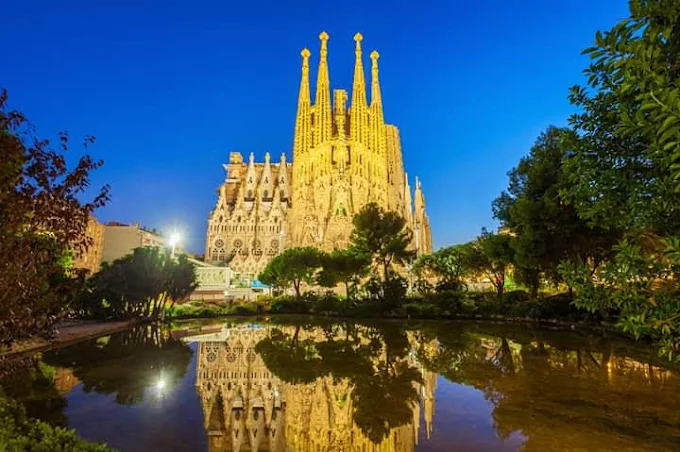
Basilica of the Sagrada Família: Where Lifelong Devotion Meets Unfinished Stone
I stand across Carrer de Mallorca just after nine in the morning. Sunlight hits the eastern facades and gilds every spire. Construction cranes rise above the roofline. They are part of the view, not an intrusion. I walk toward the ticket gates. The line moves steadily. I paid twenty-six euros online weeks ago. No walk-up tickets remain available here. I step through the entrance arch. The air inside feels cooler. Stone columns branch upward like tree trunks. Light filters through tall stained glass in broad bands of blue and gold. It shifts across the floor as I stand still. No photograph captures how the space breathes. It feels less like a building and more like something alive.
Why Basilica of the Sagrada Família Matters
Antoni Gaudí began work here in 1883. He spent forty-three years on the project. When he died in 1926, only one façade was well underway. Today the basilica remains under construction. Completion is scheduled for 2026, the centenary of his death. The design draws from nature — trees, mountains, caves — and translates those forms into stone. It broke nearly every rule of church architecture. Columns lean to distribute weight. Surfaces curve without repeating. Light serves as a building material, not decoration. It stands as a UNESCO World Heritage site and draws millions every year. That popularity brings real problems. Tickets sell out weeks ahead. Third-party sites charge far more than official prices. Crowds inside can feel dense, making quiet reflection nearly impossible. The unfinished state also divides opinion. Some visitors find the scaffolding distracting and wonder if the final version will match the vision. Construction noise carries throughout the day. For many, that ongoing work is part of the story. For others, it simply feels incomplete.
The Best Time to Experience Sagrada Família
Go from mid-April through June or September to mid-October. Temperatures sit 16°C to 24°C (61°F–75°F). Morning light streams through the east windows in clear bands. July and August bring highs above 30°C (86°F). Queues form early and the interior stays warm. November through February are cooler, 9°C to 15°C (48°F–59°F), and days grow short. Arrive at opening, 09:00. You will see the nave at its quietest. Between 09:00 and 11:00 the east-side glass glows deepest blue and green. Afternoons from 15:00 onward bathe the nave in warmer amber and red light. Weekdays work better than weekends year-round. Sunday entry starts later and stays busier throughout.
Approximate Budget for a 7-Day Trip
- Accommodation: €75–€160 per night; €525–€1,120 total. Stay in Eixample within walking distance but not directly beside the site.
- Food: €24–€42 per day; €168–€294 total. Local lunch menus offer fair value.
- Transport: €13 per day; €91 total. Metro L2 or L5 reaches the basilica in minutes.
- Attractions: €26 basic entry; €36 with tower access; resellers charge €33–€47 for the same entry.
- Miscellaneous: €14–€28 per day; €98–€196 total.
Total estimated: €881–€1,749
Third-party booking sites mark up tickets by up to thirty percent. A basic entry ticket costs €26 directly. Resellers sell the same ticket for €34 or more. Book only through the official website. You save money and avoid unreliable sellers.
Essential Sagrada Família Experiences
- Walk the central nave — Stand beneath the branching columns and look up. Light shifts as the sun moves. Spend time in the middle. Skip if you have less than ninety minutes; rushing diminishes the effect.
- Climb one of the towers — Elevators take you partway. Short stair sections finish the ascent. The view spreads across the city toward sea and hills. Choose the Passion Façade for wider, clearer views.
- Visit the crypt — Gaudí lies buried here. The space feels quiet and modest. It contrasts sharply with the scale above. Respect the silence; people come here to pray as well as visit.
- Examine the Nativity Façade up close — Completed during Gaudí’s lifetime, it carries more organic, detailed work. Every surface holds narrative. Look at it from the pedestrian area outside.
- Step into the museum — Drawings and scale models show how the design evolved. You see the geometry behind the curves. It explains why the building took so long to finish.
- View the basilica from Carrer de Marina — Walk one block away. The towers rise together against the sky. This angle shows the full composition better than street level near the gates.
Hidden Gems Most Travelers Miss
- Quiet benches near the side chapels. Most visitors stay in the main aisle. Sit briefly. The scale feels different when you pause.
- Geometric tile patterns near the floor line. They follow the same natural mathematics as the columns above. Look down as well as up.
- Small park to the northeast across the street. It offers an unobstructed view of the rising spires without crowds or ticket lines.
- Do not pay extra for the "fast-track" experience sold by third parties. It offers no real speed advantage over booking directly and arriving on time.
Cultural & Practical Tips
- Book tickets at least four to six weeks in advance. Popular slots sell out fast. Walk-up tickets no longer exist.
- Dress modestly. Shoulders and knees must be covered. Staff turn visitors away at the gate otherwise.
- Arrive ten minutes early, not thirty. Waiting areas offer little shelter. Have your ticket QR ready on your phone.
- Download the official audio guide app before you go. Mobile data slows near the entrance and delays activation.
- Do not block aisles or doorways for photos. Keep moving in high-traffic zones.
- Tower access closes in high wind or rain. No partial refund applies if it shuts unexpectedly.
- Photography is allowed inside but without flash. Keep shots brief so others can see too.
Essential Visitor Information
Location & Access: Carrer de Mallorca, 401, 08013 Barcelona. Metro L2 or L5 to Sagrada Família station, 2 minutes walk. Bus 19, 33, 34, H10 stop nearby. Taxi from Plaça Catalunya takes roughly 15 minutes and costs €10–€15.
Tickets & Booking: Basic entry €26. Entry + tower €36. Guided tour €30. Book only through the official site. Walk-up entry unavailable. ID may be checked against ticket details.
Operating Hours: Nov–Feb: 09:00–18:00, Sundays from 10:30. Mar & Oct: 09:00–19:00. Apr–Sep: 09:00–20:00. Last entry roughly 45 minutes before closing. Closed Dec 25–26, Jan 1, Jan 6.
Visit Duration: Minimum 90 minutes. Allow 2 hours to include museum and crypt. Add 45 minutes if climbing a tower.
Family Suitability: Children welcome. Under 11 enter free but need reserved ticket. Stroller access possible but tight; baby carriers work better. Elevator to tower available but limited.
Timing: Best season: May, June, September. Best time: 09:00 opening for east light; 15:00 onward for west light.
Highlights: Central nave columns, stained glass light bands, tower city views, crypt, Nativity Façade.
Nearby & Day Trip: Avinguda de Gaudí promenade 5 minutes. Hospital de Sant Pau 15 minutes. Park Güell 20 minutes by metro. Girona makes a rewarding day trip, one hour by train.
Conclusion: Travel with Patience, Not Just a Checklist
The Sagrada Família costs more and demands more planning than most sites. Third-party sellers inflate prices. Crowds press close. Construction continues. Yet nothing matches the light inside. It changes minute by minute, hour by hour, season by season. Gaudí did not live to see it finished. He knew others would carry on. When you step outside, look back at the cranes beside the spires. They are not a flaw. They are proof that great work takes time.
Comments
Post a Comment