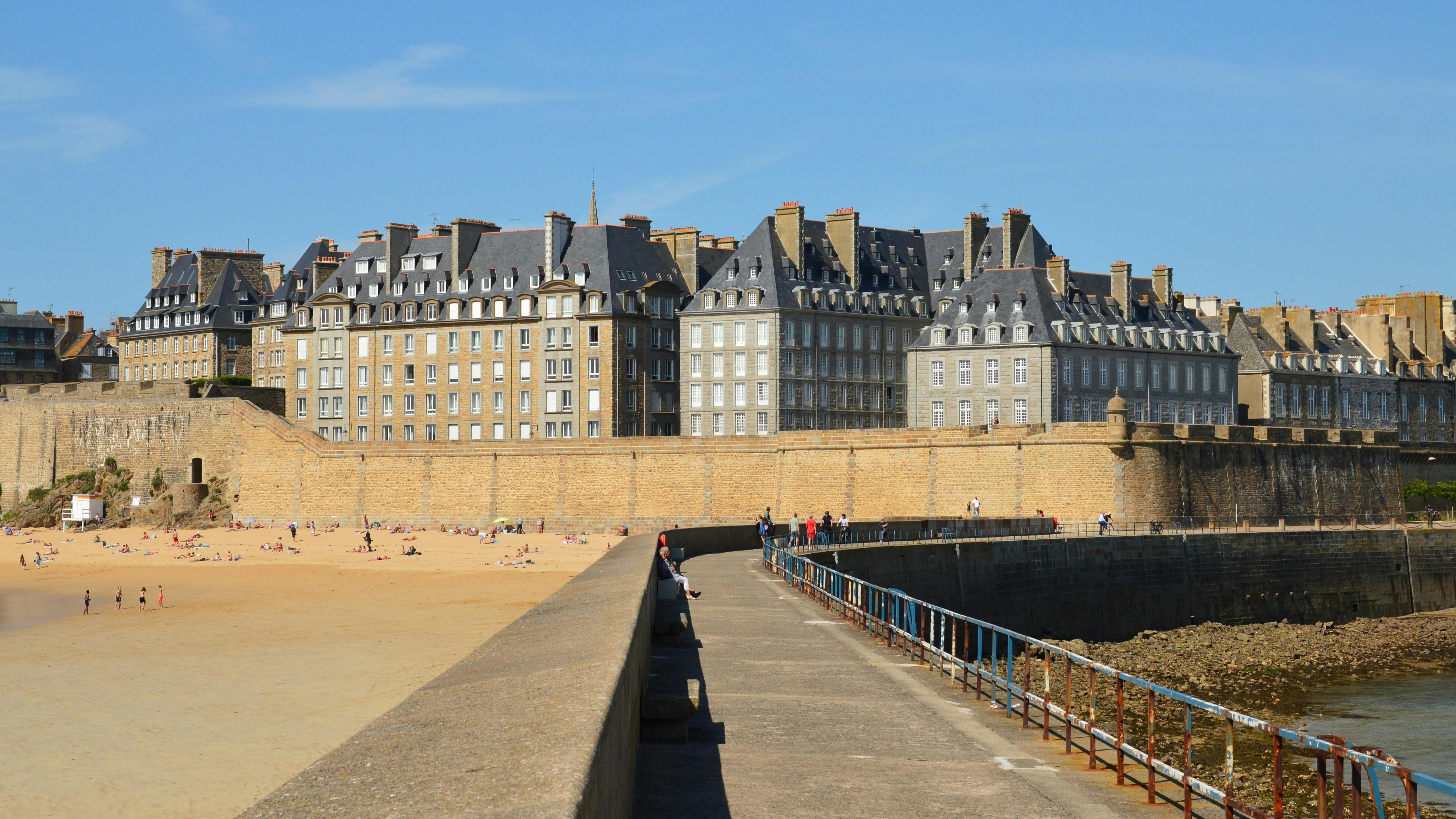
Les Remparts de Saint-Malo: Where Granite Walls Meet Open Atlantic
I stood on the ramparts at 9:25 on a Tuesday morning. Salt wind pulled at my jacket. Below, waves crashed against the outer rocks — white foam exploding against dark granite. The walled city clustered inside, slate roofs tight and spire rising at the centre. I paid nothing to walk the full circuit. A warm crêpe with sugar cost 4 euros from a stall tucked beside the Saint-Vincent gate. The ramparts stretch nearly two kilometres around, high enough to see everything — ships on the horizon, islands rising from the bay, narrow lanes winding below. It feels solid, unyielding, built to stand against both time and tide.
Why Les Remparts de Saint-Malo Matters
Saint-Malo grew from a fortified islet, separated from the mainland by a narrow channel. The ramparts took their present shape between the 17th and 18th centuries — thick granite walls, bastions at intervals, gateways that once could be sealed against attack. They protected generations of sailors, merchants, and shipbuilders who made this port famous. Privateers sailed from here; explorers departed to map distant lands. In 1944 heavy bombing damaged sections, but restoration returned the walls to their full strength. Today they remain one of Europe’s most complete coastal fortifications. Yet popularity brings pressure. The main viewpoints fill by midday. Some sections show wear from millions of footsteps. The inner lanes beneath the walls feel crowded in summer. You must walk the quieter stretches to feel the walls as guardians, not just landmarks.
The Best Time to Experience Les Remparts de Saint-Malo
Late May through June offers long evenings and fresh breezes — 11°C (52°F) to 19°C (66°F). Days stretch late and light falls soft on stone. July and August reach 15°C (59°F) to 23°C (73°F), but the circuit fills fast. Arrive before 10:00 AM then. September holds steady at 13°C (55°F) to 20°C (68°F). Crowds thin and golden light warms the granite. October through April runs quieter and wilder — storms can be dramatic but some outer paths close for safety. Visit midweek. Tuesday through Thursday stays quietest. High tide at sunrise or sunset frames the walls most beautifully.
Approximate Budget for a 7-Day Trip
- Accommodation: 7 nights in a guesthouse just outside the walls — 581 euros. Staying inside costs roughly 175 euros extra and feels noisier — day-trippers fill lanes late into the evening.
- Food: Daily breakfast, harbour lunches, evening meals — 448 euros. Restaurants directly beneath the main rampart gateways charge premium prices. Menus cost nearly double what places one street back ask. They are overpriced.
- Transport: TGV from Paris to Saint-Malo — 129 euros. The station sits twenty minutes’ walk from the city gates. Local buses cover nearby areas. Taxis are overpriced — walking covers the ramparts and old town perfectly.
- Attractions: Rampart circuit free. Château museum — 9 euros. Island ferries — 14 euros combined.
- Miscellaneous: Waterproof layers, cider, postcards, rain gear — 94 euros.
Total estimated cost: 1,266 euros per person
Skip the souvenir kiosk beside the main gate. The bookshop inside the walls sells identical local histories and cards at lower prices.
Essential Les Remparts de Saint-Malo Experiences
- Walk the full rampart circuit — Nearly two kilometres atop thick walls. You pass bastions, gateways, and cannon emplacements. Views open across the sea, the islands, and the tiled city below. It takes roughly one hour at steady pace. Go early — once crowds gather, you cannot stop and watch the waves.
- Stand at the western bastion at high tide — Water rises close to the wall base. The Atlantic stretches unbroken to the horizon. It feels raw and exposed. Skip if you dislike wind — this section stays open and unshielded.
- Enter through Saint-Vincent Gate — The main historic entrance. Heavy stone arch, cobbled passage, lanterns overhead. It sets the tone before you step inside. Imagine arriving by ship and climbing through here centuries ago.
- Climb the château tower — At the eastern corner, the ancient fortification rises above the walls. Steps lead to wide views across the city and bay. It adds height to the rampart perspective — you look down on the walls themselves as well as out.
- Walk beneath the walls at low tide — The shore spreads wide. Rocks, forts, and islets appear. You see the ramparts from water level — how massive they rise straight from the waves. Check tide times — water returns fast and covers the path completely.
- Watch sunset from the southern wall — The sun dips toward the mainland. Light turns the granite warm gold. Day-trippers leave by late afternoon. Stay and watch the city lights come on inside the walls.
- Explore the inner lanes after the circuit — Narrow streets wind between stone houses. Cafés, bookshops, and bakeries fill the spaces the walls protect. It feels lived-in, not just visited. This is the heart the ramparts were built to guard.
Hidden Gems Most Travelers Miss
- The northern stretch of ramparts runs past quieter walls and fewer viewpoints. Almost no one lingers here. The sea stretches open and you can hear waves clearly above the wind. It feels closest to what the ramparts were — a silent watch over the water.
- The lane leading from the château down to the inner harbour stays quiet. Old warehouses and small workshops line it. The main promenade cafés are overrated — queues stay long and prices run high.
- The small bastion midway along the western wall has a bench tucked behind a low stone wall. It faces straight out to sea. Almost no one sits there. It offers perfect quiet to watch the horizon.
- The path around the tidal island of Grand Bé, visible from the ramparts, connects at low water. A short walk takes you to the grave of writer Chateaubriand. It feels like a natural extension of the rampart experience — defence and memory combined.
Cultural & Practical Tips
- Arrive before 10:30 AM. By mid-morning in July and August, the best viewpoints fill completely. Come early for empty walls and clear photos.
- Wear windproof and waterproof layers. The ramparts sit fully exposed. It feels 3–5 degrees colder up here than at street level. Weather changes fast — sun, rain, and wind can alternate in the same hour.
- Stay on marked paths. Some wall sections remain fragile. Do not climb or sit on unprotected edges. Drop-offs are steep and waves reach far at high tide.
- Check tide times daily. Low tide reveals the shore path beneath the walls; high water covers it completely. Plan your walk so you do not get stranded.
- Respect quiet after dark. People live inside the walls. Voices carry far on stone. Keep noise low as you pass through lanes in the evening.
- Carry small change. Public restrooms and some parking areas require coins. Not every small café takes cards.
- Walk the circuit in both directions. The view changes depending on which way you face. Return along the outer shore path at low water for a completely different perspective.
Essential Visitor Information
Location & Access: Les Remparts, Saint-Malo, Ille-et-Vilaine, Brittany. GPS coordinates 48.64, -2.02. Three options: TGV from Paris Montparnasse directly to Saint-Malo (3 hours 15 minutes); drive via Rennes and N137 (4 hours from Paris); ferry from Dinard (15 minutes).
Tickets & Booking: Rampart circuit free. Château museum — 9 euros adults. Under 12 — 5 euros. Island ferries — 7–14 euros return. No booking required for ramparts.
Operating Hours: Ramparts open daylight hours year-round. Some exposed sections close temporarily after storms. Museum: daily 10:00–12:30 and 14:00–18:00; closed Mondays October–March.
Visit Duration: Minimum 1 hour for the circuit. Recommended half-day including château, inner lanes, and low-tide shore walk.
Family Suitability: Rampart paths wide and mostly flat. Low walls exist but keep children close — drops are significant. Public restrooms near main gates and inside the city.
Timing: Best season: May–June or September. Best time: before 10:00 AM or sunset. Quietest walls, clearest light, freshest wind.
Highlights: Full rampart circuit, western bastion at high tide, château tower view, low-tide shore beneath walls, sunset from southern wall, inner lanes after crowds leave.
Nearby & Day Trip: Three nearby stops: Dinard Belle Époque resort (15 minutes by ferry), Cancale oyster coast (30 minutes drive), Dinan medieval town (45 minutes). Mont-Saint-Michel makes a rewarding full-day trip one hour away.
Conclusion: Travel with Respect, Not Just Sightseeing
The ramparts of Saint-Malo have stood through war, storm, and rebuilding. Some lanes feel crowded. Some prices run too high. Those things do not weaken the walls. You do not need to know every date to feel them. Stand where sailors once watched the horizon. Hear the sea crash against granite. Remember — these walls were built to protect a community, not just to welcome visitors. What will you carry away from their shelter?
Comments
Post a Comment