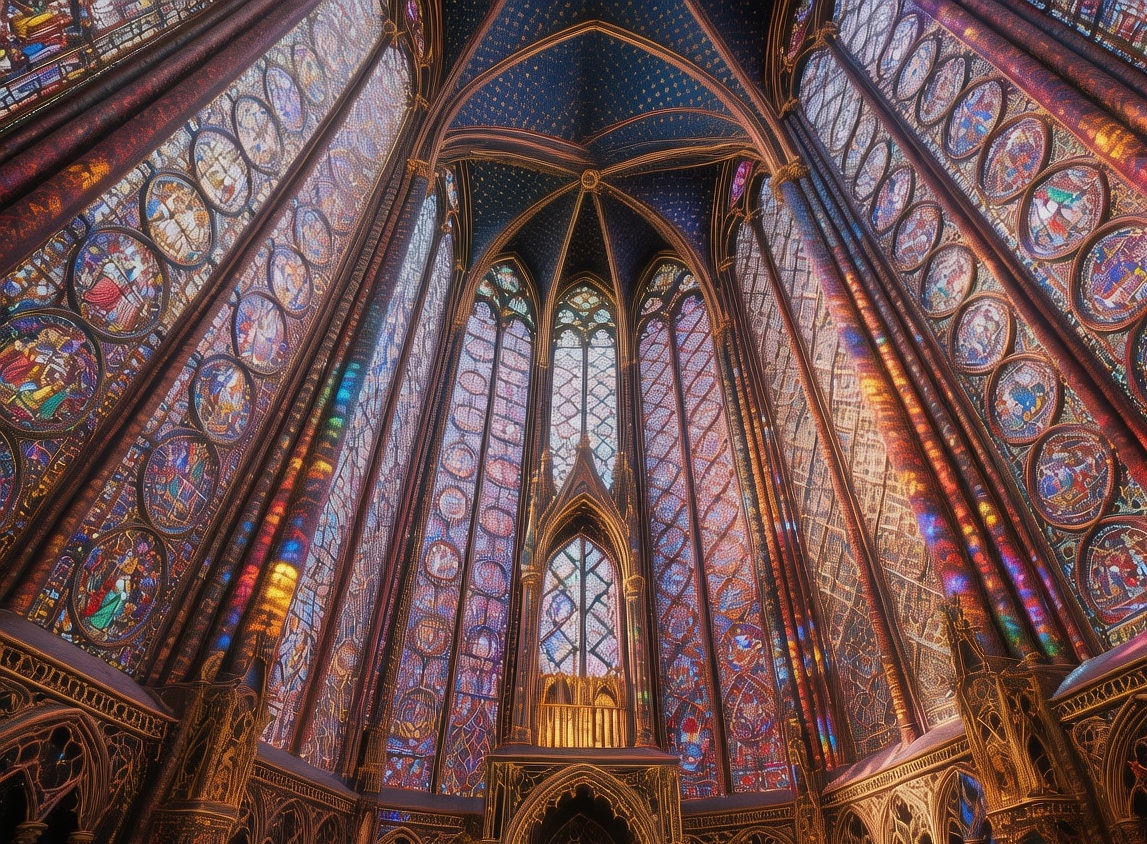
Sainte-Chapelle Stained Glass: Where Medieval Light Meets Stone Vaulting
I step into the upper chapel just after nine in the morning. A combined ticket costs seventeen euros. The doors close behind me and the world outside falls quiet. Glass rises fifty metres overhead — fifteen immense windows, nearly the entire wall surface. Deep blues, vivid reds, golds, and emeralds blend into a glowing tapestry. Sunlight streams through and paints the stone floor in shifting colour. A woman stands perfectly still, head tilted upward. She does not speak. No one does. The light changes as you watch — brighter, softer, warmer — minute by minute. You do not just see this place. You feel it.
Why Sainte-Chapelle Stained Glass Matters
King Louis IX — later Saint Louis — commissioned the chapel in the 1240s to house sacred Christian relics including the supposed Crown of Thorns. Built in barely seven years, it was designed as a radiant reliquary in stone and glass. The fifteen upper chapel windows contain more than 1,100 scenes spanning the Old and New Testaments, arranged in a narrative flow that was meant to instruct as much as inspire. This is one of the most complete surviving medieval stained‑glass ensembles anywhere. Yet it has endured centuries of damage — fire, revolution, war, and pollution. Large sections are 19th‑century restoration; some panels are modern replacements. The glass is fragile and irreplaceable. Crowds press close in summer. The chapel feels small, and the flow moves steadily. You cannot linger indefinitely. Protecting this beauty means balancing access with care.
The Best Time to Experience Sainte-Chapelle Stained Glass
Late April through June and mid‑September through early October offer ideal conditions. Daytime temperatures sit 16°C to 22°C (61°F to 72°F). The sun angle is high enough to flood the upper chapel but not so harsh that colours wash out. Mid‑November through February has shorter days and lower sun — the light feels richer and deeper, though the chapel stays cooler inside. July and August see 22°C to 26°C (72°F to 79°F) and very long queues. Arrive on the first daily entry slot. You will stand beneath the glass with space to look. After ten thirty, the chapel fills and the flow becomes slow and continuous. Mid‑afternoon sun from the west intensifies the reds and golds on that side — worth staying for if you can.
Approximate Budget for a 7‑Day Trip
These figures are per person, based on staying in central Paris and visiting independently.
- Accommodation: €85–€145 per night in the 1st or 4th Arrondissements nearby; €65–€95 across the river in the 5th or 6th — short walk and quieter streets.
- Food: Nearby terrace café lunch €18–€32. Bakery sandwich and drink €8–€13. Picnic beside the Seine or Place Dauphine — fresh bread, cheese, fruit — costs far less and feels just as special.
- Transport: Metro line 4 to Cité or line 7 to Châtelet — €1.90 per ride. Walk from central districts in 15–25 minutes.
- Attractions: Sainte‑Chapelle €17 adult; under 18 free. Combined ticket with Conciergerie €20. Guided tour supplement €8–€12.
- Miscellaneous: €14–€25 daily for supplies, prints, and spontaneous stops.
Total estimated 7‑day cost: €610–€940 per person. The premium guided tour at €45 is overpriced. The standard ticket with free information leaflet covers the essential history and layout. You can stand and look at your own pace without being herded.
Essential Sainte-Chapelle Stained Glass Experiences
- Stand in the centre and turn slowly. Face each window in turn. Notice how the light shifts tone — deep blue on the north side, warmer gold and red on the south and west. Skip if you dislike enclosed spaces — the chapel feels tall but narrow and fills fast.
- Follow the narrative flow. Windows run from Genesis to the life of Christ to the relics themselves. Small numbered markers help you trace the story. It takes twenty minutes to read the sequence.
- Visit the lower chapel too. Often overlooked. Its windows are smaller and softer, dedicated to the Virgin Mary. The atmosphere feels quieter and more intimate.
- Return at different times if you can. Morning light brings out blues and purples. Afternoon intensifies reds and golds. The same glass looks entirely distinct.
- Climb to the exterior balcony. The view across the Île de la Cité and Seine frames the chapel spire perfectly. It shows how the building fits into the historic heart of Paris.
- Attend a concert. Evening performances use the space as it was meant — music rising beneath vaulted stone. Tickets cost more but the experience is unforgettable.
Hidden Gems Most Travelers Miss
- West rose window. The chapel’s only large circular glass piece. It sits above the entrance and is often missed once inside. The intricate design depicts the Apocalypse.
- Lower chapel corner bench. Tucked beside the altar. Almost no one pauses here. You see light spill down the upper stairs and feel the space breathe.
- The main upper chapel is famous; it is overrated on summer afternoons. Go first thing or visit in winter. The same glass awaits you, but with room to truly see it.
- Place Dauphine ten minutes away. Quiet cobbled square with soft light. It feels like old Paris — perfect for processing what you have just experienced.
Cultural & Practical Tips
- Book timed tickets online at least one week ahead. Summer slots sell out completely. Walk‑ups may wait over two hours or be turned away.
- Keep voices low. The acoustics carry every whisper. Respect the silence others have come to find.
- Photography without flash is allowed, but step aside if taking photos. Do not block the flow or hold your phone up in front of others.
- Do not touch anything. Stone, railings, and glass are all fragile. Oils from hands cause permanent damage.
- Allow extra time to pass through security. The line moves slowly and bags are checked thoroughly.
- Check free entry dates. The first Sunday of each month is free — expect extremely large crowds then.
Essential Visitor Information
Location & Access: 8 Boulevard du Palais, 75001 Paris, France. GPS roughly 48.86° N, 2.35° E. Île de la Cité, beside Notre‑Dame. Reach it by Metro Cité (line 4), RER B to Châtelet‑Les Halles then walk 10 minutes, or by foot across the Seine from the Left Bank.
Tickets & Booking: €17 adult; €13 reduced; under 18 free. Combined with Conciergerie €20. Timed booking essential May–September.
Operating Hours: 9 AM–7 PM daily April–September; 9 AM–5 PM October–March. Closed 1 January, 1 May, and 25 December.
Visit Duration: Minimum 45 minutes. 1 to 1.5 hours lets you explore both chapels and linger without rushing. Add 30 minutes if visiting the Conciergerie next door.
Family Suitability: Very family‑friendly. Strollers work on lower levels but must be carried up the narrow upper chapel stairs. Free entry for children makes it accessible.
Timing: Best months May, June, September. Best time of day: first entry slot or after 4 PM for warm afternoon light.
Highlights: Upper chapel fifteen windows, narrative sequence, lower chapel, west rose window, exterior balcony, evening concerts.
Nearby & Day Trip: Notre‑Dame Cathedral 5 minutes’ walk. Conciergerie adjacent. Louvre 15 minutes across the river. Musée d’Orsay 20 minutes’ walk. All make comfortable half‑day or full‑day outings.
Conclusion: Travel with Wonder, Not Just Checklist
Sainte‑Chapelle is not just a building. It is light captured and held. You do not need to identify every scene or date every panel to be moved by it. Stand still. Let the colours wash over you. Notice how the quiet settles around you. This is what remains of the medieval world — fragile, luminous, and shared with all who come after. Which hue will stay with you longest?
Comments
Post a Comment