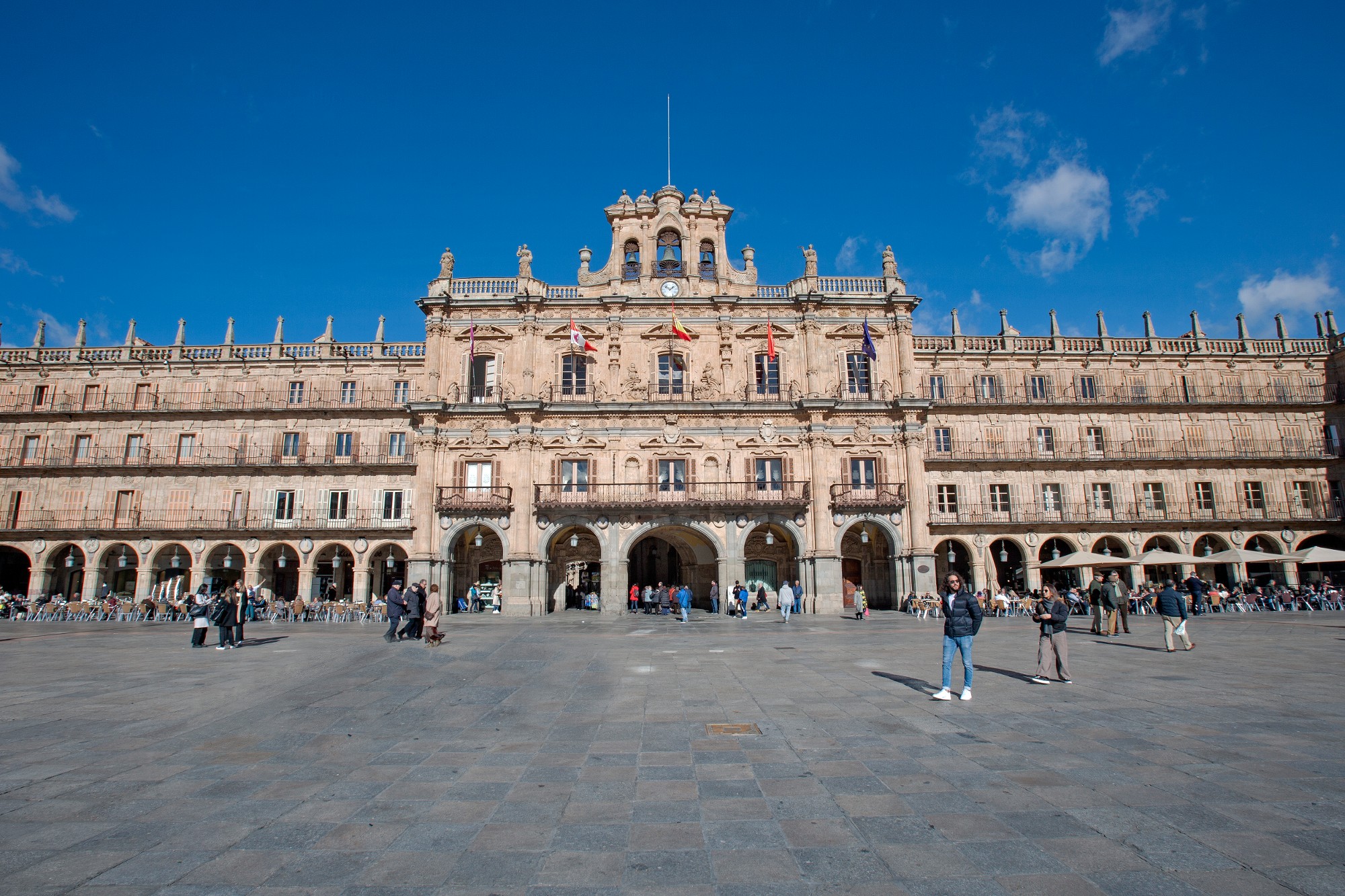
Plaza Mayor, Salamanca: Where Golden Stone Meets Living Heart
The sun dips low at eight in the evening. I sit on a stone bench, warm surface still holding the day’s heat. The sandstone glows honey-gold, every arch and cornice sharp against the blue sky. A group of students laughs as they pass. An elderly couple walks slowly arm in arm. Streetlamps flick on one by one, casting soft light across the paving. This plaza is not just a landmark. People live here. Most visitors take photos and leave within half an hour. They miss how the space changes through every hour, and how it has anchored the city for centuries.
Why Plaza Mayor Matters
Construction finished in 1755. Designed by Andrés García de Quiñones, it stands as one of Spain’s finest examples of Baroque public space. Three levels of arcades surround an open square, every facade symmetrical and carved with intricate detail. For hundreds of years this has been the centre of Salamanca — markets, festivals, gatherings, and quiet evenings all unfold here. The university, one of Europe’s oldest, sits just a few lanes away. Students and scholars have filled these arcades for generations. Yet the plaza bears scars from time. Rain and wind erode the soft stone. Restoration work is constant, scaffolding often covers sections. In summer, crowds fill every bench and table. The magic remains, but it can feel loud and crowded when you seek quiet.
The Best Time to Experience It
Late April through early June offers ideal days. Temperatures sit 12°C to 22°C (54°F–72°F). Evenings feel cool and fresh, flowers bloom in window boxes, and crowds stay manageable. September matches these numbers — golden light, clear skies, and students returning to fill the lanes with energy. July and August reach 16°C to 30°C (61°F–86°F). The sun burns strong by midday; locals stay indoors until evening. November stays mild at 7°C to 16°C (45°F–61°F). Winter months run 2°C to 10°C (36°F–50°F). Frost sometimes dusts the stone at dawn, and the square feels quiet and intimate. Arrive before nine in the morning. You will share the space with very few people.
Approximate Budget for a 7-Day Trip
Plan your spending with these daily averages:
- Accommodation: 55–120. Apartments in the old town sit closer to 55; rooms with plaza views push well above 110. Right on the square is overpriced. Stay one lane back and save 35 a night with the same easy access and quieter sleep.
- Food & Drink: 25–45. Coffee and pastry cost 3–5. Tapas and a drink cost 6–9. A full meal with local wine runs 18–32. Terraces directly facing the square charge premium prices.
- Transport: 15–28. Train from Madrid 2.5 hours ~25; from León 2 hours ~18. Bus from Ávila 1.5 hours ~12. Most of Salamanca is walkable.
- Attractions & Small Costs: 8–18. University and cathedrals 5–10; plaza itself is free.
- Miscellaneous: 7–18. Pastries, books, or handcrafted gifts.
Total for 7 days: 550–1,050 per person
Drinks and meals on the main plaza terraces cost nearly double what you find just around the corner. Step fifty metres away — eat better, pay less, and sit where locals sit.
Essential Experiences
- Walk the full arcade circuit. Four sides, each with its own character. Light shifts as you turn corners. Shadows lengthen differently on every facade. Go slowly; notice how the stone catches the sun. Skip this if you rush — the pleasure lies in moving at walking pace.
- Sit and watch the evening unfold. Tables fill, voices rise, musicians play. The plaza changes from quiet thoroughfare to gathering place. Stay an hour or more. Do not just take photos — be present.
- See the square from above. A few buildings offer rooftop views. You see the perfect symmetry, the pattern of arches, and the lanterns glowing in rows. The perspective shifts everything.
- Visit at dawn. Empty stone, soft light, and absolute quiet. The plaza feels vast and timeless. It is a completely different place before the day begins.
- Explore the surrounding lanes. Cobblestone streets lead toward the old university. Carved doorways, hidden plazas, and ancient walls sit steps away. The plaza is the heart — the body around it matters too.
- Return after dark. Warm light spills from arches. The stone glows differently. Families stroll; friends gather. This is when the plaza truly comes alive.
Hidden Gems Most Travelers Miss
- Pasaje de los Escudos. A covered passage on one side, quieter and cooler. Few tourists enter. Sit on a bench and watch the world go by without noise.
- Plaza de los Bandos. Two lanes away. Smaller, older, and almost empty. The architecture feels more intimate. It gives a sense of what the main square was like centuries ago.
- Calderón de la Barca statue niche. Tucked into a corner arcade. Quiet and unmarked. Pause and read the inscription — it honours a writer who shaped Spanish literature.
- The main north terrace is famous but overrated. Tables fill fast, service slows, and prices rise. Sit on the east or west side instead — the view is just as good and the atmosphere feels more relaxed.
Cultural & Practical Tips
- Respect the space. This is not just a tourist site — people live and work here. Keep noise low after midnight.
- Try the local pastry called hornazo. Savoury and filled with pork. Bakeries just off the square sell it fresh. It tastes better there than on any terrace.
- Wear comfortable shoes. The paving is uneven and worn smooth in places. Heels catch easily — flat soles work best.
- Do not block doorways or arcades. Narrow sections fill fast. Step aside and let others pass.
- Carry small change. Public restrooms are limited; many bars allow use for customers buying a drink.
- Book accommodation months ahead for September. Festivities fill every room. Prices rise and availability vanishes.
- Take time to look up. The best detail is carved high above eye level. Most people never notice.
Essential Visitor Information
Location & Access: Salamanca old town, Castile and León, western Spain. Madrid 200 km — 2.5 hours by train or car. Valladolid 120 km — 1.5 hours. León 190 km — 2 hours. Salamanca station 15 minutes walk to the plaza. Parking is limited nearby — use designated underground car parks outside the historic centre.
Tickets & Booking: Plaza entry is free. No ticket required. Nearby historic sites and university charge separate fees 4–12; booking recommended July–August.
Operating Hours: Open public space — accessible all day and night. Surrounding cafes and bars generally 08:00–00:00; shorter hours winter.
Visit Duration: Minimum half a day. Plan a full day to sit, walk, explore surrounding lanes, and return at different times without rushing.
Family Suitability: Excellent. Flat, open, and pedestrian-friendly. Children love the space — keep them away from road edges at the four entrances.
Timing: Best seasons April–June and September–October. Best times: before 09:00 and 19:00–21:00.
Highlights: Full arcade circuit, evening terrace hours, dawn visit, rooftop view, surrounding historic lanes, night-time atmosphere.
Nearby & Day Trip: Salamanca University 5 minutes; Old and New Cathedrals 5 minutes; Ávila 1.5 hours; Segovia 2 hours; Coimbra, Portugal 2.5 hours. All make satisfying half-day or full-day trips.
Conclusion: Travel with Presence, Not Just Photos
This plaza has stood here longer than nations have taken shape. You will find crowded tables, higher prices facing the square, and days when scaffolding covers a favourite corner. That is real. Put your camera down sometimes. Sit quietly. Ask yourself what you remember most — the perfect shot, or the feeling of warm stone beneath you and golden light falling on walls that have watched generations come and go.
Comments
Post a Comment