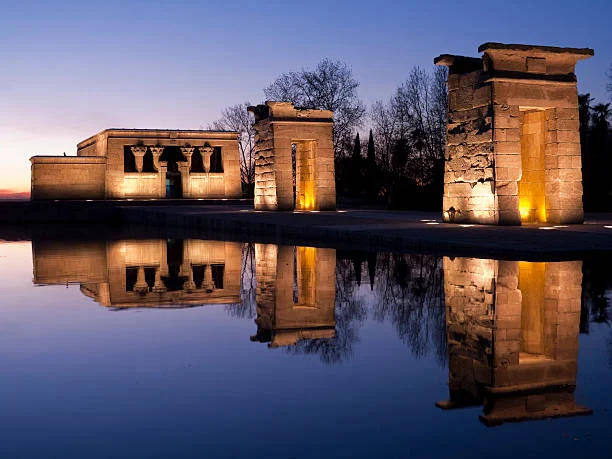
Temple of Debod: Where Ancient Egypt Meets Madrid’s Open-Air City Life
At 7:42 p.m., with the stone walls still warm from the afternoon sun, I bought a €2.50 bottle of water from a nearby shop and walked into Parque del Oeste toward the Temple of Debod. The first thing I noticed was not the temple itself, but the dry scent of grass, the sound of skateboards on the paths, and the orange light falling across Madrid’s western skyline. The Temple of Debod feels unusual because it is both an ancient Egyptian monument and a relaxed public meeting place. People arrive for the history, then stay for the view. The site is free to enter, although access inside can be limited or suspended. The surrounding park is open and easy to visit without a plan. If you are exploring Madrid, the Temple of Debod makes a good stop before dinner in Plaza de España or a walk toward the Royal Palace. Bring water, arrive early for the interior, and do not expect a large museum experience.
Why the Temple of Debod Matters
The Temple of Debod dates back more than two thousand years and was originally built in southern Egypt, near the first cataract of the Nile. Its oldest section is linked to King Adikhalamani of Meroë, while later rulers expanded the complex with spaces dedicated to the Egyptian gods Amun and Isis.
Spain received the temple in the late 1960s as a gift from Egypt after international assistance helped save monuments threatened by the construction of the Aswan High Dam. The blocks were dismantled, transported, and reconstructed in Madrid. That history gives the site a meaning beyond its stone reliefs. It represents international cooperation, but it also raises a fair question about how ancient monuments move between countries and who gets to display them.
The setting adds another layer. In Egypt, the temple belonged to a river landscape and a religious complex. In Madrid, it stands beside lawns, roads, apartment buildings, and one of the city’s best-known sunset viewpoints. That contrast is the reason many visitors remember it.
The criticism is simple: the interior is small, and the interpretation can feel limited if you arrive without background knowledge. Some visitors expect a full Egyptian museum and leave disappointed. Think of it as a compact monument with a strong story, not a major indoor attraction.
The Best Time to Experience the Temple of Debod
The most comfortable periods are from March 15 to May 31 and from September 15 to October 31. Daytime temperatures usually range from 17°C to 27°C, or 63°F to 81°F. Evenings can feel cool, especially on the open paths around the park.
For warm weather, visit between June 1 and July 15. Expect roughly 28°C to 35°C, or 82°F to 95°F, during the day. July and August can be uncomfortable in direct sun, with temperatures sometimes above 35°C, or 95°F. The stone area offers little shade, so midday is a poor choice.
From November 1 to February 28, Madrid is cooler, with typical daytime temperatures around 10°C to 16°C, or 50°F to 61°F. Winter skies can produce excellent sunset color, but wind makes the hilltop feel colder than the temperature suggests.
Arrive 45 to 60 minutes before sunset for photographs and a relaxed walk. The golden light is popular, so the viewpoint becomes crowded. For a quieter visit, go between 9:30 a.m. and 11:00 a.m., especially from Tuesday to Friday. Interior access may depend on staffing, conservation work, school visits, and seasonal schedules.
Approximate Budget for a 7-Day Trip to the Temple of Debod and Madrid
The Temple of Debod itself is free, so the main cost comes from staying in Madrid and visiting nearby attractions. The following estimate suits one traveler sharing a double room or using a mid-range private room.
- Accommodation: €560 to €980 for seven nights in a practical central hotel or guesthouse.
- Food: €245 to €420 for breakfast, casual lunches, tapas, and several sit-down dinners.
- Transport: €45 to €75 for metro, bus, and occasional local trips. Airport transfers may cost extra.
- Attractions: €90 to €180 for museums, the Royal Palace, guided visits, and one paid day trip.
- Miscellaneous: €70 to €130 for water, snacks, lockers, small purchases, and travel essentials.
Estimated seven-day total: €1,010 to €1,785 per person.
Accommodation near Plaza de España can be overpriced during weekends, football matches, and major events. Staying near Argüelles, Lavapiés, or Chamberí can reduce the nightly rate while keeping you close to public transport. A rooftop drink near the temple can also cost €12 to €18. A supermarket picnic in Parque del Oeste is the cheaper choice, and it is often more enjoyable.
Essential Temple of Debod Experiences
- See the temple from the western viewpoint. Walk past the monument toward the open terrace for broad views across Madrid, particularly around sunset.
- Study the carved gateways. Look closely at the reliefs and the changes in stone color. The details are easy to miss when the area is crowded.
- Visit the interior if it is open. The rooms are compact, but they help explain the temple’s original religious function. Entry is generally free, though queues and closures happen.
- Walk through Parque del Oeste. Leave time for the paths, mature trees, and quieter corners behind the main viewpoint.
- Continue toward Plaza de España. The walk takes around 10 to 15 minutes and links the temple with central Madrid, the Cervantes Monument, and Gran Vía.
- Return after dark. The illuminated temple has a different character, though the best reflections depend on weather and fountain conditions.
Skip the sunset visit if you dislike crowds. The view is popular, and people often arrive early to claim a clear position near the water. Morning is much easier for photographs and a calm look at the monument.
Hidden Gems Most Travelers Miss
- Rosaleda de Madrid: This formal rose garden lies within Parque del Oeste and makes a pleasant nearby detour during the warmer months.
- Teleférico de Madrid lower station: The cable car area sits close to the park and offers a different way to view the city, although service can vary by season and maintenance.
- Príncipe Pío gardens: Walk downhill toward Príncipe Pío for quieter green spaces and a useful transport connection.
- Cuartel de la Montaña memorial: Near the temple, this small memorial marks the site of a major event in Madrid’s twentieth-century history.
- Sabatini Gardens at night: A short walk away, these gardens provide a more polished evening setting near the Royal Palace.
- Madrid Río: Continue west and south by bus or on foot for riverside paths, bridges, and open space away from the central tourist route.
The overrated part is the idea that the Temple of Debod has the best sunset in Madrid every evening. Clouds, haze, construction, and crowds can weaken the view. Treat it as a good sunset option, not a guaranteed masterpiece.
Cultural & Practical Tips
- Wear shoes with decent grip. The park paths are easy, but some routes include slopes and uneven paving.
- Bring water in summer. The temple area has limited shade and few convenient places to buy refreshments.
- Do not climb on the stones or touch the reliefs. The monument is ancient, and repeated contact causes damage.
- Arrive early if you want to enter the building. A free attraction can still have a queue or restricted capacity.
- Do not confuse the park’s open access with indoor opening hours. The grounds may be accessible when the temple building is closed.
- Use the metro or bus rather than a taxi during busy evening periods. Traffic around Plaza de España can be slow.
- Keep valuables secure during sunset crowds. The viewpoint is relaxed, but busy public spaces still require normal care.
Essential Visitor Information
Location & Access: The Temple of Debod is at Calle de Ferraz, 1, 28008 Madrid, Spain. Approximate GPS coordinates are 40.4240, -3.7177. It is about 1 kilometer from Plaza de España, roughly 1.5 kilometers from the Royal Palace, and around 15 kilometers from Madrid-Barajas Airport. The easiest options are Metro Line 3 to Plaza de España, Metro Lines 3 or 6 to Argüelles, or EMT city buses serving Plaza de España and Ferraz. A taxi or rideshare is practical with luggage, but traffic can add delays.
Tickets & Booking: Entry to the Temple of Debod is generally free. No standard paid ticket is required. Booking is usually not needed, but access inside may be controlled and capacity can be limited. Check current notices at the entrance before making a special journey.
Operating Hours: The outdoor grounds are normally accessible during park hours. Indoor visiting hours have commonly been listed around Tuesday to Sunday, approximately 10:00 a.m. to 8:00 p.m., with shorter hours or changes during winter, public holidays, conservation work, and extreme weather. Mondays are commonly closed for indoor visits. Treat posted times at the entrance as the final guide.
Visit Duration: Allow 30 minutes for a quick look at the temple and 60 to 90 minutes for the monument, viewpoint, and park. Add another hour if you continue to Plaza de España, the Royal Palace area, or the Sabatini Gardens.
Family Suitability: Children usually enjoy the open park, the Egyptian carvings, and the skyline. Strollers can reach the main paths, but some slopes and uneven surfaces may be awkward. There are no large visitor facilities inside the temple, so plan toilets, snacks, and water before arriving.
Timing: Spring and early autumn offer the best balance of temperature and daylight. Visit in the morning for fewer people and clearer access inside. Visit before sunset for the city view, but expect crowds and limited shade.
Highlights: The surviving Egyptian gateway, carved reliefs, the small sanctuary rooms, the western Madrid viewpoint, and the surrounding paths of Parque del Oeste are the main reasons to come.
Nearby & Day Trip: Plaza de España, the Royal Palace, Sabatini Gardens, and the Almudena Cathedral are all close enough to combine in one afternoon. A day trip to Toledo, Segovia, or Ávila is feasible from Madrid by train or organized transport, but it needs a full day rather than a quick add-on.
Conclusion: Travel with Historical Curiosity, Not Just Sunset Expectations
The Temple of Debod is easy to visit, free, and genuinely unusual. Its value comes from the meeting of places: an ancient Egyptian temple, a modern Spanish capital, and a public park used by local residents. Go for the history first, then stay for the view. If the sunset disappoints, the visit still has meaning. Arrive in the morning for a quieter experience, or come before sunset with patience and realistic expectations. Pair it with Plaza de España and the Royal Palace, and you can turn a short stop into a rewarding half-day route.
Comments
Post a Comment