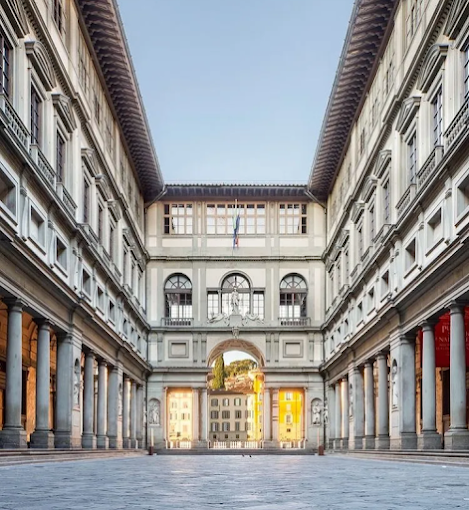
Uffizi Galleries: Where Renaissance Vision Meets Public Trust
I enter through the main doorway just before eight forty-five in the morning. A standard ticket costs twenty euros. The corridor stretches straight ahead, light flooding through tall windows onto polished floor. Only a few other visitors walk the first hall. Botticelli’s *Birth of Venus* appears at the far end — soft, pale, unforgettable. By ten, every room will fill. Groups will pause shoulder to shoulder. For now, the space feels quiet enough to see the paintings as they were meant to be seen — slowly, and without hurry.
Why Uffizi Galleries Matters
The Uffizi began as government offices — *uffizi* means exactly that — built in the mid-16th century for Florence’s ruling Medici family. Giorgio Vasari designed the long U-shaped building framing the square and river below. Over generations, the family placed their finest art here. When the last Medici heir died in 1737, she left everything to the people of Florence, with one condition: nothing could be removed. The collection opened to the public shortly after, making it one of the oldest purpose-built art museums in the world. Every work stayed where it was hung, preserved not as scattered treasures, but as a shared legacy.
It carries real frustrations though. Rooms feel narrow and crowded. Ventilation struggles in summer. Restoration work closes sections for months at a time. Queues stretch far outside even on quiet days. You will find more people viewing the most famous pieces than space to actually see them. The building was never designed for millions of visitors — it was built for administrators and courtiers. The beauty remains, but the experience can feel overwhelming.
The Best Time to Experience Uffizi Galleries
Late April through early June offers ideal conditions. Days run 14°C to 23°C (57°F–73°F). Natural light falls soft and even. Lines move faster. September and early October work equally well. Temperatures hold between 15°C and 24°C (59°F–75°F). Summer crowds thin and the galleries stay open slightly later on selected days.
July and August push past 30°C (86°F) outside. Heat builds inside. Wait times stretch two hours or longer. Tickets sell out weeks ahead. Winter stays cool — 5°C to 12°C (41°F–54°F) — and queues shorten noticeably. Light feels dimmer, but crowds thin enough to stand before each painting. Arrive exactly at opening time or in the final hour before closing for the quietest experience.
Approximate Budget for a 7-Day Trip
Prices are per person in euros. Staying outside the historic centre cuts accommodation costs noticeably.
- Accommodation: 65–120 per night. A clean room in a neighbourhood guesthouse sits near the lower end. Something walking distance to major sites runs higher. Lodging directly beside the Uffizi costs nearly double what you find five minutes away. The art does not change — stay farther out and save hundreds.
- Food & Drink: 35–55 daily. Lunch at a family-run trattoria, dinner with wine, coffee, and snacks included. Restaurants facing the square charge triple normal rates. Walk two lanes inward and prices drop to realistic levels.
- Transport: 12–20 daily. Most central sites sit within walking distance. Buses cost 1.50 euros per ride. Train connections to Siena, Pisa, and Lucca run 3–15 euros one-way.
- Attractions: 50–85 total. Uffizi 20 euros. Accademia and Duomo complex cost extra. Combined passes offer savings across multiple museums.
- Miscellaneous: 15–30 daily. Posters, books, small souvenirs.
Total estimated 7-day cost: 910–1,645 euros per person
Essential Uffizi Galleries Experiences
- Stand before Botticelli’s *Birth of Venus* — Soft colours, gentle movement, a figure floating on a shell. The painting feels quieter and more delicate in person than any reproduction suggests. Go early. Skip if crowds press in — you will not see it properly.
- Follow the timeline room by room — The galleries hang works in roughly chronological order. You watch style shift step by step: from stiff medieval forms to lifelike faces, balanced compositions, and bold colour. The journey matters as much as any single masterpiece.
- Visit the *Primavera* room — Also by Botticelli, hanging nearby. Allegorical figures move through an orchard. Every element carries meaning. It rewards close, slow looking. Most people rush past — pause and let it settle.
- Notice the frames and setting — Paintings sit within the architecture they were made for. Ceiling designs, light direction, and room shape all frame the art. This is not a neutral white box — it is a palace corridor repurposed. The building itself is part of the collection.
- Look out toward the Arno — Windows run along one side. The river and distant hills appear between canvases. The same view inspired artists centuries ago. Step back and let your eyes rest.
- Find da Vinci’s unfinished *Adoration* — A crowded, dynamic composition left incomplete. You see underdrawing and brushwork clearly. It feels intimate and unfinished, revealing the process beneath the image.
Hidden Gems Most Travelers Miss
- First-floor corridors — Many visitors head straight up. The lower level holds quieter rooms, early works, and fewer people. The perspective changes entirely.
- Views from the Loggiato — The terrace above the square opens on selected afternoons. You look straight down onto the Uffizi layout and across to Palazzo Vecchio. It feels private and calm.
- Later rooms beyond the favourites — Most turn back after Botticelli. Farther along hang portraits, landscapes, and lesser-known works that reward attention. The crowds thin steadily the deeper you go.
- Botticelli rooms — Everyone gathers here. You will wait just to stand for seconds before each canvas. The experience feels rushed and crowded. The quieter rooms hold equal beauty without the pressure.
Cultural & Practical Tips
- Book tickets 2–6 weeks ahead. Summer slots sell out completely. Walk-up queues rarely offer entry — do not rely on them.
- Arrive 15 minutes before your time slot. Latecomers may be turned away. Security checks and bag scans move slowly.
- Travel light. Backpacks, large purses, and suitcases are not permitted. Lockers cost extra and add delay. Bring only what fits in a small shoulder bag.
- Keep voices low. Sound carries easily between hard surfaces. Many people come to focus — help them.
- Do not touch or lean near paintings. Even light contact damages surfaces. Barriers exist for protection, not obstruction.
- Plan your route. Pick 3–5 must-sees and head there first. Trying to see everything leads to exhaustion and rushing past what matters most.
- Restrooms sit at the far end. Use them before you enter — returning through crowded rooms wastes precious time.
Essential Visitor Information
Location & Access: Galleria degli Uffizi, Piazzale degli Uffizi 6, 50122 Florence. From Piazza della Signoria: 2 minutes’ walk. From Ponte Vecchio: 5 minutes. From Santa Maria Novella Station: 15 minutes on foot. Parking nearby is extremely limited and expensive — walk or use public transport.
Tickets & Booking: Standard entry ~20 euros. Reduced rates for EU citizens 18–25. Under 18 free. Book ahead online. Third-party sites charge extra fees — book directly through official channels.
Operating Hours: Tuesday–Sunday: 8:15 AM to 6:30 PM, last entry 4:30 PM. Closed Mondays. Extended evening hours operate seasonally — check current schedules.
Visit Duration: Minimum 1.5 hours for a highlights loop. 3–4 hours lets you explore thoroughly without rushing.
Family Suitability: Children welcome everywhere. Corridors are narrow and crowded — keep young ones close. Strollers prove impractical; use a carrier. Restrooms exist at the far end of the gallery.
Timing: Best seasons: late April–June and September–October. Arrive at opening time or within the final hour for thinnest crowds and softest light.
Highlights: *Birth of Venus*, *Primavera*, chronological journey, Arno window views, da Vinci *Adoration*, lesser-known later rooms.
Nearby & Day Trip: Ponte Vecchio — 5 minutes. Palazzo Vecchio — 2 minutes. Boboli Gardens — 15 minutes. Accademia (David) — 20 minutes. Siena — 1 hour by train. All make rewarding half or full-day outings.
Conclusion: Travel with Looking, Not Just Checking
This collection was never meant to be rushed. It grew slowly over centuries, cared for by people who believed art belonged to everyone. You can see the famous paintings in an hour and leave satisfied. You will remember it far longer if you slow down, look beyond the best-known names, and notice how one artist taught the next. Great art does not shout. It waits. What quiet masterpiece will speak to you when you visit?
Comments
Post a Comment