
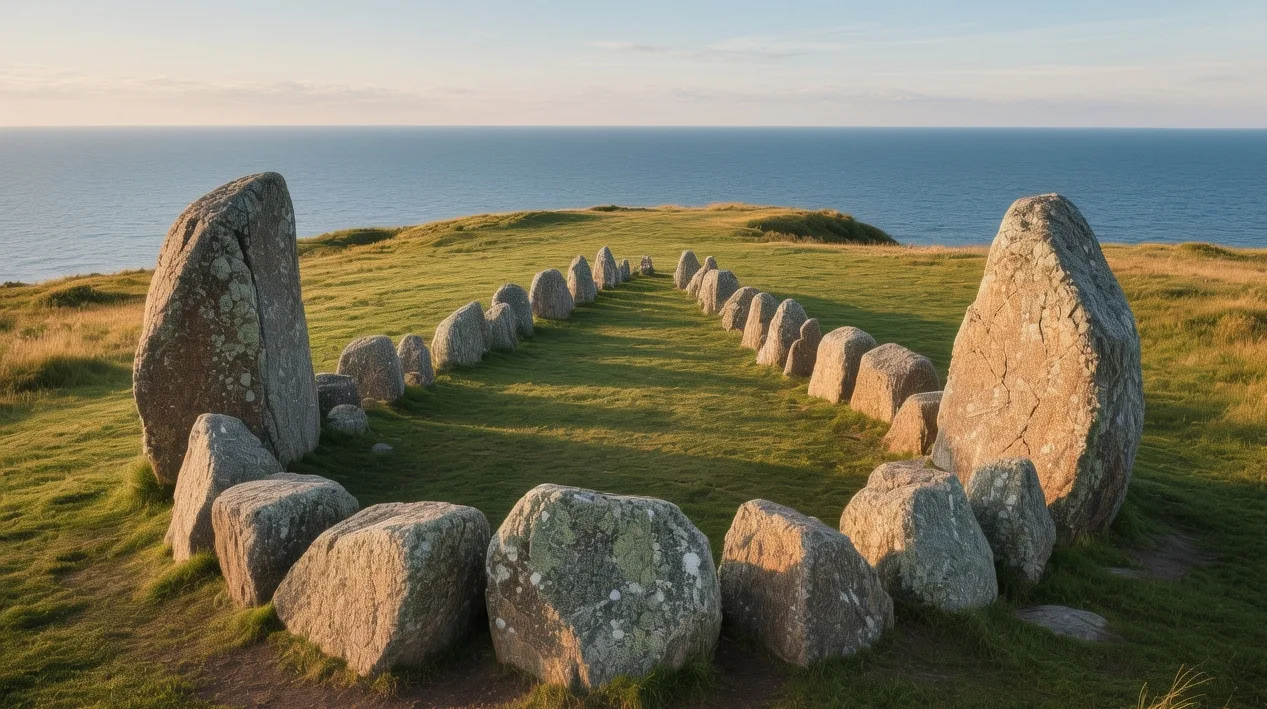
Ales Stenar Iron Age Stone Meets Baltic Wind
The wind sweeps across the limestone cliff at 5:45 PM, carrying the salty breath of the Baltic Sea up toward the 59 massive boulders that define the horizon. You stand before Ales Stenar, Sweden's largest stone ship setting, where quartzite stones weighing up to 4 tons each rest in a deliberate oval formation stretching 67 meters long and 19 meters wide. The grass beneath your feet bends in rhythmic waves, whispering against the silence of rocks that have stood sentinel since approximately 600–1000 AD—long before Stockholm existed, long before Christianity reached these shores. Seagulls cry overhead, their voices echoing off the stone stems that rise nearly 2 meters from the earth, while the setting sun casts long, dramatic shadows that align perfectly with the ancient solstice markers. This is not merely a archaeological site; it is a portal to the Iron Age, a place where Scandinavian ancestors encoded their understanding of the cosmos into heavy stone and earth. In 2026, as digital noise drowns out ancient wisdom, Ales Stenar remains a sanctuary of silence—a place where you can touch the same weathered quartzite your ancestors touched a millennium ago. This matters now: in an era of fleeting attention spans, standing before these monoliths demands patience, reverence, and a willingness to listen to what the wind says about time.
Why Ales Stenar Embodies Scandinavian Ancient Mystery
Ales Stenar stands as the crown jewel of Scandinavian Iron Age monuments, solving a profound historical need: marking power, burial, or time in a landscape dominated by sea and sky. Constructed between 600–1000 AD during the late Iron Age or early Viking Age, the monument consists of 59 boulders of quartzite dragged from nearby beaches—some sources suggest as far as 10 kilometers away—to this 45-meter-high cliff overlooking the Baltic. The formation solves an engineering puzzle: how to move 1.8-ton average stones (with the largest reaching 4 tons) without modern machinery, using only logs, ropes, and human labor. Archaeologists debate its purpose: some argue it served as a burial monument for a chieftain named Ale, while others, including astronomer Nils-Axel Mörner, propose it functioned as an astronomical calendar tracking solstices and equinoxes. The stones are arranged in a ship shape, a common Scandinavian burial tradition symbolizing the journey to the afterlife, yet the precision of the alignment suggests sophisticated observational knowledge. Two stones stand at the bow and stern, while the sides curve inward, creating a hull shape visible only from above—a design intention that implies aerial awareness or divine perspective. The site was excavated in 1989 and again in 2006, revealing charcoal deposits dated to 600 AD, confirming its antiquity. Today, Ales Stenar embodies the Scandinavian relationship with nature: not conquering the landscape, but arranging its existing elements into meaningful patterns that withstand a millennium of coastal erosion and wind.
The Best Time to Experience Ales Stenar
For the optimal Ales Stenar experience, target May 25–June 20 or September 5–October 10 when the light is dramatic, temperatures moderate, and summer crowds thin. During these windows, daytime temperatures range from 15–21°C (59–70°F), perfect for hiking the cliff paths without winter's biting chill. The astronomical alignment is most visible during solstice periods—arrive between 4:00–6:00 AM for sunrise or 8:00–10:00 PM for sunset during June, when the sun lingers near the horizon due to the 55° northern latitude. Avoid July 1–August 15 when Swedish school holidays bring peak tourist numbers, making photography difficult and parking at the visitor center challenging. Winter visits (November–February) offer atmospheric solitude but limited daylight—sunset occurs as early as 3:30 PM in December, and icy paths require crampons. For current weather and path conditions.
Approximate Budget for a 7-Day Trip (2026)
Scania offers moderate pricing for Northern Europe—less expensive than Stockholm but pricier than Eastern Europe. The following estimates reflect 2026 rates with approximately 3% annual inflation from 2024 baseline data, assuming a comfortable mid-range travel style with a mix of self-catering and local dining.
- Accommodation: €90–€150 per night for a double room in Ystad or Kåseberga (near the stone ship); budget hostels from €45/night; seaside cottages average €180–€250/night
- Food: €45–€65 per day total
- Breakfast: €9–€13 (hotel buffet or café with coffee and smörgås)
- Lunch: €15–€20 (dagens lunch—daily special with main, salad, bread, and drink)
- Dinner: €21–€32 (restaurant main course; try local fish or Scanian pork)
- Transportation:
- Copenhagen Airport to Ystad: €26 one-way via Skånetrafiken train (90 minutes)
- Local bus Ystad to Kåseberga: €4.50 single ticket (Bus 323)
- Bicycle rental: €14/day (recommended for coastal paths)
- Day trip to Malmö: €16 round-trip train ticket (55 minutes)
- Day trip to Lund: €18 round-trip train ticket (35 minutes)
- Attractions:
- Ales Stenar Visitor Center: €8 adults, free under 19
- Guided tour of stone ship: €12 per person
- Ystad Museum: €10 adults, free under 19
- Glemminge hus (nearby castle): €9 adults
- Kåseberga Fishing Harbor tour: Free
- Miscellaneous:
- Local crafts at visitor shop: €10–€40
- Fika (coffee + cinnamon bun): €6–€8
- Smoked fish at harbor: €12–€18
- Hiking map: €5
- Parking at visitor center: €8 per day
Total estimated cost for 7 days: €900–€1,300 per person (excluding international flights)
7 Essential Ales Stenar Experiences
- Walk the Stone Ship Perimeter: Begin at the visitor center and follow the marked gravel path to the monument. Walk the entire 67-meter length slowly, noting how the stones increase in size toward the bow and stern. Touch the quartzite surface—rough, lichen-covered, and cold even in summer. Stand at the center point where the largest stones flank the axis; this is where ancient ceremonies likely occurred. The view from inside the ship looking out toward the Baltic creates a framing effect that emphasizes the horizon. Allow 30 minutes for quiet contemplation without rushing.
- Watch the Sunset from the Cliff Edge: Position yourself on the grassy slope west of the stone ship between 8:30–10:00 PM during June. The sun dips below the Baltic horizon, casting the stones in silhouette against a violet sky. The wind typically dies down at this hour, creating eerie silence. Bring a warm layer—temperatures drop quickly after sunset even in summer. This is the most photographed angle, so arrive 20 minutes early to secure a spot without other tourists in your frame.
- Explore the Visitor Center Exhibition: Enter the modern glass-and-wood visitor center (€8 entry) to see artifacts excavated from the site, including Bronze Age jewelry and Iron Age tools. The multimedia display explains the construction theories and astronomical alignments using interactive models. Open daily 10:00 AM–5:00 PM (May–September). The café inside serves excellent Swedish coffee and locally sourced pastries—perfect for warming up after a windy walk. Spend 45 minutes here to contextualize what you see outside.
- Hike the Skåneleden Trail: The monument sits on the Skåneleden long-distance hiking path. Follow the blue markers south toward Kåseberga village (3 kilometers) or north toward Stenshuvud National Park (10 kilometers). The coastal trail offers dramatic cliff views, wildflowers in summer, and access to small beaches below. Wear sturdy shoes—the path is uneven and can be slippery after rain. This hike connects Ales Stenar to the broader cultural landscape, showing how the monument fits into the coastal geography.
- Visit Kåseberga Fishing Harbor: Walk down the hill from the stone ship to the small harbor below (15-minute walk). Watch fishermen unload the morning catch of herring and cod. Several small shacks sell smoked fish directly from the boats—try the warm smoked mackerel (€15) with rye bread. The harbor retains a working authenticity rare in tourist areas. Visit between 7:00–9:00 AM for the most activity, or late afternoon when boats return. The contrast between the ancient stones above and working boats below tells the full story of this coast.
- Attend a Midsummer Celebration: If visiting around June 21, join the local Midsummer celebration held near the stone ship. Traditional dances, flower crowns, and singing occur against the backdrop of the ancient monument—a continuity of ritual spanning millennia. Contact the Ystad tourist office at info@ystad.se for exact dates. This is when the astronomical alignment theory feels most potent, as the sun reaches its northernmost point. Expect crowds, but the communal atmosphere is unforgettable.
- Photograph the Sunrise Alignment: For serious photographers, arrive at 4:00 AM during the summer solstice period. The sun rises directly over the bow stone, creating a perfect alignment visible from the stern. Bring a tripod—light levels are low despite the early hour. The quartzite stones glow orange in the first light, contrasting with the blue Baltic Sea. This requires dedication, but the reward is having the site entirely to yourself for 30 minutes before other visitors arrive.
3 Hidden Gems Most Travelers Miss
- Glemminge hus Medieval Castle: Located 15 kilometers northwest of Ales Stenar, this well-preserved medieval fortress dates to 1499 and is often overlooked by visitors focused solely on the stone ship. The castle features original brick vaulting, a moat, and a museum detailing Scanian medieval history. Access by car (20 minutes) or bus #323 to Glemmingebro then 2km walk. Open Tuesday–Sunday 11:00 AM–4:00 PM (May–September). Entry €9. The castle provides context for the region's later history, bridging the gap between Iron Age monuments and medieval power structures. Few tourists make the detour, meaning you often have the courtyard to yourself.
- The Secret Beach Below the Cliffs: A narrow, unmarked path descends the cliff face 200 meters east of the stone ship, leading to a secluded pebble beach. The path is steep and requires careful footing—wear hiking boots. Access is not officially promoted to protect the fragile cliff ecology, so use discretion and pack out all trash. The beach offers a unique perspective looking up at the monument from sea level, emphasizing its commanding position. Visit during low tide for safe access. This spot is known locally but rarely appears in guidebooks, offering solitude away from the main viewing platforms.
- Kåseberga Local Bakery (Kåseberga Bageri): Tucked on the main village street below the monument, this family-run bakery sells traditional Scanian pastries not found in visitor centers. Try the skånsk spettekaka (dry spit cake) or cardamom buns fresh from the oven. Open Monday–Saturday 7:00 AM–5:00 PM, Sunday 8:00 AM–4:00 PM. Cash only sometimes, so carry Swedish kronor. The owners speak limited English but welcome visitors warmly. This is where locals buy their bread, offering an authentic glimpse into daily life beyond the tourist economy. Stop here before hiking up to the stones for supplies.
Cultural & Practical Tips
- Respect the monument: Climbing on the stones is strictly prohibited to prevent erosion and damage to the archaeological site. Stay on marked paths—the grass around the stones is fragile and recovers slowly from foot traffic. Rangers patrol periodically, and fines apply for violations. This is a protected heritage site, not a playground.
- Weather preparation: The cliff is exposed and windswept—temperatures feel 5°C cooler than inland. Bring windproof layers even in summer. Rain is possible year-round; pack a waterproof jacket. The path can become muddy after rain, so wear sturdy shoes with good traction. Sun protection is essential in summer—there is no shade on the cliff top.
- Essential Swedish phrases:
- "Hej" (hey) = Hello/Goodbye
- "Tack" (tahk) = Thank you
- "Var ligger...?" (var lig-er) = Where is...?
- "En kaffe, tack" (en kaf-fe tahk) = One coffee, please
- "Hur mycket?" (hoo myk-et) = How much?
- Photography guidelines: Photography is permitted throughout the site, but drone use requires permission from the County Administrative Board—contact lansstyrelsen@lansstyrelsen.se in advance. Tripods are allowed but must not obstruct paths. Be mindful of other visitors when composing shots—wait for gaps in crowds. Sunrise and sunset offer the best light without harsh shadows.
- Accessibility: The path from the visitor center to the stone ship is gravel and relatively flat, suitable for most mobility levels. However, the grass around the stones is uneven. Wheelchairs can reach the viewing platform but not walk among the stones. The visitor center is fully accessible with ramps and elevators. Parking spaces for disabled visitors are available near the entrance.
- Payment and connectivity: Sweden is nearly cashless—cards accepted everywhere, including the visitor center and bakery. Mobile coverage is good on the cliff (Telia/Tele2). Free WiFi available at the visitor center café. Inform your bank of travel dates to avoid card blocks. ATMs available in Ystad (15km away) but not in Kåseberga village.
- Safety: The cliff edge is unfenced in sections—keep children close and stay back from the edge, especially in wind. There are no guardrails near the stone ship itself. Emergency number: 112 (works throughout EU). The nearest hospital is in Ystad (15km). First aid kits available at the visitor center.
Conclusion: Travel with Reverence, Not Just Tourism
Ales Stenar asks something different of you than the hurried checklist approach of modern travel. This is not a place to photograph and flee; it is a sacred landscape where 59 stones have held their position through centuries of war, weather, and change. When you stand within that oval formation, feeling the wind sweep across the Baltic, remember that someone stood here 1,000 years ago looking at the same horizon, encoding their hopes into stone. That continuity is fragile. Every unauthorized step erodes the soil; every touched stone accumulates oils that accelerate lichen decay; every disregard for the path damages the context that gives the monument meaning. Travel here with reverence: stay on the marked trails, support the local visitor center that maintains the site, speak softly, and leave only your footprints in the grass. In return, Ales Stenar offers something increasingly rare in our accelerated world—the chance to stand in deep time, to feel the weight of history not as a burden but as a gift, to understand that we are temporary custodians of beauty that must outlast us. This is why we travel: not to consume places, but to be transformed by them, to carry their stories forward with care and gratitude.