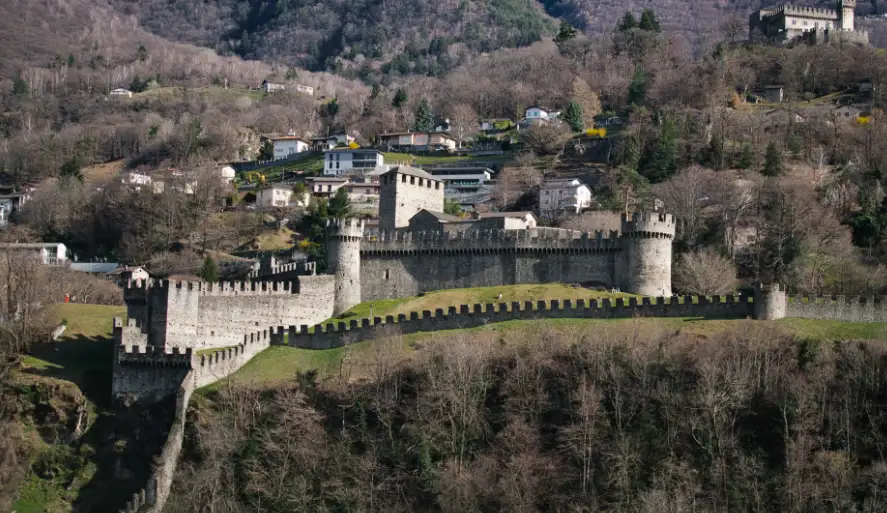
Bellinzona Castles: Where Medieval Power Meets Living Valley
I stand on the ramparts of Castelgrande at 9:50 on a bright September morning. The sun warms the grey stone beneath my hands. I buy a warm pastry from the small kiosk inside the upper gate. It costs three francs. Below me the valley spreads wide — the river glinting, terracotta rooftops clustered, roads converging from every direction. Bellinzona sits where the Alps open toward Italy. For millennia whoever held these heights controlled the passage north and south. Three castles stand guard still, perched on ridges that rise straight from the plain. They do not just overlook the town. They define it.
Why Bellinzona Castles Matters
These fortifications secured the most vital alpine crossing of the Middle Ages. Armies, emperors, merchants, and pilgrims passed beneath their walls. Rival powers fought for them for centuries — Uri, Milan, the Swiss Confederation. All three castles and the connecting town walls became a UNESCO World Heritage site in 2000. Today they stand remarkably intact. That preservation brings crowds. Castelgrande fills with day trippers between 11 AM and 3 PM. The other two castles stay quieter but see fewer visitors. Signage can feel sparse in places. Some sections have steep uneven steps and no handrails. For all their fame, they remain genuinely imposing — nothing softens the scale or the history.
The Best Time to Experience Bellinzona Castles
Late April through early July brings warm days and green slopes. Daytime temperatures sit between 18°C and 26°C, or 64°F and 79°F. Nights stay mild at 10°C to 16°C, or 50°F to 61°F. July and August are warmest — 24°C to 30°C, or 75°F to 86°F — and busiest. September offers perfect balance: golden light, thinner crowds, and readings of 20°C to 25°C, or 68°F to 77°F. This is widely considered the best month. Winter stays mild — 6°C to 12°C, or 43°F to 54°F — but some upper paths and outdoor areas close in rain or ice. Spring rain can make stone steps slippery in April and May.
Approximate Budget for a 7-Day Trip
Prices are in Swiss francs per person.
- Accommodation: 140–280 francs per night. Bellinzona centre sits convenient and well-priced. Staying in nearby villages like Giubiasco saves 30 to 60 francs nightly. Locarno and Lugano are easy day trips from here.
- Food: 60–95 francs daily. Castle restaurants average 28–45 francs per main dish. Town centre trattorias serve pasta and risotto for 16–24 francs. Espresso costs roughly 4 francs.
- Transport: 25–45 francs daily. Local buses connect all three castles and run frequently. Short train rides to Locarno or Lugano cost 10–18 francs one-way.
- Attractions: 25–45 francs total. Combined ticket for all three castles ~22 francs. Individual castles cost less. Guided tours ~15 francs extra.
- Miscellaneous: 25–45 francs daily. This covers drinks, gelato, and small purchases.
Total estimated 7-day cost: 1,550–2,550 francs per person.
Organised day tours from Zurich charge 130–170 francs per person. Independent travel costs roughly 45 francs round trip by train. You stay longer and explore at your own pace. The restaurant inside Castelgrande charges 4 to 6 francs extra per drink. The café 100 metres downhill serves identical coffee at standard prices.
Essential Bellinzona Castles Experiences
- Climb Castelgrande first — The highest and oldest fortress crowns the central ridge. Towers, walls, and courtyards remain complete. The view across the valley and toward distant peaks unfolds in every direction. Arrive before 10 AM to have the ramparts quiet. Skip if you have mobility challenges — the ascent is steep and steps are uneven.
- Walk the connecting town walls — Sections of the medieval fortifications still link Castelgrande to Montebello. You pass through gates and towers that have stood for centuries. The path runs above rooftops and quiet lanes. It feels like walking through history rather than just looking at it. Allow one hour.
- Explore Montebello — The second castle sits on a lower ridge, closer to the modern town. It feels more enclosed, with thick walls and a quiet inner courtyard. The museum inside displays weapons, tools, and everyday objects from centuries of occupation. It sees fewer visitors and feels more peaceful.
- Reach Sasso Corbaro — Perched highest on the eastern ridge, this fortress stands apart from the other two. The approach feels exposed and dramatic. From the terrace you look down on the other castles and across the entire valley. It feels wilder and less restored — exactly its charm. Skip if you dislike heights or exposed paths.
- Wander the old town below — Cobbled lanes, painted facades, and small squares fill the space between the castle hills. This was the civilian settlement protected by the walls. The atmosphere stays warm and lived-in. Most visitors head straight for the castles and miss it.
- See the castles at sunset — As the sun dips low, stone glows deep gold. The ramparts empty of crowds. Views stretch farther and clearer in the evening light. Stay until the first lights flicker on in the valley below. It feels entirely different from the daytime visit.
Hidden Gems Most Travelers Miss
- The path between Montebello and Sasso Corbaro runs through olive groves and small vineyards. It sees almost no one. The castles appear framed through trees. It takes 25 minutes and feels like a secret walk.
- The small chapel beside the lower gate of Montebello dates to the 16th century. It sits beside the path, unmarked. The door stands open during daylight. Step inside for quiet and cool air.
- The viewpoint from the terrace behind the railway station faces straight toward all three castles aligned across the valley. No one gathers here. It is the perfect photo spot without crowds.
- The bakery in the old town, tucked down a side lane, makes sweet breads and biscuits that have been baked here for generations. Prices are lower than anywhere near the castle gates.
Cultural & Practical Tips
- Buy the combined ticket. It covers all three castles and costs less than buying separately. Keep it handy — you will show it at each gate.
- Wear sturdy shoes. Stone steps are worn smooth and can be slippery. Some sections have no handrails. Flip-flops are not suitable.
- Arrive early or late. Between 11 AM and 3 PM the castles feel busiest. Before 10 AM or after 4 PM you share the ramparts with only a few others.
- Carry water. There are no fountains or kiosks at Sasso Corbaro. The ascent feels longer when you are thirsty. Bring a bottle and refill in town.
- Respect quiet. People live and work in the lanes between the castles. Keep voices low and do not block doorways. This is still a functioning neighbourhood.
- Check closing times. Sasso Corbaro closes earliest — usually 5 PM. Allow enough time to walk up and back down before gates lock.
Essential Visitor Information
Location & Access: Bellinzona, Canton Ticino, at the southern end of the Gotthard route. Approximately 190 kilometres or 118 miles southeast of Zurich. By train via Gotthard — roughly 2 hours. By car via A2 motorway. Railway station sits 10 minutes’ walk from the castle approaches.
Tickets & Booking: Combined adult ticket ~22 francs. Children 6–16 half price. No reservation needed except for special events. Guided tours available on request.
Operating Hours: Daily year-round. Castelgrande 9 AM–6 PM; Montebello 10 AM–5:30 PM; Sasso Corbaro 10 AM–5 PM. Hours shorten in winter. Closed 1 January and 25 December.
Visit Duration: Minimum 3 hours for all three castles. One full day lets you walk the connecting walls, explore the old town, and stay for sunset. Two days gives time to visit nearby valleys without rushing.
Family Suitability: Families welcome. Lower sections are wide and accessible. Upper paths and towers have steep steps — hold children’s hands. Restrooms exist at each castle and in the town centre.
Timing: Mid-September balances warm days, golden light, thin crowds, and fair prices. Arrive before 10 AM any day. Weekends draw regional visitors.
Highlights: Castelgrande rampart panorama, medieval town walls, Montebello museum, Sasso Corbaro high terrace, old town lanes, sunset view across the valley.
Nearby & Day Trip: Locarno and Lake Maggiore 20 minutes. Lugano 30 minutes. Verzasca Valley 30 minutes. Gotthard Pass historic route 45 minutes. Milan 2 hours by train. Returning here at dusk means watching light fade across walls that have stood sentinel for 800 years.
Conclusion: Travel with Respect, Not Just View
Bellinzona Castles were not built as attractions. They were built to hold, to defend, to control passage through the mountains. Their stone carries the weight of centuries of conflict and trade. When you walk where soldiers stood and emperors passed, will you tread lightly enough to honour the history?
Comments
Post a Comment