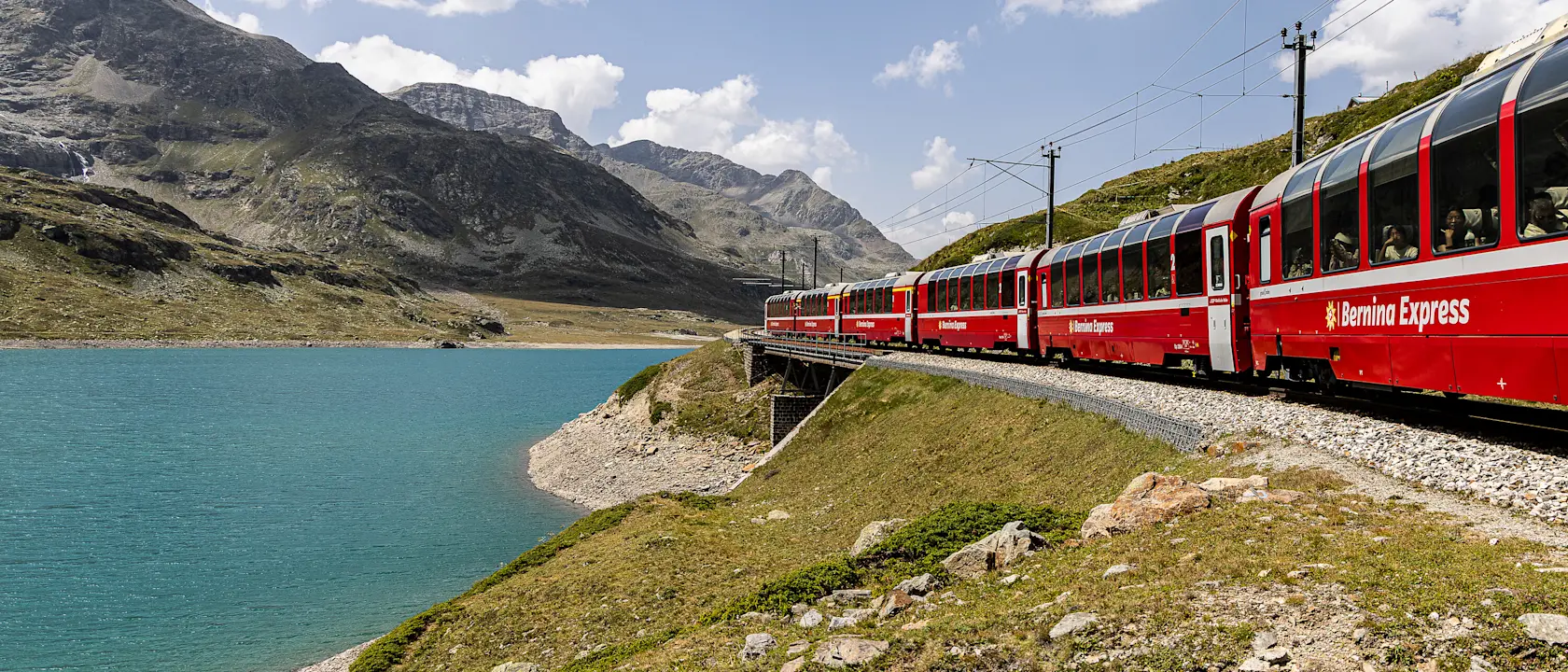
Bernina Express: Where Mountain Railway Meets Living Landscape
I board the train at Chur at 9:25 on a bright September morning. The carriage feels warm and wood-lined. I buy a coffee from the onboard counter. It costs five francs. The doors close and we glide out of the station. Within minutes the valley narrows and the line begins to climb — steadily, beautifully, without ever rushing. The Bernina Express is not a high-speed train. It does not need to be. Its purpose is to show you the mountains, not just cross them. Every window frames a new view. And every curve reveals something worth slowing down for.
Why Bernina Express Matters
The route follows the Rhaetian Railway’s Albula and Bernina lines, built between 1898 and 1910 to connect eastern Switzerland with the Engadin and beyond. No heavy machinery was used for most of the work — tunnels, viaducts, and stations were carved and laid by hand. The entire section became a UNESCO World Heritage site in 2008. Today the Bernina Express carries visitors along tracks that still serve local communities. This is a working railway, not a museum ride. That means it can feel busy. Carriages fill quickly in summer. Windows reflect light in certain seats. The train stops at every village along the way — locals board, children get off at school, farmers haul supplies. Some visitors find the pauses slow. Others realise this is the point: you are travelling with the valley, not just passing through it.
The Best Time to Experience Bernina Express
Late June through mid-September offers green meadows, long daylight, and wildflowers beside the tracks. Daytime temperatures sit between 14°C and 22°C, or 57°F and 72°F. July and August see the most passengers. September brings golden larch colour, thinner crowds, and readings of 11°C to 18°C, or 52°F to 64°F. This is widely considered the best month. Winter from December through March carries dependable snow and clear crisp days. The line stays open year-round — one of the few high-Alpine routes never to close. Views feel stark and bright, white against blue. February and March run busiest. Spring thaw can make lower slopes patchy April through May — still scenic, but less vivid. Trains run hourly most months; midweek services stay quietest.
Approximate Budget for a 7-Day Trip
Prices are in Swiss francs per person.
- Base Accommodation: 140–280 francs per night. Chur, St. Moritz, or Tirano make convenient starting points. Staying in smaller villages along the route saves 40 to 70 francs nightly.
- Food: 60–95 francs daily. Onboard snacks and light meals cost 8–18 francs. Village bakeries and cafés serve meals for 14–24 francs.
- Ticket & Reservation: Full route Chur–Tirano one-way approximately 76 francs. Seat reservation mandatory in high season — 10 to 30 francs extra. Swiss Travel Pass holders travel free but still need the reservation fee.
- Stopovers & Local Transport: 35–60 francs daily. Local trains connect every station along the line. Regional passes cover all services.
- Miscellaneous: 25–45 francs daily. This covers drinks, souvenirs, and small purchases.
Total estimated 7-day trip cost: 1,650–2,750 francs per person.
Organised guided tours from Zurich charge 140–190 francs per person one-way. Independent travel costs less than 80 francs total. You can hop off and reboard later trains at no extra cost. The dedicated panoramic carriages carry a premium reservation fee. Standard carriages use the same tracks and offer identical views — just book early to secure a window seat.
Essential Bernina Express Experiences
- Ride the Albula Viaduct section — Near Filisur the line curves across stone arches that seem to float above the valley. The train loops through tunnels and emerges facing a new direction. It feels like watching a living map unfold. Sit on the right side going upward. Skip if you dislike heights or tight curves — the gradient is gentle but the drop feels visible.
- Stop at Bernina Pass & Alp Grüm — At 2,253 metres the line crosses the watershed. From Alp Grüm the view drops straight toward the Palü Glacier and Italian valley. The terrace café sits right beside the tracks. Allow one hour for the stop. The return train runs hourly — plan your connection.
- Pass Lake Bianco & Lago di Livigno — The water glows intense turquoise beside the tracks. On clear days the surface mirrors peaks perfectly. The train slows naturally here. Have your camera ready but keep it inside — windows stay closed in most carriages.
- Descend the southern slope to Tirano — The landscape shifts dramatically. Stone chalets give way to terracotta roofs and chestnut trees. The light feels warmer, the air softer. You cross from one culture to another without leaving your seat.
- Walk the trail beside the highest section — From Ospizio Bernina a flat path runs parallel to the line past lakes and meadows. Trains pass slowly through the open landscape. You see the train itself as part of the scenery. Allow two hours one way.
- Board the local version instead — Regional trains use the same tracks and stop at every village. Carriages feel simpler, reservations are free, and you can open the windows. The journey takes 15 minutes longer but feels more authentic.
Hidden Gems Most Travelers Miss
- The station at Cavaglia sits beside three glacial lakes where ice once flowed down the slope. Short trails lead to each one. Almost no one gets off here. The stopover takes 45 minutes and feels entirely private.
- At Preda the line enters a long spiral tunnel. The train emerges above the entrance. You can stand on the platform and watch it reappear from the mountain. It is a marvel of engineering most passengers never see from outside.
- Lake Lej Nair sits just above the railway near Morteratsch. The train passes close but the best view is from the shore. Walk 10 minutes from the station and you catch the train gliding past blue water and white peaks.
- The restaurant at Alp Grüm has a premium terrace. The self-service hall inside serves the same view for half the price. Most people walk straight past to pay extra outside.
Cultural & Practical Tips
- Book seat reservations early. In July, August, and September, slots sell out 4 to 6 weeks ahead. You can travel on regional trains without booking — they follow the same route and cost nothing extra with a pass.
- Pick your side carefully. Chur→Tirano: right side up to Bernina Pass, left side descending into Italy. Tirano→Chur: reverse. Both sides see views — the difference is which valley faces you longest.
- Keep tickets visible. Staff check continuously. Digital passes work but load them before boarding — signal drops in tunnels.
- Layer clothing. Temperature at the pass can feel 8 to 10 degrees colder than Chur or Tirano. Even in summer, bring a jacket for stops at Ospizio Bernina and Alp Grüm.
- Respect local life. This is not a tourist ride alone — students, workers, and families use these trains daily. Keep voices low and leave space for boarding passengers with bikes and luggage.
- Do not rush. The line rewards slowness. Break the journey over two days, stay in Pontresina or St. Moritz, and see the light change on the mountains at different hours.
Essential Visitor Information
Route & Access: Chur → Filisur → Pontresina → St. Moritz → Ospizio Bernina → Alp Grüm → Tirano (Italy). 128 kilometres total. Journey time approximately 4 hours. Trains run hourly year-round. From Zurich connect via Chur; from Milan connect via Tirano.
Tickets & Booking: One-way Chur–Tirano ~76 francs. Reservation fee 10–30 francs depending on carriage type. Swiss Travel Pass / Eurail covers base fare — only reservation due. Book online 4+ weeks ahead for peak season.
Operating Hours: Daily year-round. First departure Chur ~6 AM; last return ~9 PM. Reduced service early January and November for short maintenance periods.
Visit Duration: Minimum 4 hours one-way. Two days lets you stop at key stations and explore. Three to five days lets you travel slowly, stay overnight in the Engadin, and return next morning.
Family Suitability: Families welcome. Wide aisles and large windows suit all ages. Restrooms on board. Stopovers at Bernina Pass and Alp Grüm need warm layers — air feels thin and brisk.
Timing: Mid-September balances warm days, golden larch colour, thinner crowds, and fair prices. Morning trains catch best light on north-facing slopes; afternoon return glows across the Italian valley.
Highlights: Albula curved viaducts, Bernina Pass high lakes, Alp Grüm glacier panorama, descent to Tirano, Cavaglia glacial lakes, local train alternative.
Nearby & Day Trip: St. Moritz 30 minutes. Pontresina 20 minutes. Swiss National Park 1 hour from St. Moritz. Chur — Switzerland’s oldest city — at the northern end. Returning by evening train lets you see the valley fade into dusk from the window.
Conclusion: Travel with Pace, Not Just Speed
The Bernina Express is famous for its views. But its true gift is something rarer — it reminds you that the journey itself can be the destination. No tunnels cut through the landscape to hurry you past. Every bend, every viaduct, every station honours the land it crosses. When you ride a line built by hand more than a century ago, will you slow down enough to see it properly?
Comments
Post a Comment