Dalarna Painted Horses: Where Craft Meets Heritage
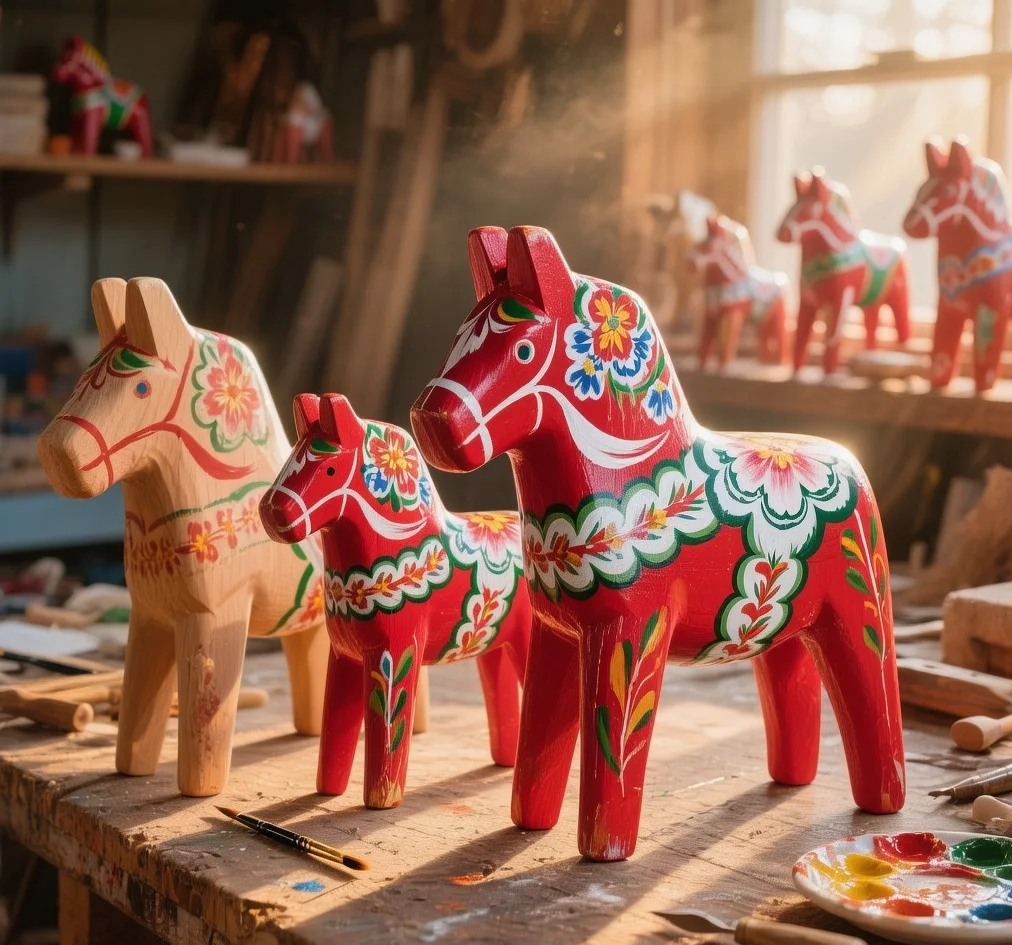
I stand in a woodcarver’s workshop near Nusnäs at ten in the morning in early September. Shavings cover the floor. I paid 195 SEK to watch the painting demonstration. A craftsman dips a brush into bright red paint. The strokes follow the wood grain — confident, flowing, never perfectly identical. No stencil guides the hand. Each horse takes shape slowly. It feels alive even before the clear coat goes on. The finished ones line shelves — red, orange, natural wood, different sizes. The largest cost thousands of kronor. Mass-produced copies sit in supermarkets for a fraction of the price. You can see the difference instantly. The real ones have soul.
Why Dalarna Painted Horses Matter
The story began in the 17th century. Carvers in Dalarna’s forests made small wooden horses as simple toys for children. Over time painting styles evolved — bright base colours, floral patterns, curved lines, and distinct borders. By the 19th century the horses had become symbols of the region, carried as gifts or sold at markets. In 1939 they represented Sweden at the New York World’s Fair, and the world took notice. Today they stand as one of Sweden’s most recognizable symbols. But fame brings strain. Factories churn out cheap versions overseas. The genuine article takes hours of skilled work. Some workshops worry that people no longer understand what makes a real Dala horse real. It is not the shape or the colour. It is the human hand behind it.
The Best Time to Experience Dalarna Painted Horses
Mid-June through mid-August brings long days and open workshops — 15°C to 22°C (59°F to 72°F). Most carving studios welcome visitors daily. Summer tourists fill the workshops. Late August into September offers golden light and quieter visits — 10°C to 16°C (50°F to 61°F). Woodcarving is in full swing before winter slows production. October through April sees shorter hours and fewer visitors — -2°C to 4°C (28°F to 39°F). Some smaller workshops close entirely or run on reduced schedule. May is fresh and green — 8°C to 14°C (46°F to 57°F). New work seasons begin. Avoid Midsummer weekend. Every shop is crowded and demonstrations book up fast. Weekdays from late August through early September give you the best balance of access and calm.
Approximate Budget for a 7-Day Trip
Most visitors base themselves around the Siljan Lake area — Nusnäs, Rättvik, Mora. Here is what one week costs for two people.
- Accommodation: 8,050 SEK — 7 nights guesthouse at 1,150 SEK nightly. Staying in a self-catering cottage outside the main villages cuts this to roughly 6,300 SEK.
- Food & Drink: 840 SEK per person daily. Restaurants near famous workshops charge premium prices. Eat in smaller villages or cook some meals to save.
- Transport: Round-trip train Stockholm–Mora 1,500 SEK. Car rental 600 SEK per day — recommended to reach independent studios spread across the region.
- Workshops & Experiences: 600 SEK total for demonstrations and small museum entry. Making your own painted horse workshop 1,200 SEK for two.
- Souvenirs & Miscellaneous: 1,500 SEK — genuine hand-painted horses start around 250 SEK each. Mass-produced versions cost much less but are not the same thing.
Total estimate: 13,490 SEK for two people. One warning: souvenir shops near major roads sell factory-made horses at inflated prices. Visit actual workshops instead — you pay fairer rates and support the craft directly.
Essential Dalarna Painted Horses Experiences
- Watch a Master Painter at Work — Stand close but quietly. You see how pressure and brush angle change the line. No two strokes match exactly. That imperfection is what makes it beautiful. Skip this if you rush; the work unfolds slowly.
- Make Your Own Small Horse — Guided session. You get the blank wood, choose colours, apply patterns. It will not be perfect. That is the point. Take it home as your own piece, not just a purchase.
- Visit Nusnäs Workshop District — The heart of the craft. Several family studios within walking distance. Each has its own style — brighter, softer, more detailed. Compare them and you learn to tell genuine work apart.
- See Historical Horses at Local Museum — Examples from 100 years ago. Simpler lines, darker colours, different shapes. You see how the design evolved without losing its spirit. Few visitors stop here.
- Walk the Village at Dusk — Wooden horses stand outside shops and homes as large decorative figures. Painted in traditional style. They look different in fading light. No ticket needed.
- Talk to the Carvers — Many workshops are family-run. Ask about their process. They explain the wood, the drying, the painting. Respect their time — they have work to finish.
- Winter Visit to a Quiet Studio — November through March. Fewer people, warm wood stove, focused work. You see the craft without crowds. Call ahead; hours vary.
Hidden Gems Most Travelers Miss
- Small Independent Studios — Away from Nusnäs main road. Signposted only by hand-painted boards. Families carving and painting alone. Their work feels personal and prices are fair.
- Natural Wood Series — Unpainted or lightly oiled. The grain shows through. Elegant and understated. Many visitors walk past them looking only for bright red.
- Pattern Detail Differences — Each workshop has signature flourishes. Border style, leaf shape, colour shade. Look closely and you will learn to recognize them instantly.
- Highway Souvenir Stalls — Convenient but mostly mass-produced. Buy directly from the source instead. The difference in quality and meaning is enormous.
Cultural & Practical Tips
- Learn to spot a genuine horse. Look for slight brush variations, hand-signed base, solid wood, and price reflecting hours of work. If it looks perfectly printed and costs very little, it is not hand-made.
- Respect workshop space. Do not touch wet paint or unfinished wood. Some areas are off-limits; follow signs.
- Carry purchases carefully. Clear coat scratches easily. Wrap them well and keep them on your lap during travel, not packed at the bottom of a bag.
- Ask before photographing. Some painters prefer their technique not shared online. Others are happy to pose. Always ask first.
- Book hands-on sessions early. They fill weeks ahead. Arriving hoping to join same-day usually means missing out.
- Visit more than one place. Styles differ. The first workshop is not the only one worth seeing. Drive ten minutes further and you may find your favourite.
- Support small. Family studios need your visit more than large commercial ones. Your purchase helps keep the craft alive for another generation.
Essential Visitor Information
Location & Access: Dalarna region, central Sweden. Main area around Nusnäs, 15 km south of Mora. Drive from Stockholm 4 hours. Train to Mora 3.5 hours then bus or taxi 20 minutes. Fly to Borlänge or Stockholm then connect.
Tickets & Booking: Most workshops free entry. Demonstration sessions 100–200 SEK adult. Make-your-own workshop 400–600 SEK per person. Booking recommended for hands-on sessions.
Operating Hours: Summer mid-June to mid-August generally 09:00–17:00 daily. Spring and autumn 10:00–16:00, closed Mondays. Winter reduced hours or by appointment.
Visit Duration: Minimum half day for Nusnäs area. Recommended 1–2 days to visit different workshops and villages.
Family Suitability: Excellent. Make-your-own sessions great for ages 6+. No stroller access in older workshops. Small children need supervision near tools.
Timing: Best season: late August to September. Best time of day: 09:00–11:00 before tour buses arrive.
Highlights: Live painting demonstrations, make-your-own workshop, historical collection, independent studio visits, village evening walks.
Nearby & Day Trip: Mora 15 km — Zorn Museum and lake. Rättvik 25 km — long pier and waterfront. Falun 1.5 hours — UNESCO mining area. Orsa 20 km — wildlife park.
Conclusion: Travel with Discernment, Not Just Shopping
A real Dala horse is not a souvenir. It is days of drying, hours of carving, years of practiced brushwork, and generations of tradition passed down. You will find mass-produced copies everywhere, prices that seem too good to be true, and busy shops where no one can explain what you are buying. You will also find quiet studios where every stroke matters and every piece carries a story. That is the one worth taking home. Will you choose the one made by hand?
Comments
Post a Comment