
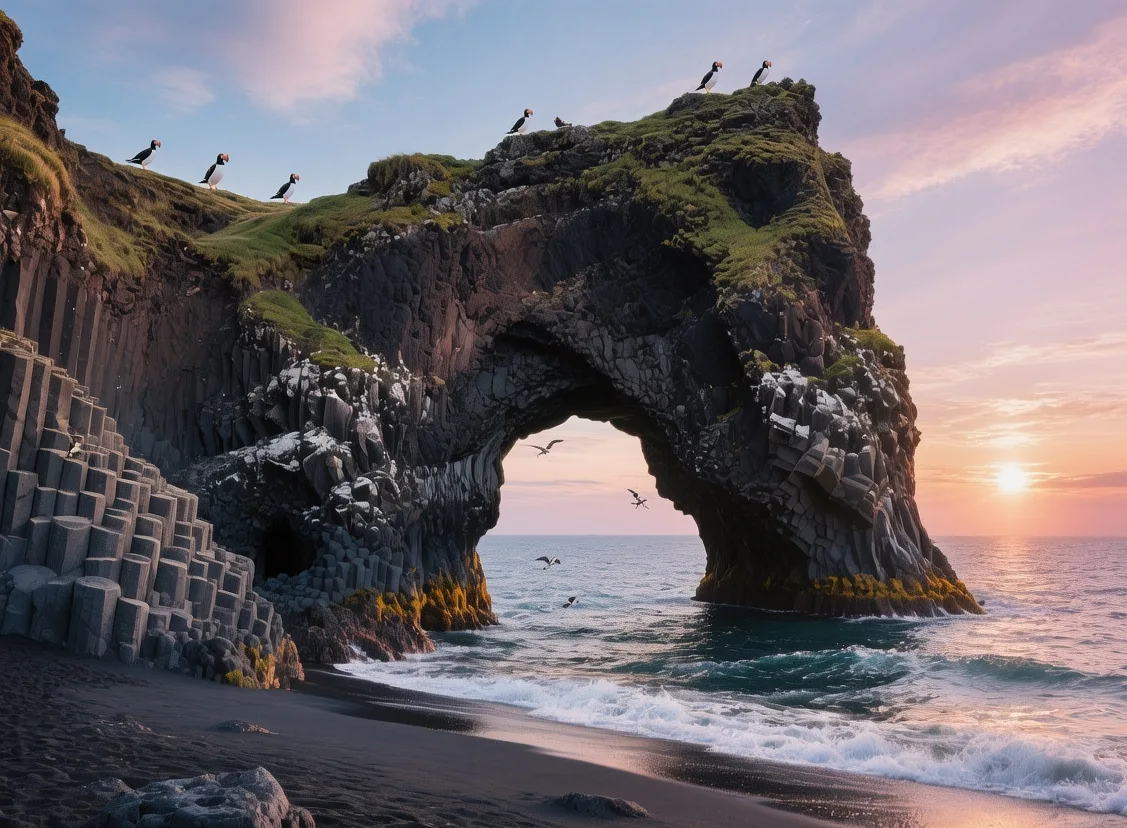
Dyrhólaey Black Sand Arch Volcanic Stone Meets Atlantic Fury
The wind howls—a constant, gale-force companion that whips your jacket and carries the salty spray of the North Atlantic. You stand at the edge of the cliff, 120 meters (394 feet) above the churning black sand below, looking through the massive stone arch that gives this place its name. The Dyrhólaey black sand arch rises like a cathedral door carved by millennia of wave erosion, framing the endless gray-blue ocean beyond. Basalt columns stack geometrically along the headland, remnants of ancient lava flows cooled rapidly by the sea. Below, waves crash against the shore with rhythmic violence, sending white foam across the dark volcanic sand. This isn't just a viewpoint; it's a nature reserve established in 1978, protecting nesting puffins and fragile geological formations from the encroachment of modern tourism. In 2026, as coastal erosion accelerates and wildlife habitats shrink globally, the Dyrhólaey black sand arch matters now more than ever—a stark reminder that some landscapes demand distance to survive, where respect for nature outweighs the desire for proximity.
Why Dyrhólaey Black Sand Arch Embodies Icelandic Resilience
The Dyrhólaey black sand arch represents far more than a photographic backdrop—it is a monument to Iceland's volcanic origins and maritime history. Originally an offshore island formed by volcanic eruption approximately 100,000 years ago, Dyrhólaey (meaning "Door Hill Island") was connected to the mainland by sediment accumulation over centuries. The arch itself stands 120 meters (394 feet) high, wide enough for a small ship to pass through, though navigation here is treacherous. In 1919, the first lighthouse was constructed on the headland to warn ships of the dangerous reefs; it was upgraded in 1921 with a more powerful optic, standing sentinel through two world wars and countless storms.
Designated a protected nature reserve in 1978, the site solves a critical conservation need: balancing public access with wildlife preservation. The headland hosts one of Iceland's largest puffin colonies, with up to 10,000 pairs nesting annually between May and August. The tuff rock formation is soft compared to basalt, making it susceptible to erosion; unrestricted foot traffic would destabilize the cliff edges. Today, the area draws 500,000+ visitors annually, managed through designated viewing platforms and seasonal road closures. The Dyrhólaey black sand arch fulfills a human need for connection to raw geological power while demonstrating that preservation requires boundaries. It proves that tourism can coexist with conservation only when visitors accept limits on their access for the greater good of the ecosystem.
The Best Time to Experience Dyrhólaey Black Sand Arch
Timing your visit to the Dyrhólaey black sand arch requires balancing wildlife activity, weather safety, and road accessibility. For optimal puffin viewing and midnight sun photography, target May 15–August 10. During these windows, temperatures range from 7–13°C (45–55°F), and daylight stretches 20–24 hours, allowing evening visits when the light is soft and golden. The puffins are most active between 6:00–9:00 PM, diving into the ocean to feed their chicks. Crowds are manageable if you arrive before 10:00 AM or after 7:00 PM.
For dramatic storm photography, visit between October 15 and March 1. Temperatures drop to -2–5°C (28–41°F), and the ocean becomes turbulent, creating spectacular wave action against the arch. However, the road to the summit (Route 218) is often closed during winter due to ice and snow. Plan your visit between 11:00 AM–3:00 PM for maximum daylight. Avoid December 20–January 10 unless confirmed open; the road is frequently impassable, and visibility can drop to zero in blizzards. Also skip June 20–July 5 if you dislike congestion; this peak window brings 2,000+ daily visitors.
For real-time road status and weather, verify at www.road.is and www.vedur.is. The gate to the summit opens at 8:00 AM and closes at 10:00 PM in summer; winter hours vary based on conditions.
Approximate Budget for a 7-Day Trip (2026)
Exploring the Dyrhólaey black sand arch anchors a week-long South Coast adventure. This budget assumes a 7-day trip based in Reykjavík or Vík with day trips along the Ring Road. Prices reflect 2026 rates, accounting for Iceland's average 3.8% annual inflation from 2024–2026 (source: Statistics Iceland). All amounts shown in euros; multiply by 1.08 for USD equivalents. Note that Iceland uses ISK, but € is provided for international comparison.
Accommodation: €150–€320 per night
• Budget guesthouse in Vík (near Dyrhólaey): €150–€200
• Mid-range hotel (Selfoss area): €220–€280
• Luxury (Hotel Ranga or similar): €380–€550
• Camping (seasonal, Vík): €25 per person
Food: €55–€95 per day
• Breakfast: €12–€18 (hotel buffet or bakery pastry + coffee)
• Lunch: €18–€28 (Icelandic lamb soup, fish of the day, or hot dog)
• Dinner: €25–€49 (pan-fried Arctic char or traditional lamb)
• Groceries (self-catering): €35/day
Transportation:
• Keflavík Airport to Reykjavík Flybus: €32 round-trip
• Rental car (4x4 SUV, 7 days): €420 + €160 fuel
• South Coast day tour: €95
• Reykjavík city bus (Strætó): €3.20 per ride
• Dyrhólaey parking: Free (donation suggested)
Attractions:
• Dyrhólaey viewpoint: Free
• Reynisfjara black sand beach: Free
• Skógafoss waterfall: Free
• Sólheimajökull glacier tour: €85
• Perlan Museum: €30
• Blue Lagoon day trip: €110
• Golden Circle tour: €95
Miscellaneous:
• Icelandic wool sweater (lopapeysa): €110–€180
• Waterproof jacket: €120
• Travel insurance: €55
• Souvenirs (lava rock, handicrafts): €40
• Tips (not expected but appreciated): €25
Total for 7 days (mid-range): €2,250–€2,600 per person
Total (budget-conscious): €1,500–€1,750 per person
6 Essential Dyrhólaey Black Sand Arch Experiences
1. View the Arch from the Upper Platform: Drive to the summit parking lot via Route 218. Walk the short gravel path to the fenced viewing platform. The arch frames the ocean perfectly from this angle. Visit at 8:00–10:00 PM in summer for midnight sun lighting. The wind is strongest here; secure your hat and hold onto railings. This is the safest and most iconic perspective of the Dyrhólaey black sand arch.
2. Watch Puffins in Their Natural Habitat: Between May and August, puffins nest on the cliff edges. Bring binoculars to observe them without disturbing the colony. Stay behind the marked barriers; approaching closer than 5 meters causes parents to abandon nests. Visit at 6:00–8:00 PM when birds return with fish. The sound of thousands of wings flapping is unforgettable. This experience highlights the ecological importance of the reserve.
3. Photograph the Basalt Columns: The headland features geometric basalt formations similar to Reynisfjara but less crowded. Position yourself on the eastern side of the summit. The best light occurs between 10:00 AM–12:00 PM when the sun illuminates the column faces. Use a polarizing filter to enhance the contrast between black rock and green moss. Bring a tripod, but anchor it against the wind. These columns reveal the volcanic history of the South Coast.
4. Visit the Lighthouse: The current lighthouse stands near the summit, automated since 1995 but historically significant. Walk the 500-meter path from the parking lot to the structure. The white tower contrasts sharply against the black landscape. Visit at 2:00–4:00 PM for optimal shadows. While you cannot enter the tower, the exterior offers historical context. Read the information plaque detailing the 1919 construction and 1921 upgrade.
5. View the Beach from Above: Never walk on the beach directly below the arch due to dangerous sneaker waves. Instead, view the black sand shoreline from the cliff top. The contrast between white foam and black sand is striking. Visit at 5:00–7:00 PM when the tide is low. Use a telephoto lens to capture wave patterns without risking safety. This perspective emphasizes the power of the Atlantic Ocean against the land.
6. Drive the Coastal Route 218: The road to Dyrhólaey is unpaved gravel for the final 2 kilometers. Drive slowly to avoid dust and stone chips. The ascent offers panoramic views of Vík village and Reynisfjara. Best driven at 9:00–10:00 AM before tour buses arrive. Ensure your rental car agreement permits gravel road driving. This journey builds anticipation before reaching the summit viewpoint.
3 Hidden Gems Most Travelers Miss
• Hjörleifshöfði Mountain: Located 15 kilometers east of Dyrhólaey on Route 218. This volcanic plug offers hiking trails with views exceeding those from the arch. Access requires a 2-hour hike round-trip. Why overlooked: Requires physical effort; tour buses skip it. Best visited at 7:00–8:00 AM for sunrise. Coordinates: 63.4167° N, 19.2333° W. Insider tip: Look for the grave of Hjörleifur, a Viking settler, at the summit.
• Vík Church Viewpoint: Located in Vík village, 5 kilometers west. The churchyard offers a panoramic view of Dyrhólaey in the distance. Open 24/7; entry is free. Why overlooked: Tourists focus on the arch itself and miss the contextual view from town. Best visited at 6:00–7:00 PM for sunset. Insider tip: Combine with a visit to the Vík wool store for authentic souvenirs.
• Reynisfjara Cave (Restricted): Located near the black sand beach base. While the main cave is often closed for safety, the basalt columns nearby are accessible. Access via the beach parking lot (€8 fee). Why overlooked: Safety closures confuse visitors; many turn away entirely. Check with local guides for safe access times. Insider tip: Never turn your back on the ocean; sneaker waves reach 30 meters inland.
Cultural & Practical Tips
• Respect wildlife barriers: Fences exist to protect puffin nests, not just visitors. Climbing over barriers fines you up to €500. Stay on marked paths; the soil is fragile and erodes easily. Disturbing nests causes chick mortality. This ensures the Dyrhólaey black sand arch remains a living habitat.
• Wind preparation: The headland is exposed to full Atlantic gales. Even in summer, wind speeds reach 60 km/h (37 mph). Bring a windproof jacket and secure loose items. Temperatures at the summit average 3–5°C cooler than Vík village. Check www.vedur.is for wind forecasts before ascending.
• Learn these Icelandic phrases:
— Takk (tahk): Thank you
— Góðan daginn (go-than dy-in): Good day
— Dyrhólaey (deer-ho-lay): The headland's name
— Lundi (lun-di): Puffin
Icelanders appreciate effort; pronunciation matters less than attempting the language.
• Photography guidelines: Tripods permitted on viewing platforms but cannot block paths. Drone use strictly prohibited without special permit from the Icelandic Transport Authority (apply 4 weeks ahead). Best light: Midnight sun (10:00 PM–12:00 AM summer); golden hour (8:00–10:00 PM). Respect other visitors; don't monopolize the railing.
• Road conditions: Route 218 is gravel and steep. 4x4 vehicles recommended but not mandatory in summer. Winter access is frequently closed; check road.is. Parking lots fill by 11:00 AM in peak season. Arrive early or late to secure a spot. The road surface can be slippery when wet.
• Safety near cliffs: The edges are unstable and unfenced in some areas. Stay back at least 5 meters from the cliff edge. Do not climb down to the beach from the summit; the descent is dangerous. Keep children close and supervised at all times. Sneaker waves below are fatal; never turn your back on the ocean.
Conclusion: Travel with Respect, Not Just Proximity
The Dyrhólaey black sand arch demands more than a close-up selfie—it asks for respect. As you stand behind the fences looking out at the arch, recognize that you're not just visiting a viewpoint; you're entering a sanctuary where wildlife prioritizes survival over spectacle. In 2026, as coastal ecosystems face pressure from climate change and tourism, Dyrhólaey offers both beauty and boundary: that some wonders are best admired from a distance, that preservation requires sacrifice, and that future generations deserve to see puffins nesting undisturbed. Slow down. Listen to the wind that shaped this stone. Feel the spray that carries the ocean's power. Understand that this landscape exists because humans chose to step back. When you visit the Dyrhólaey black sand arch in 2026, don't just capture the stone for Instagram—contemplate the life it shelters. Don't just check a box—honor the reserve's purpose. Iceland protects this site not as a stage, but as a home. Learn. Reflect. Carry this respect home. The world needs more guardians of wild places, not just conquerors of views.