
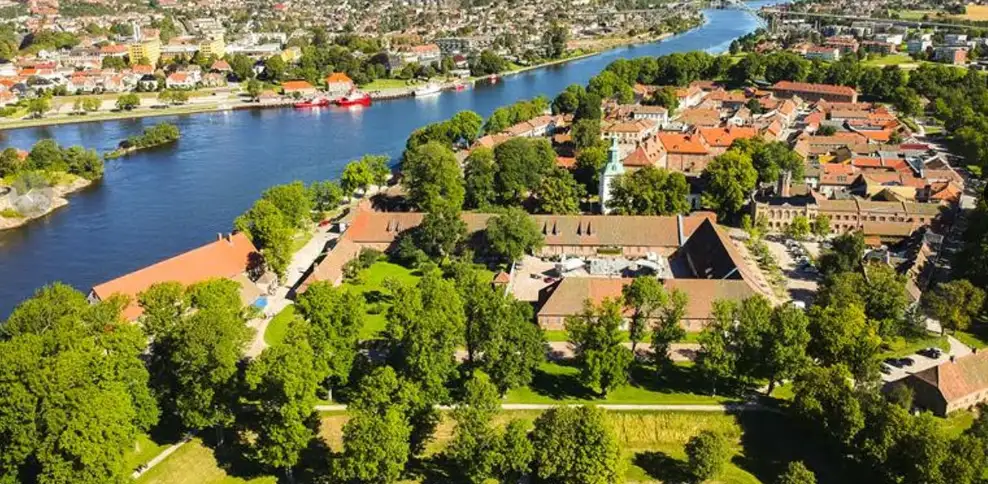
Fredrikstad Fortress Town Star-Shaped Walls Meet River Silence
The cobblestones click under your boots—a rhythmic, hollow sound that echoes through the narrow lanes—as you walk the ramparts at 7:15 AM. It is July 2026, and the morning mist clings to the Glomma river, casting a soft, diffused light across the Fredrikstad fortress town. You hear the distant cry of gulls circling the bastions, the gentle lap of water against the stone quay, and the silence of a military complex that has stood guard since 1567. This star-shaped fortification—covering 60 hectares with 12 bastions—is the best-preserved fortress town in Northern Europe, a wooden time capsule spared from modern development. It is 2026, and the Fredrikstad fortress town stands at a critical juncture. Climate change threatens the wooden structures with humidity fluctuations; tourism surges along the coastal route; yet the King's Gate remains intact. You are not just visiting a museum; you are stepping into a living testament to military engineering—and where your presence must be mindful to ensure this wooden cathedral endures.
Why Fredrikstad Fortress Town Embodies Military Heritage
The Fredrikstad fortress town is not merely a scenic district; it is a masterpiece of 16th-century defensive architecture. Historically, this location solved a critical strategic need: protecting the mouth of the Glomma river, Norway's largest waterway, from Swedish invasion. King Frederik II founded the town in 1567 after the previous settlement burned, designing it with a star-shaped layout to eliminate blind spots for cannon fire. The engineering required to construct these earthworks was significant: ramparts rising 10 meters high, surrounded by a water-filled moat, with walls reinforced by oak palisades. The town contains over 170 wooden buildings, most dating from the 18th and 19th centuries, preserved within the fortification lines.
What distinguishes this site is the completeness of the urban plan. Unlike other fortresses reduced to ruins, the Fredrikstad fortress town remains a functioning neighborhood where people live and work. In 2026, the management faces the challenge of balancing preservation with habitation. The wooden facades require constant maintenance against rot and insects; visitor numbers are monitored during peak season to prevent wear on the historic cobblestones. The National Property Estate manages the site, ensuring that restoration uses traditional materials like tar and linseed oil. This interplay between historical permanence and ecological fragility creates a unique responsibility. You walk on streets that have marched soldiers for 400 years, yet one careless touch can damage the patina of history. Preservation here is not passive; it requires active stewardship from every visitor who respects the sanctity of the space.
The Best Time to Experience Fredrikstad Fortress Town
For the optimal cultural experience, plan your visit between June 15 and August 15—the peak summer window when the museums are open daily, temperatures range from 15–22°C (59–72°F), and daylight persists until 10:00 PM. During this period, the best photography light occurs between 8:00 PM and 10:00 PM, when the setting sun illuminates the wooden facades without harsh shadows. For winter enthusiasts, the optimal window shifts to December 15 to January 15, when the town hosts its Christmas market, temperatures hover around -5–5°C (23–41°F), and the contrast of snow against dark wood is striking. The winter atmosphere is visible on approximately 80% of days during this window.
Avoid traveling between October 15 and November 30 unless you seek specific off-season conditions: many attractions close for maintenance, temperatures fluctuate wildly, and rainfall is high. The cobblestones can become slippery when wet. For current opening hours, verify at fredrikstad.kommune.no and weather forecasts at yr.no. The shoulder season (September 1–September 20) offers a compelling alternative: fewer crowds, autumn colors on the trees, and prices 25% lower than peak summer, though daylight decreases rapidly. Always check event schedules at visitnorway.com; the fortress may host reenactment events that affect access.
Approximate Budget for a 7-Day Trip (2026)
Visiting the Fredrikstad fortress town requires a base in Eastern Norway, making this budget reflective of a 7-day regional trip centered around Fredrikstad. The following estimates assume a mid-range travel style: staying in local hotels or cabins, eating a mix of self-catered meals and local seafood, renting a car for essential mobility, and participating in guided activities. Prices reflect 2026 estimates with a 3.5% inflation adjustment based on 2025 Statistics Norway (SSB) data for Viken county.
- Accommodation: €140–€240 per night for a double room in Gamlebyen; budget hostels start at €70/night; camping cabins €90/night
- Food: €65–€85 per day: breakfast €12 (included at most lodgings), lunch €18 (fish soup or open-faced sandwiches), dinner €35–€45 (fresh cod or lamb with local beer)
- Transportation: €320 total: rental car €70/day (5 days, essential for Route 108), fuel €100 (350 km total driving), train Oslo–Fredrikstad €45 round-trip, local bus route 100 (€12 day pass, limited frequency)
- Attractions: €130 total: Fortress Museum entry €20, guided walking tour €40, museum entries €30, boat cruise €40, cultural workshop €20
- Miscellaneous: €85: souvenirs (wool sweater €50, local aquavit €20, artisan jewelry €15), rain gear rental €10, emergency buffer €10
Total for 7 days: €1,420–€1,720 per person (based on double occupancy)
6 Essential Fredrikstad Fortress Town Experiences
- Walk the Ramparts: Begin at 10:00 AM from the King's Gate. The 2-kilometer path circles the entire fortress. Spend 90 minutes walking the earthworks. The light at 11:00 AM renders the wood surreal—shadows highlight the details. Bring warm layers; temperatures on the ramparts are 2°C cooler than the town. This experience immerses you in the military heart of the fortress.
- Visit the Fortress Museum: Located in the Commandant's House, open 10:00 AM–6:00 PM daily (June–August). Spend 90 minutes exploring exhibits on military history. The guided tour departs at 11:00 AM and 3:00 PM (€20). Don't miss the original uniforms and the model of the fortress. The facility focuses on conservation and education. The building itself dates to 1760, preserving the industrial heritage of the region.
- Explore the Cobblestone Streets: Position yourself at Storgata at 2:00 PM. The 1-kilometer path follows the main thoroughfare. From the hill, you see the church against the sky backdrop. The light at 3:00 PM is bright enough to see the stone details. Bring sturdy boots; the path is uneven. Carry a headlamp with red light mode to preserve night vision.
- Take the River Cruise: Located near the quay, open 10:00 AM–6:00 PM daily (June–August). Spend 60 minutes cruising the Glomma river. The architecture contrasts beautifully with the natural landscape. The light at 11:00 PM in June renders the scene surreal—shadows disappear, and the water glows. Bring windproof layers; temperatures on the fjord are 3°C cooler than the valley. This experience immerses you in the cultural heart of Fredrikstad.
- Cycle the Outer Defenses: Book a 2-hour tour departing at 1:00 PM from the visitor center (€40). Wear provided helmets if renting. You'll glide past bastions and bridges without engine noise. The silence of the electric motor allows you to hear the water and wildlife without disturbance. Tours operate May–September, weather permitting. No prior experience needed. This moment—standing on a bike at sunset, bathed in golden light—defines the experience.
- Watch the Sunset from the Quay: Arrive at 8:30 PM in late June. The main harbor, backed by mountains, offers one of the best vantage points for the sun dipping toward the horizon without setting. Bring a thermos of coffee and a warm blanket. The stone retains heat from the day, making it comfortable to sit even at night. Swim if you dare—the water temperature averages 16°C (61°F) in summer. This moment—standing on a canal quay at sunset, bathed in golden light—defines the experience.
3 Hidden Gems Most Travelers Miss
- Isegran Island: While everyone visits the main fortress, the Isegran island offers equally iconic views. Located 2 kilometers east, this spot offers a glimpse into shipbuilding history. Access is via footbridge (open 24 hours). Best visited at 8:00 PM when light is soft. Why it's overlooked: most visitors drive straight into Fredrikstad without exploring the outer islands. Insider tip: Use a telephoto lens (70-200mm) to capture the shipyard against the river. Watch for trail markers; do not wander off path.
- Gressholmen Battery: Just 5 kilometers south lies the historic battery, hosting unique views of the lights reflecting off glaciated peaks. This spot hosts unique marine life adapted to brackish water. Open daily 24 hours. The wooden cabins contrast beautifully with the snowy landscape. Why it's missed: most tourists stop at the fortress and skip the southern islands. Insider tip: Visit the coffee shop on the waterfront for homemade waffles (€8). The view back toward the fortress from here is unique and less crowded.
- Fredrikstad Cathedral: Accessible only by foot or car, this historic stone church near the village requires a 15-minute drive from the E105 (look for the signpost near the harbor). The church features white stone and vertical cliffs that amplify sound. Service times matter: visit outside Sunday 11:00 AM for quiet reflection. Check opening times at kirken.no. Why it's overlooked: no signage and requires moderate fitness. Insider tip: Bring a waterproof bag for your phone; waves can splash high during incoming tide. No facilities exist here—pack out all trash.
Cultural & Practical Tips
- Respect Historic Structures: The Fredrikstad fortress town is a living heritage site. Do not touch the wooden facades. Stay on marked paths. Photography is permitted without flash. Use red light mode to preserve night vision for yourself and others.
- Learn three Norwegian phrases: Takk (tahk—thank you), Unnskyld (oon-shuld—excuse me), and Ha det bra (hah deh bra—goodbye). Locals appreciate the effort, though 95% speak fluent English.
- Photography guidelines: Drone flights require permission from the Norwegian Civil Aviation Authority (apply at luftfartstilsynet.no). Drones are prohibited near populated areas without special permit. Respect privacy—do not photograph tourists without consent. Tripods are permitted in public areas.
- Weather preparedness: Weather changes rapidly; pack layers (wool base, fleece mid, waterproof outer). Even in July, temperatures can drop to 10°C (50°F) with wind chill. Rain occurs on 200 days annually. Waterproof boots are essential for walking.
- Driving etiquette: Speed limits are strictly enforced (80 km/h on open roads, 50 km/h in villages). Use pull-outs to let faster local traffic pass. Watch for sheep, especially at dawn and dusk. Winter tires are mandatory November–April.
- Accessibility note: Major villages (Fredrikstad, Gamlebyen) have wheelchair-accessible paths, but cobblestone streets are generally uneven. The Museum entrance has ramp access. Request the accessible travel guide at visitnorway.com.
- Emergency contacts: Medical emergencies: 113. Police: 112. Tourist information: +47 69 30 00 00. Nearest hospital: Sykehuset Østfold (5 km), 24-hour emergency. Coastguard: 120. Mobile coverage is good on E6 but spotty on hikes.
Conclusion: Travel with Reverence, Not Just Sightseeing
The Fredrikstad fortress town demands more than your admiration; it requires your stewardship. This landscape—carved by earth, sustained by wood, and inhabited by resilient communities—is not a theme park but a living ecosystem where every footprint matters. When you visit in 2026, remember that the timber is fragile, the history is deep, and the roads are lifelines for residents who endure winter darkness so you can enjoy summer light. The wood that holds the roofs up is vulnerable to rot; the silence that honors the soldiers is fragile. So travel slowly. Buy local crafts from the village, not imported souvenirs. Stay on marked trails to protect the vegetation. Listen to the stories of the guides who still read the history like maps.
In an era of instant gratification and checklist tourism, Fredrikstad asks you to pause—to watch the light change on the wood for an hour without lifting your camera, to feel the cold wind without rushing indoors, to understand that you are a guest in a place that has survived millennia without you. Travel with reverence, and you ensure that the Fredrikstad fortress town heritage remains not just a photograph in your portfolio, but a thriving sanctuary where military history and modern heritage continue to coexist. The walls will stand long after we are gone; let us ensure they remain preserved enough to deserve their fame.