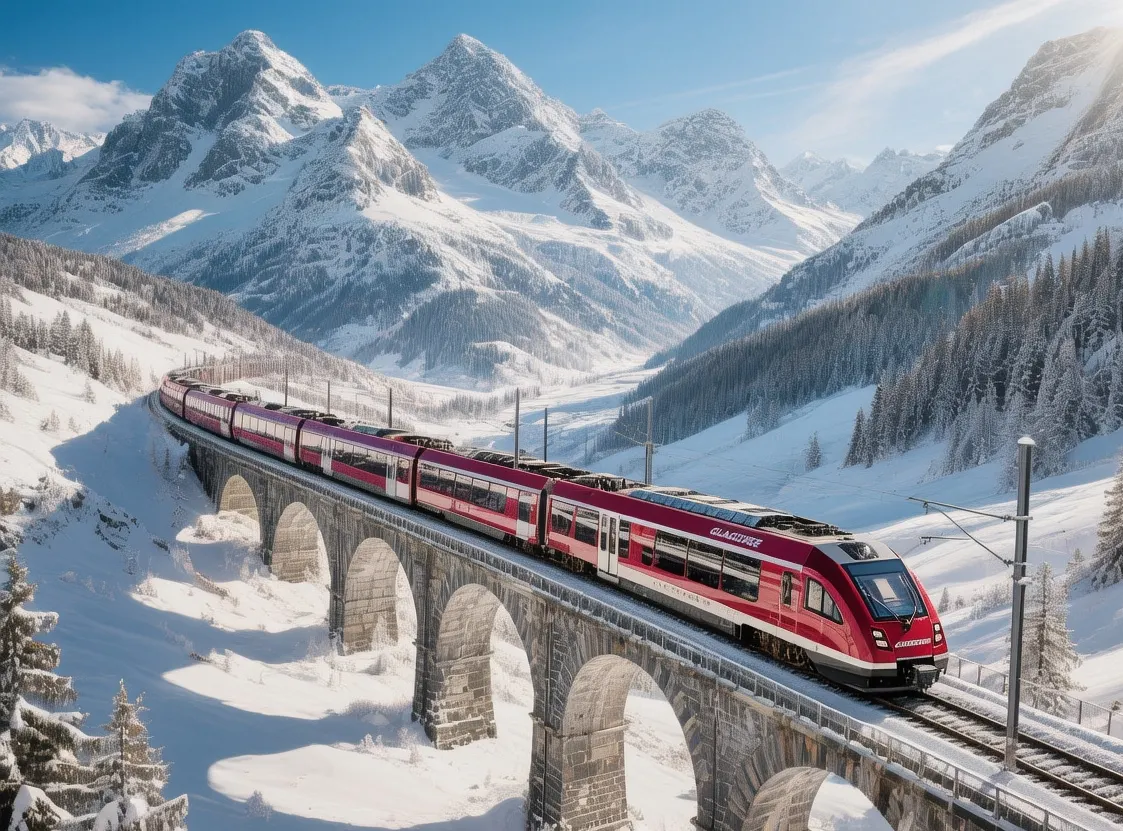
Glacier Express: Where Slow Speed Meets Alpine Grandeur
I settle into my seat at St. Moritz at 8:50 on a bright July morning. The carriage feels spacious, with large windows framing the platform. I buy a small apple and a bottle of water from the onboard bistro. It costs four francs. The train pulls away gently — no rush, no announcement of speed. It will take nearly eight hours to travel 291 kilometres. That is the point. The Glacier Express does not hurry. It winds through 91 tunnels and across 291 bridges, climbing and descending passes that once separated entire worlds. You do not just see the landscape. You move with it.
Why Glacier Express Matters
The service began in 1930, connecting St. Moritz and Zermatt across the heart of the Swiss Alps. It links two famous resorts but also preserves the older railways that once served isolated mountain communities. Today the route carries passengers along tracks that still see local trains and freight alongside the famous service. That shared status creates tension. The Glacier Express fills quickly in peak season. Seats feel narrow when full. Windows reflect light in certain directions. Some visitors find the journey too long. Others come to understand that slowness is the gift — the mountains deserve to be watched at walking pace, not highway speed.
The Best Time to Experience Glacier Express
Late June through mid-October is the main operating season. Daytime temperatures sit between 14°C and 22°C, or 57°F and 72°F. Valleys feel warm; passes stay cool. July and August run busiest. September brings golden larch colour, thinner crowds, and readings of 11°C to 18°C, or 52°F to 64°F. This is widely considered the best month. Limited winter services run December through March with snow-draped slopes and shorter daylight. Trains depart once daily in each direction. Spring and autumn schedules offer fewer departures — always check timetables before booking. Heavy storms can delay or reschedule services; this is rare but possible.
Approximate Budget for a 7-Day Trip
Prices are in Swiss francs per person.
- Accommodation: 180–360 francs per night. St. Moritz, Andermatt, and Zermatt command the highest rates. Staying in Chur, Brig, or smaller villages along the route saves 50 to 100 francs nightly.
- Food: 65–105 francs daily. Onboard meals cost 28–45 francs. Village bakeries and cafés serve meals for 14–24 francs. Coffee onboard costs roughly 5 francs.
- Ticket & Reservation: Full one-way adult fare ranges 150–260 francs depending on class and season. Mandatory seat reservation adds 30 francs. Holders of Swiss Travel Pass or Eurail still pay the reservation fee.
- Stopovers & Local Transport: 45–70 francs daily. Local trains connect every station along the route. Most are included with rail passes.
- Miscellaneous: 30–50 francs daily. This covers drinks, snacks, and small purchases.
Total estimated 7-day trip cost: 1,850–3,100 francs per person.
Full-service dining car meals carry a premium — 42 francs for a main dish comparable to village options at half the price. Standard panoramic carriages use identical tracks and views. Local trains follow the same sections and cost nothing extra with a pass. Break the journey over two days and save on accommodation costs too.
Essential Glacier Express Experiences
- Cross the Landwasser Viaduct — Near Filisur the train curves across six stone arches and directly into a tunnel carved into the cliff face. It is one of the most photographed railway structures in the world. Sit on the right side travelling St. Moritz toward Zermatt. Skip if you dislike heights — the drop feels sharp and unobscured.
- Climb the Oberalp Pass — The line winds steadily upward through meadows and forest to 2,033 metres. The view opens across rocky peaks and distant glaciers. The train slows naturally here. Have your camera ready. The descent toward Andermatt unfolds gradually and feels entirely different.
- Wind through the Rhine Gorge — Known as the Swiss Grand Canyon, this section runs beside turquoise water between towering rock walls. Sunlight shifts across the stone as the train moves. It feels like travelling through a living cathedral.
- Traverse the Mattertal before Zermatt — The final hours follow the valley floor past villages and forests. The Matterhorn appears and reappears between slopes, growing larger as you near the end. Arrival at Zermatt feels quiet and grand — no cars, just mountains.
- Break the journey at Andermatt — The historic village sits at the pass crossroads. Walk the cobbled lanes, visit the old stone bridge, and catch a later train. The change of pace restores energy. Trains run twice daily — plan your connection.
- Ride the local alternative sections — Regional trains use the same tracks at different times. Carriages feel simpler, windows open wider, and no reservation fee applies. The journey takes 20 minutes longer but feels closer to the land.
Hidden Gems Most Travelers Miss
- The short stop at Versam-Safien sits beside the Rhine Gorge. A riverside path leads downstream through quiet forest. Most passengers stay on board. Step off for 45 minutes and you see the gorge from ground level.
- At Oberalp Pass the train pauses briefly. A flat path leads uphill to a small lake. The water reflects peaks perfectly on calm mornings. You have enough time to walk there and back if you move quickly.
- The dining car carries a premium. The bistro counter serves identical coffee and simpler snacks at lower prices. The windows are the same and the view does not change.
- The section between Andermatt and Göschenen runs through deep forest. It sees fewer cameras than the viaducts but feels quieter and more intimate. Watch for waterfalls tumbling down the rock face beside the track.
Cultural & Practical Tips
- Book 3 to 4 months ahead for July, August, and September. Departures sell out and prices rise closer to travel. Shoulder months offer better availability and lower rates.
- Pick your side carefully. St. Moritz→Zermatt: right side for Landwasser, both sides for Oberalp, left for Matterhorn approach. Zermatt→St. Moritz: reverse. If both sides are full, accept middle seats — the train turns direction multiple times.
- Pack layers. Temperature shifts significantly between valleys and passes. What feels warm in the south can feel brisk at 2,000 metres. A light jacket belongs in your day bag.
- Charge devices beforehand. Power outlets are not available in all carriages. Signals drop in tunnels and deep valleys. Download maps and timetables before boarding.
- Respect space. Legroom is limited. Keep bags overhead or under the seat. Large suitcases go to designated racks — do not block aisles or doors.
- Do not treat stops as sightseeing breaks. Most pauses last only 2 to 3 minutes. The train departs promptly. If you want to explore, book a stopover ticket and continue next day.
Essential Visitor Information
Route & Access: St. Moritz → Chur → Andermatt → Brig → Zermatt. 291 kilometres. 8 hours total one-way. Daily departures mid-June to mid-October; limited winter service. Connect from Zurich via Chur; from Geneva via Brig; from Milan via Brig.
Tickets & Booking: One-way adult fare 150–260 francs. Reservation fee 30 francs mandatory. Swiss Travel Pass / Eurail covers ticket portion — only reservation due. Book online directly for best rates.
Operating Hours: One train daily each direction. Departure ~9 AM; arrival ~5 PM. Winter schedule reduced. Closed short periods in late autumn and spring for maintenance.
Visit Duration: Minimum 8 hours one-way. Two days lets you stop at Andermatt and Rhine Gorge. Three to five days lets you travel slowly, explore Zermatt, and return next day by local train.
Family Suitability: Families welcome. Large windows and steady pace suit children. Restrooms on board. Seats fill fast — book early. Bring activities; 8 hours feels long for younger travellers.
Timing: Mid-September balances warm days, golden larch colour, thinner crowds, and lower prices. Morning light favours southbound views; afternoon return glows across western slopes.
Highlights: Landwasser Viaduct, Oberalp Pass ascent, Rhine Gorge, Mattertal approach, Andermatt stopover, local train alternative.
Nearby & Day Trip: Zermatt and the Matterhorn at one end. St. Moritz and Engadin at the other. Brig connects to the Simplon Pass and Italy. Chur — Switzerland’s oldest city — sits 1 hour from the eastern start. Returning next day lets you see the route in new light.
Conclusion: Travel with Patience, Not Just Itinerary
The Glacier Express is famous as the world’s slowest express. That slowness is not a flaw — it is the whole point. It does not rush you past mountains, viaducts, or valleys. It stays with them. When you travel somewhere built by hand, one tunnel and one arch at a time, will you give yourself time to truly watch?
Comments
Post a Comment