
Gullfoss Waterfall Glacial Power Meets Icelandic Conservation
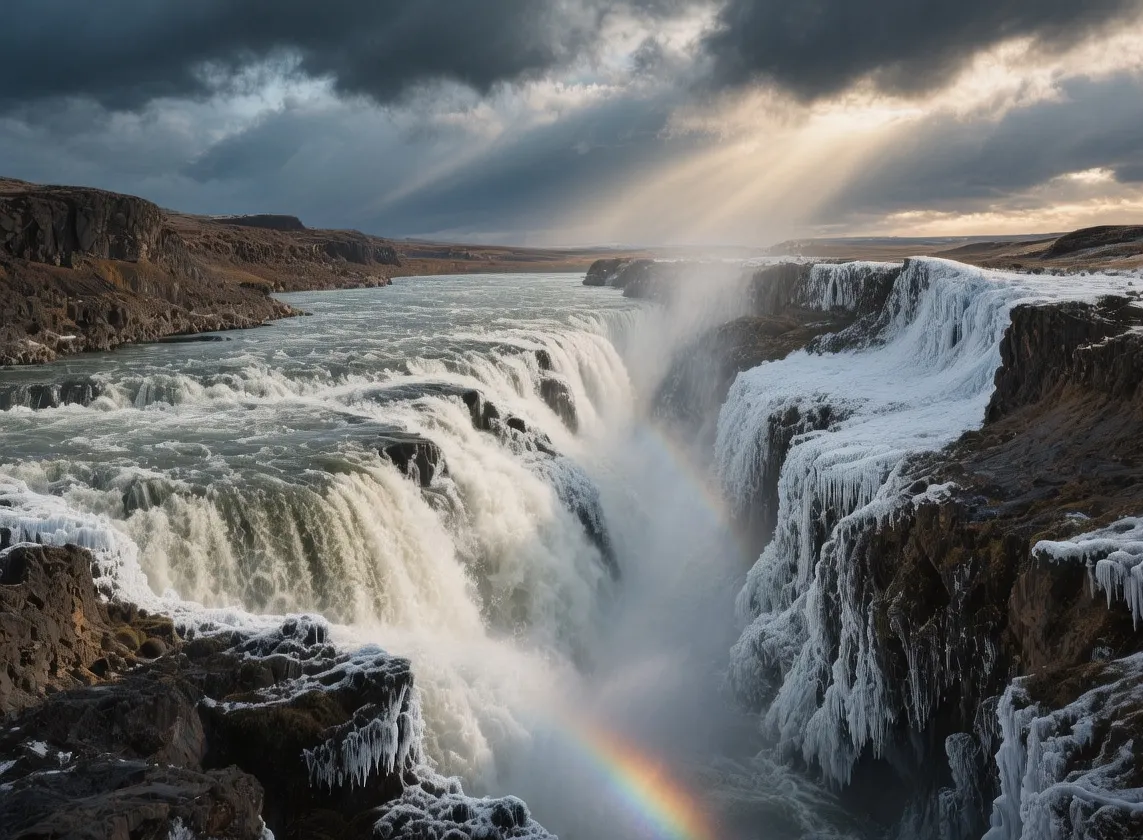
The roar hits you first—a thunderous crescendo that vibrates through your chest before you even glimpse the falls. You stand at the upper viewing platform, gripping the railing as the Hvítá river—swollen with glacial meltwater from Langjökull—plunges 11 meters (36 feet) into a narrow crevice, then crashes another 21 meters (69 feet) into a jagged canyon below. Mist rises in perpetual columns, catching sunlight in fleeting rainbows that dance across the basalt walls. This isn't just water falling; it's 140 cubic meters per second of raw glacial force carving through volcanic rock, a spectacle that has mesmerized visitors since Sigríður Tómasdóttir fought to preserve it in 1923. The canyon walls, stained orange and brown by centuries of mineral deposits, frame the falls like a natural amphitheater designed by geological giants. In winter, ice clings to the edges in frozen curtains; in summer, the flow swells with meltwater. Standing here in 2026, you witness more than natural beauty—you experience a triumph of environmental activism that saved Gullfoss waterfall from hydroelectric development, a reminder that some places are worth protecting at all costs.
Why Gullfoss Waterfall Embodies Icelandic Conservation
The Gullfoss waterfall represents far more than geological spectacle—it stands as Iceland's first conservation victory and a symbol of national environmental consciousness. In the early 20th century, foreign investors proposed harnessing the falls for hydroelectric power, a plan that would have flooded the canyon and destroyed one of Iceland's most iconic landscapes. Sigríður Tómasdóttir, daughter of the farm owner at Tómas, fought tirelessly against the development, even threatening to throw herself into the falls to stop construction. Her determination, combined with legal battles lasting until 1929, ultimately preserved Gullfoss in its natural state. Today, a memorial stone near the upper parking area honors her legacy, ensuring visitors understand that this landscape exists because one woman refused to surrender.
The waterfall's technical specifications are staggering: the Hvítá river, fed by the Langjökull glacier 40 kilometers away, averages 109 cubic meters per second in summer and 35 cubic meters in winter. The two-tiered cascade creates a total drop of 32 meters (105 feet), with the water disappearing into a 2.5-kilometer-long canyon carved during the last Ice Age. The upper falls measure 11 meters (36 feet); the lower section plunges 21 meters (69 feet) at a 70-degree angle into a gorge just 20 meters wide. This constriction amplifies the power, creating the characteristic thunderous roar audible from 500 meters away.
Designated a protected natural monument in 1979, Gullfoss waterfall now anchors the Golden Circle route, drawing over 1.5 million visitors annually. The site fulfills a critical need: proof that natural beauty and economic value aren't mutually exclusive. Tourism revenue funds conservation efforts across Iceland, while the falls themselves remain untouched by industrial development. The visitor center, built in 2006 using sustainable materials and geothermal heating, demonstrates how infrastructure can serve visitors without degrading the landscape. This balance between accessibility and preservation defines modern Icelandic environmental policy.
The Best Time to Experience Gullfoss Waterfall
Timing your visit to Gullfoss waterfall requires understanding Iceland's extreme seasonal variations and your tolerance for weather challenges versus crowd density. For optimal conditions combining accessibility, dramatic flow, and manageable tourism, target May 20–June 15 or September 10–October 5. During these shoulder seasons, air temperatures range from 5–12°C (41–54°F), and the waterfall flows at 80–120 cubic meters per second—powerful enough to create spectacular mist and rainbows without the overwhelming crowds of peak summer. Daylight stretches 18–20 hours in June, allowing evening visits when the low-angle sun creates golden illumination on the mist.
For winter photographers and ice enthusiasts, visit between November 20 and March 1. Temperatures drop to -8 to 2°C (18–36°F), and the falls partially freeze, creating spectacular ice formations along the canyon edges while the center continues flowing. The contrast between frozen spray and moving water produces ethereal blue ice sculptures. Plan your visit between 11:00 AM–2:00 PM for maximum daylight and safety. The pathways are heated to prevent ice accumulation, but wind chill can be severe—dress in layers.
Avoid July 1–August 20 if you dislike crowds. This peak window brings 5,000–8,000 daily visitors, creating bottlenecks at viewing platforms between 11:00 AM–3:00 PM when tour buses converge. Parking fills by 10:30 AM, and the mist from the falls soaks photographers jostling for position. Also skip December 25–January 2 unless prepared for potential road closures on Route 35 due to blizzards and limited services. For real-time road conditions and weather.
Approximate Budget for a 7-Day Trip (2026)
Exploring Gullfoss waterfall anchors a week-long Icelandic adventure. This budget assumes a 7-day trip based in Reykjavík with day trips to the Golden Circle. Prices reflect 2026 rates, accounting for Iceland's average 3.8% annual inflation from 2024–2026 (source: Statistics Iceland). All amounts shown in euros; multiply by 1.08 for USD equivalents.
Accommodation: €150–€320 per night
• Budget guesthouse in Reykjavík (101 district): €150–€200
• Mid-range hotel (Laugardalur area): €220–€280
• Luxury (Hotel Gullfoss or nearby): €350–€500
• Camping at Gullfoss (seasonal): €25 per person
Food: €55–€95 per day
• Breakfast: €12–€18 (hotel buffet or bakery pastry + coffee)
• Lunch: €18–€28 (Icelandic lamb soup, fish of the day, or hot dog)
• Dinner: €25–€49 (pan-fried Arctic char or traditional hákarl tasting)
• Groceries (self-catering): €35/day
Transportation:
• Keflavík Airport to Reykjavík Flybus: €32 round-trip
• Golden Circle day tour (Gullfoss/Geysir/Þingvellir): €85
• Rental car (compact SUV, 7 days): €380 + €140 fuel
• Reykjavík city bus (Strætó): €3.20 per ride
• Gullfoss parking fee: Free
Attractions:
• Gullfoss waterfall: Free
• Geysir geothermal area: Free
• Þingvellir National Park: Free (parking €7)
• Friðheimar tomato farm lunch: €38
• Perlan Museum: €30
• Secret Lagoon entry: €32
• Glacier hiking on Langjökull: €120
Miscellaneous:
• Icelandic wool sweater (lopapeysa): €110–€180
• Thermal base layers: €85
• Travel insurance: €55
• Souvenirs (lava rock, handicrafts): €40
• Tips (not expected but appreciated): €25
Total for 7 days (mid-range): €2,180–€2,520 per person
Total (budget-conscious): €1,450–€1,680 per person
6 Essential Gullfoss Waterfall Experiences
1. Descend to the Lower Viewing Platform: Take the stone staircase—258 steps carved into the hillside—from the upper parking area to the lower platform. The descent takes 15 minutes; allow 20 minutes to return. At the bottom, you stand just meters from the falls' base, where the spray soaks everything within a 50-meter radius. The roar becomes deafening; the ground vibrates beneath your feet. Wear waterproof clothing—cotton will soak through in minutes. This platform offers the most dramatic perspective, looking up at the water disappearing into the canyon. Visit at 2:00–4:00 PM when sunlight creates rainbows in the mist.
2. Walk the Upper Canyon Trail: From the upper parking area, follow the marked path along the canyon rim for 1.2 kilometers. This 30-minute walk offers multiple viewpoints where you peer directly down into the churning water before it plunges. The trail crosses volcanic scree and ancient lava flows, with interpretive signs explaining the geological formation. Best hiked at 9:00–10:00 AM before crowds arrive. The perspective from above reveals the river's violent entry into the narrow crevice—a sight invisible from lower platforms.
3. Visit the Gullfoss Visitor Center: Open daily 9:00 AM–6:00 PM (May–September) and 10:00 AM–4:00 PM (October–April), this facility houses exhibits on Sigríður Tómasdóttir's conservation fight and the waterfall's geological history. The café serves traditional rúgbrauð (rye bread baked using geothermal heat) with Icelandic butter. Entry is free; donations support conservation. Use the clean restrooms and free Wi-Fi here before exploring remote areas.
4. Photograph the Winter Ice Formations: If visiting between December and March, bring a tripod and telephoto lens. The spray freezes on contact with the canyon walls, creating massive ice sculptures that can reach 10 meters tall. The best vantage point is the upper platform at 11:00 AM–1:00 PM when light penetrates the canyon. Use a polarizing filter to reduce glare from ice and water. Shutter speeds of 1/60s or slower create silky water effects while maintaining ice detail.
5. Combine with Langjökull Glacier Tour: Book a 4-hour glacier hiking or ice cave tour departing from Gullfoss (€120–€180). The glacier feeding the waterfall sits 40 kilometers away, visible on clear days from the upper platform. Tours include transportation, crampons, and guide. This combination reveals the complete water cycle: from glacial ice to rushing river to thunderous falls. Depart at 10:00 AM for optimal glacier conditions.
6. Attend the Midnight Sun Viewing (June): During the summer solstice period (June 15–30), the sun sets after 12:00 AM and rises before 3:00 AM. Experience Gullfoss at 11:00 PM when the light turns golden-pink and crowds thin. The falls glow in perpetual twilight, creating surreal photography conditions. Bring warm layers—temperatures drop to 5–8°C (41–46°F) even in June. This is Iceland's magic hour that never ends.
3 Hidden Gems Most Travelers Miss
• Búðarháls Viewpoint: Located 3 kilometers east of Gullfoss on Route 35, this unmarked pull-off offers a panoramic vista of the entire canyon system from 400 meters elevation. Access requires a 10-minute scramble up a grassy slope. The perspective reveals how the river carves through the landscape, creating a 2.5-kilometer gorge invisible from standard viewpoints. Best visited at 7:00–8:00 AM for morning light. Why overlooked: No signage; requires independent exploration. Coordinates: 64.3267° N, 20.0833° W.
• Faxi Waterfall (Vatnsleysufoss): Situated 12 km from Gullfoss on the Tungufljót river, this 20-meter (66-foot) wide cascade is often skipped for its famous neighbor. A fish ladder allows salmon to migrate upstream, and there's a small café onsite serving fresh trout caught in the river. Open 10:00 AM–5:00 PM (summer). Entry: €5 parking fee. Why overlooked: Tour buses prioritize Gullfoss; Faxi offers intimate waterfall experience without crowds.
• Kerid Crater Lake: Located 10 km from Gullfoss on Route 35, this volcanic crater lake features striking red volcanic rock and aquamarine water. The 55-meter (180-foot) deep crater formed 3,000 years ago. Entry: €4 (self-service payment box). Open 24/7. Walk the rim (1.2 km, 30 minutes) or descend to the water's edge via stairs. Why overlooked: Requires separate entrance fee; many Golden Circle tours skip it to save time.
Cultural & Practical Tips
• Waterproof everything: The mist from Gullfoss soaks clothing within minutes at the lower platform. Bring a waterproof jacket with hood, waterproof pants, and protective covers for cameras/phones. Cotton clothing becomes heavy and cold when wet—wear synthetic or wool base layers.
• Wind awareness: The canyon creates wind tunnels that can reach 60 km/h (37 mph). Secure hats, scarves, and loose items. The combination of wind and spray creates dangerous wind chill even in summer—dress in layers you can adjust.
• Learn these Icelandic phrases:
— Takk (tahk): Thank you
— Góðan daginn (go-than dy-in): Good day
— Gullfoss (gull-foss): Golden waterfall
— Fallegt (fah-lekt): Beautiful
Icelanders appreciate effort; pronunciation matters less than attempting the language.
• Photography guidelines: Tripods permitted on designated platforms but cannot block paths. Drone use prohibited without special permit from the Icelandic Transport Authority (apply 4 weeks ahead at loftleidings.is). Best light: Early morning (8:00–10:00 AM) or evening (7:00–9:00 PM) in summer; midday (11:00 AM–2:00 PM) in winter when sun is highest.
• Safety barriers are non-negotiable: Never climb over railings or venture onto unstable canyon edges. The rock is slippery, and falls have resulted in fatalities. Stay on marked paths; the canyon walls are undercut and can collapse without warning. Keep children close and leashed pets away from edges.
• Facilities and accessibility: The visitor center has free Wi-Fi, café, and restrooms. The upper platform is wheelchair-accessible (paved path, max 5% grade). The lower platform requires descending 258 steps and is not accessible. Electric wheelchairs available free at visitor center (reserve 48 hours ahead: gullfoss@gullfoss.is). No ATMs onsite—bring cash for café purchases.
Conclusion: Travel with Reverence, Not Just Photography
The Gullfoss waterfall demands more than a quick photo stop—it asks for reverence. As you stand where glacial water crashes through volcanic rock, recognize that you're not just visiting a destination; you're witnessing a conservation victory that could have been lost. In 2026, as climate change accelerates glacial melt and threatens Iceland's hydrological systems, Gullfoss offers both wonder and warning: that natural wonders are finite, that human intervention can destroy or preserve, and that future generations deserve to experience what we inherited. Slow down. Listen to the thunder that convinced Sigríður Tómasdóttir to fight. Feel the mist that carries glacial particles thousands of years old. Understand that this landscape shaped a nation's environmental conscience. When you visit Gullfoss waterfall in 2026, don't just capture the rainbow for Instagram—contemplate the woman who saved it. Don't just check a box—honor the legacy of preservation. Iceland protects this site not as a commodity, but as a classroom. Learn. Reflect. Carry this reverence home. The world needs more guardians of natural wonder, not just consumers of scenery.