
Krafla Volcano Molten Earth Meets Nordic Energy
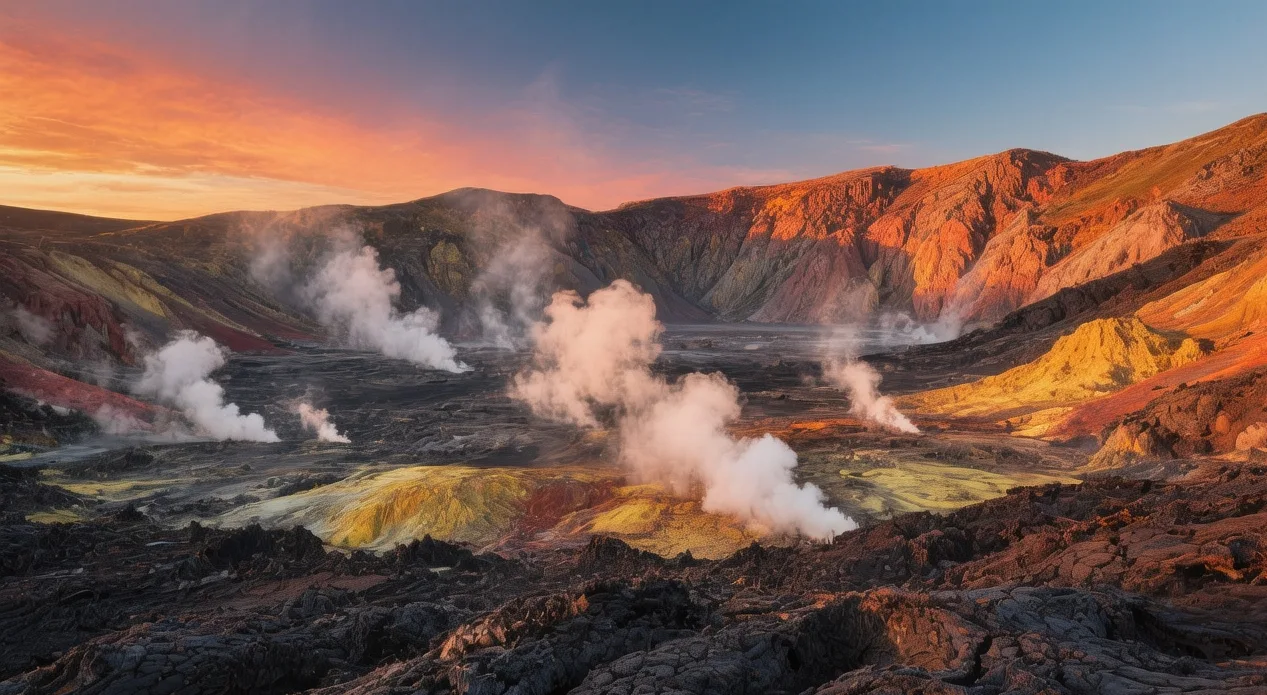
The ground hums beneath your boots—a low-frequency vibration that speaks of magma chambers shifting just kilometers below the crust. Here, at the Krafla volcano caldera, steam rises in thick white plumes from fissures that cut through rust-colored rhyolite mountains, painting the landscape in hues of ochre, sulfur yellow, and volcanic black. It is late evening—around 10:30 PM during the summer solstice—and the sun hangs stubbornly above the horizon, casting long shadows across the 10-kilometer-wide depression that formed over 100,000 years ago. The air smells of earth and electricity; nearby, the turbines of the Landsvirkjun power station spin silently, converting the planet's internal heat into light for distant homes. This isn't merely a scenic overlook; it is an active geological engine where the North American and Eurasian plates diverge at a rate of 2 centimeters per year. In 2026, as global attention turns to renewable energy and volcanic unrest increases across the Ring of Fire, Krafla matters more than ever—a living laboratory of sustainability and a stark reminder of the raw power sleeping beneath the Arctic soil.
Why Krafla Volcano Embodies Iceland's Geological Power
The Krafla volcano system represents one of the most significant central volcanoes in Iceland, serving as a critical junction where tectonic spreading meets magmatic intrusion. Historically, the site solved a fundamental energy need for the northern region; since 1977, the Krafla Power Station has generated approximately 60 megawatts of electricity, harnessing steam from wells drilled into the 290°C (554°F) reservoir beneath the caldera. This engineering feat transformed a dangerous volcanic zone into a sustainable resource, proving that human infrastructure can coexist with active geology when managed with precision.
Beyond utility, the landscape fulfills a deep cultural narrative about survival in harsh environments. The caldera itself measures 10 kilometers (6.2 miles) in diameter, formed by massive eruptions during the last Ice Age. The most recent significant unrest occurred between 1975 and 1984 during the Krafla Fires rifting episode, where 11 meters (36 feet) of crustal deformation was recorded over nine years. Today, the area remains monitored by the Icelandic Meteorological Office, with GPS stations measuring ground uplift in real-time. Walking these slopes, you traverse a terrain composed of dacite and basalt, materials that tell the story of repeated collapse and renewal. The site stands as a testament to Iceland's ability to harness volatility—turning the threat of eruption into the promise of light.
The Best Time to Experience Krafla Volcano
For safe access and optimal visibility, plan your visit between June 15 and August 20, when daytime temperatures range from 10–16°C (50–61°F) and gravel roads are most stable. The best lighting for photography occurs between 11:00 PM and 1:00 AM during the midnight sun period, when the low-angle light accentuates the red mineral stains on the rhyolite peaks without harsh shadows. During these months, Route 863 remains fully passable for standard 2WD vehicles, though 4WD is recommended for exploring deeper tracks.
Shoulder season (May 1–June 14 and August 21–September 30) brings cooler temperatures of 3–8°C (37–46°F) and fewer visitors, but road conditions become unpredictable due to thawing ground. Winter visits (November–March) are strongly discouraged for casual travelers; temperatures drop to -15°C (5°F), daylight shrinks to 4–5 hours, and snow accumulation often closes Route 863 entirely. Additionally, geothermal steam can create black ice on roads even when air temperatures are below freezing, creating hazardous driving conditions.
Avoid visiting during volcanic unrest alerts issued by the Icelandic Meteorological Office. The site is open 24 hours with no entrance fee, but access to certain zones may be restricted during inflation episodes. Always verify road conditions at road.is and volcanic status at en.vedur.is before departure, as the Krafla volcano system remains active and closures can happen without extended notice.
Approximate Budget for a 7-Day Trip (2026)
North Iceland offers slightly lower prices than the capital region, but remote logistics increase transportation costs. These 2026 estimates assume a mid-range travel style, accounting for Iceland's projected 3.5% inflation rate and current exchange rates (1 USD = 0.92 EUR). Prices reflect the Mývatn/Reykjahlíð area, which serves as the primary base for exploring Krafla.
- Accommodation: €130–€190 per night for guesthouses or farm stays in Reykjahlíð (closest village); budget hostels from €70; luxury hotels €260+
- Food: €65–€85 per day—breakfast €15 (often included), lunch €20 (soup and bread at local cafés), dinner €35–€45 (lamb stew or fish at Vogafjós Farm Café)
- Transportation: Rental car essential: €80–€100/day for 4WD vehicle (gravel protection recommended); fuel €2.15/liter (approximately €130 for week); Akureyri to Krafla round-trip: 90 km; Route 1 (Ring Road) plus Route 863
- Attractions: Krafla caldera free; Viti Crater free; Mývatn Nature Baths €38; Guided volcanic tour €75; Geothermal power station view free
- Miscellaneous: Volcanic rock souvenir €20–€50; thermal gear rental €35; travel insurance €50; parking fees minimal (€0–€5 at some sites)
Total estimated cost for 7 days: €1,550–€1,950 per person (excluding international flights)
7 Essential Krafla Volcano Experiences
- Drive to Viti Crater viewpoint: This accessible parking area (65°43.100'N, 16°48.500'W) offers the safest panoramic view of the caldera. The walk to the rim takes 15 minutes over stable gravel. Best visited mid-morning when steam vents are most visible against the dark lava. Bring windproof layers; exposure is high.
- Observe the power station infrastructure: Located at the base of the caldera, the Landsvirkjun facility offers a unique juxtaposition of industry and nature. View from the designated lookout point only—do not trespass. The pipes carry steam at 180°C (356°F); respect safety barriers. Open daylight hours; no entry fee.
- Hike the rhyolite ridges: A marked 3-kilometer trail leads along the colorful mountain slopes south of the parking area. The climb takes 1 hour and rewards with views of the entire volcanic system. The ground is unstable in places; stay on marked paths. Best photographed late afternoon for warm light on red rocks.
- Photograph the steam vents: Fumaroles release continuous vapor that creates ethereal textures against the landscape. Use a fast shutter speed to freeze steam motion or slow shutter for blur. Focus on the contrast between white vapor and black basalt. Avoid getting too close; gas concentrations can be high.
- Visit the 1984 eruption site: Located 5 kilometers east of the main caldera, this lava field remains stark and unvegetated. Access via gravel track off Route 863. The solidified lava ropes (pahoehoe) create intricate patterns. Walk carefully; surface is sharp. Best visited midday when shadows reveal texture.
- Watch the midnight sun over the caldera: On June 21, the sun sets around 12:15 AM. Position yourself at the western rim to see the landscape bathed in perpetual golden light. Temperatures drop rapidly after 11:00 PM, so wear thermal layers even in July. This surreal lighting defines the Arctic summer experience.
- Listen to the earth breathe: Pause away from the road noise. The Krafla volcano system is audible—hissing steam, cracking cooling rock, and wind through fissures. Close your eyes for five minutes. This auditory connection grounds you in the reality of active geology. Best experienced early morning when wind is calm.
3 Hidden Gems Most Travelers Miss
- Krafla Viti Lighthouse: Not a maritime light, but a historic navigation marker situated on a hill above the geothermal zone. Built in 1939, it offers a unique perspective looking down on the steam fields. Most tour buses skip it for Mývatn. Access via gravel road 2 kilometers north of main parking. Open daylight hours; no entry fee. Combine with Krafla for a half-day itinerary.
- Old Geothermal Drill Sites: Scattered around the periphery are capped wells from the 1970s exploration phase. These rusted pipes mark where engineers first tapped the heat. Located 1 kilometer south of the power station. Access requires asking permission at the visitor center. These sites offer a tangible history of energy development. Photography permitted without flash.
- Leirhnjúkur Lava Field Edge: While Leirhnjúkur is technically part of the Hverir system, the northern edge blends into Krafla's flows. Most visitors stop at the main boardwalk. Walk 500 meters north along the fence line to see where fresh lava meets old soil. No facilities here; bring water. Best visited midday when shadows reveal depth. Download offline maps before leaving Reykjahlíð.
Cultural & Practical Tips
- Safety first: Hydrogen sulfide gas is toxic in high concentrations. If you smell strong rotten eggs and feel dizzy, move to higher ground immediately. Wind direction changes quickly; always stand upwind of vents. Children and pets must be supervised closely near unstable ground.
- Stay on marked paths: The ground crust can be only centimeters thick over boiling water or weak soil. Stepping off paths risks severe burns and damages fragile geological formations. Fines for trespassing in protected areas can reach €500. Respect barriers—they are placed for your survival.
- Weather preparedness: North Iceland weather is volatile. Even in July, pack: windproof waterproof jacket, thermal base layers, sturdy hiking boots with ankle support, hat and gloves. Check vedur.is for real-time forecasts. Wind speeds can exceed 25 m/s (56 mph), making standing difficult.
- Photography etiquette: Tripods permitted on stable ground but don't block paths. Drone use requires special permit from Umhverfisstofnun (Icelandic Environment Agency)—apply at ust.is at least 14 days in advance. Steam can damage lens coatings; use protective filters.
- Local phrases: Learn these Icelandic essentials: Takk (tahk) = Thank you; Góðan daginn (go-than die-in) = Good day; Hvað heitir þetta? (kvad hey-tir thet-ta) = What is this called? Effort with language earns warm smiles from locals.
- Emergency contacts: Dial 112 for all emergencies. Nearest hospital: Akureyri Hospital, 90 km south (+354 470-1000). Cell coverage is good at Krafla parking but spotty on surrounding trails. Download offline maps via Google Maps or Maps.me before arrival.
- Accessibility note: Main viewing areas are accessible for most mobility levels. Terrain is uneven gravel in parking area. Visitor facilities include accessible restrooms. Contact visitnorthiceland.is for detailed accessibility maps before traveling.
Conclusion: Travel with Reverence, Not Just Checklists
Krafla demands more than a quick photo stop and a hashtag—it asks for your caution, your patience, your willingness to stand respectfully on ground that is actively shaping itself. As you walk these ridges in 2026, remember that each step lands on terrain sacred to both geological history and living energy systems. The steam vents aren't merely scenic backdrops; they are exhaust ports for the planet's internal engine, written in vapor and heat.
Responsible travel here means staying on paths, respecting gas warnings, and leaving only footprints on gravel. It means understanding that the heat beneath your feet powers nearby homes, connecting your visit to the daily lives of North Icelanders. When you purchase from local farms, hire regional guides, and follow safety barriers, you participate in an economy that values preservation over exploitation.
So linger past the guidebook's recommended 30 minutes. Sit on a safe rock and watch steam rise against volcanic ridges. Let the hiss of escaping gas remind you that some places aren't meant to be conquered or consumed—they're meant to be witnessed with humility, protected with intention, and carried in memory long after your boots have left the parking lot.