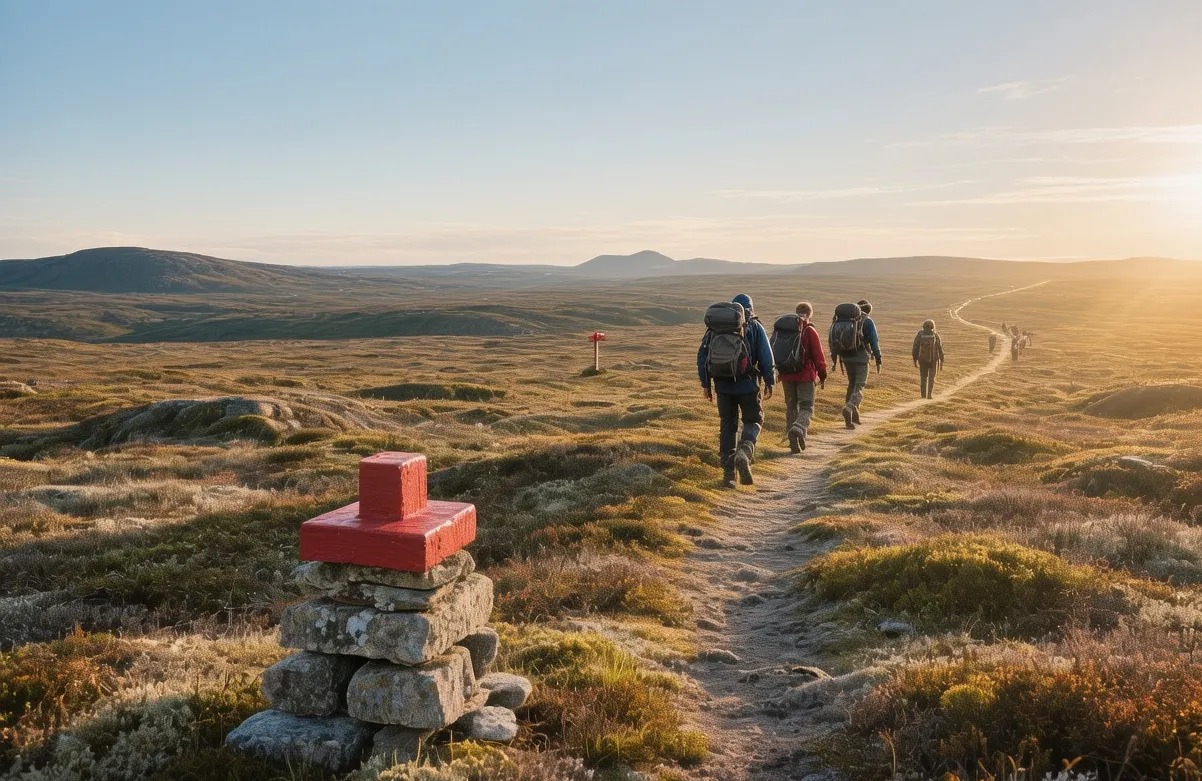
Kungsleden: Where Trail Meets Arctic Wild
I step onto the path outside Abisko Turiststation at eight in the morning in mid-July. Sun hangs low but bright, painting birch leaves gold. I paid 520 SEK for my first night at the STF hut ahead — non-member rate. The same bed costs 420 SEK if you join the association. Gravel crunches under heavy boots. Boardwalks stretch across boggy ground. The trail stretches four hundred and forty kilometers south to Hemavan. You see it vanish into the valley ahead and understand immediately: you do not have to walk all of it. Most people do not. Days are long here — midnight sun means light past twenty-three. But weather shifts fast. I have seen rain turn to sleet in July. Mosquitoes gather thick in sheltered valleys. Some sections have no huts at all. You carry everything you need.
Why Kungsleden Matters
Kungsleden — the King’s Trail — took shape in the early 20th century, built by the Swedish Tourist Association to open Lapland mountains to visitors. Today it runs from Abisko near the Norwegian border south to Hemavan, crossing four national parks and the ancestral lands of the Sámi people. What makes it different is balance. The northern and southern sections have marked paths, bridges, and huts spaced one day apart. The middle stretch between Kvikkjokk and Ammarnäs offers nothing — no marked route, no huts, no easy resupply. That contrast defines the trail. It welcomes beginners on the Abisko–Nikkaluokta section and demands full wilderness competence further south. Yet that balance creates tension too. Some locals feel popularity has brought overcrowding and erosion. Boardwalks now cover worn ground in places. The huts fill weeks ahead. This is not an untouched corridor anymore. It is a managed, loved, and heavily used path.
The Best Time to Experience Kungsleden
Late June through mid-August brings midnight sun and the warmest conditions — 10°C to 18°C (50°F to 64°F). Days stretch endlessly. The trail is fully open. Mosquitoes appear in large numbers in damp valleys. Mid-August into mid-September sees 6°C to 12°C (43°F to 54°F). Insects vanish. Birch tundra turns gold and crimson — the ruska season. Crowds thin noticeably. This is many hikers’ preferred window. Late September through early October brings shorter days, possible snow, and hut closures. Winter from February to April offers ski touring only — -10°C to -3°C (14°F to 27°F), deep snow, Northern Lights, and special winter huts operating. Avoid early June. Snow lingers at high passes, ground stays saturated, and some huts remain shut. August weekends are busiest — book accommodation months ahead.
Approximate Budget for a 7-Day Trip
Most hikers choose one section rather than the full trail. Here is what one week on the popular Abisko–Nikkaluokta route costs for one person.
- Accommodation: 2,940 SEK — 6 nights in STF huts at 490 SEK average. Membership saves roughly 100 SEK per night. Camping beside huts costs 300 SEK nightly.
- Food & Fuel: 850 SEK — supplies bought at hut shops or carried in. Eating at station restaurants adds 400–600 SEK per meal.
- Transport: Round-trip flight Stockholm–Kiruna 1,950 SEK. Train Kiruna–Abisko 320 SEK one-way. Bus Nikkaluokta–Kiruna 280 SEK. Return connections 350 SEK.
- Membership & Gear: STF annual membership 250 SEK. Map purchase 220 SEK. Satellite communicator rental optional, 400 SEK per week.
- Miscellaneous: 450 SEK for emergency supplies, extra snacks, and hot drinks at stations.
Total estimate: 7,740 SEK per person. One warning: eating every dinner at the mountain stations doubles your food budget. Carry and cook your own meals to keep costs reasonable.
Essential Kungsleden Experiences
- Abisko to Nikkaluokta Trek — The signature northern section. One hundred and five kilometers over six days. Well-marked, huts every twelve to eighteen kilometers. Crosses Tjäktja Pass at 1,150 meters. Skip this in early June; lingering snow makes the pass slow and potentially slippery.
- Midnight Sun Walking — Hike at 22:00 when crowds vanish and light turns soft gold. Shadows stretch long. The landscape feels entirely yours. Remember headlamp anyway; twilight dims briefly.
- Stay in an STF Mountain Hut — Shared rooms, wood stove, self-catering kitchen. You chop wood, fetch water, and clean up alongside other hikers. No electricity. Simple, cozy, communal. Book early — they fill months ahead.
- Tjäktja Pass Crossing — The highest point on the main trail. Views open across tundra and distant peaks. Wind blows strong here. Carry extra layers; temperatures can drop fast.
- Kebnekaise Side Trip from Singi — Four kilometers each way to Sweden’s highest mountain base. Optional climb to the summit if conditions allow. Allow extra time and check status locally before setting out.
- Autumn Ruska Colors — Late August through early September. Birch leaves shift from green to fiery orange and red. Air turns crisp. The trail quiets. This is the most beautiful season but days shorten noticeably.
- Middle Section Awareness — Kvikkjokk to Ammarnäs has no marked trail and no huts. Experienced hikers only. Carry full gear, navigation tools, and food for five to seven days. Do not attempt this as your first Arctic trek.
Hidden Gems Most Travelers Miss
- Abiskojaure Lake Shore — Quiet campsites beside clear water. Most hikers head straight to the hut. Sunset reflects across the surface. Few people linger here long.
- Låddejåhkå Valley — Between Sälka and Kebnekaise. Gentle walking through birch woods and open meadows. Wildflowers carpet the ground in early July. The main path stays close but many eyes look upward only.
- Vakkotavare to Saltoluokta — Less crowded northern stretch. Big lake views and steep descent into the Luleälven valley. Saltoluokta station itself feels grand and welcoming.
- Main Hut Restaurant Meals — Convenient but expensive. Cook your own or bring simple dehydrated dinners. The shared kitchen space becomes the best part of the experience anyway.
Cultural & Practical Tips
- Join STF before you travel. Membership pays for itself in two nights. It also gives priority booking and access to member-only slots.
- Book huts three to six months ahead for July and August. The most popular sections sell out completely. Arriving without a reservation risks sleeping outside.
- Carry enough water. Some sections cross dry high ground. Treat or filter water from streams; wildlife means bacteria exist even in remote areas.
- Pack for every season. Sun, rain, wind, and snow can all happen in one day. Waterproof everything is non-negotiable. Spare warm layers save trips.
- Respect Sámi land use. Reindeer graze freely across the entire trail. Do not disturb animals, follow dogs, or leave food where wildlife finds it. Close gates behind you.
- Phone signal vanishes in most sections. Carry a map, compass, and GPS. A satellite messenger offers extra safety. Do not rely on a smartphone alone.
- Do not try the full trail on your first visit. Pick one section. Learn how your body responds to Arctic hiking. Return for more when you know what to expect.
Essential Visitor Information
Location & Access: Kungsleden runs 440 km from Abisko (north) to Hemavan (south), Swedish Lapland. Abisko: train from Kiruna or Stockholm; nearest airport Kiruna 90 min drive. Hemavan: regional airport with flights to Stockholm; bus from Umeå 4 hours. Nikkaluokta: bus from Kiruna 1.5 hours. Kvikkjokk: bus from Jokkmokk 1 hour.
Tickets & Booking: Trail access free. STF huts 420–520 SEK/night non-member, 320–420 SEK member. Camping beside huts 200–300 SEK/night. Booking essential June–September.
Operating Hours: Hiking season mid-June to mid-September. Winter ski season February–April. Huts open late June to early September; dates shift annually. Trail accessible year-round but winter requires full ski gear.
Visit Duration: Minimum 5–7 days for one section. 21–28 days for full trail. Many visitors do 2–3 shorter multi-day trips across separate visits.
Family Suitability: Partial suitability. Abisko–Nikkaluokta works for older children with outdoor experience. No stroller access. No facilities outside huts. Middle sections not recommended for families.
Timing: Best season: late August to early September. Best time of day: 20:00–22:00 for quiet trails and soft light.
Highlights: Tjäktja Pass, midnight sun walking, STF hut stays, Kebnekaise views, ruska autumn colors, Lake Torneträsk overlook.
Nearby & Day Trip: Abisko National Park 0 km — Aurora Sky Station nearby. Kebnekaise massif via Singi. Sarek National Park boundary near Kvikkjokk. Hemavan mountain resort at southern end.
Conclusion: Travel with Lightness, Not Just Distance
Kungsleden does not demand you conquer its full length. It offers itself in pieces — one valley, one pass, one quiet evening by a lake. You will find huts fully booked, mosquitoes persistent in damp hollows, and weather that turns without warning. You will also find a path built with care, shared spaces that feel like community, and light that touches no crowds. This trail matters because it meets you where you are. It does not require you to be an expert or an athlete. It asks only that you prepare well and walk gently. Will you choose one section this time, and leave the rest for later?
Comments
Post a Comment