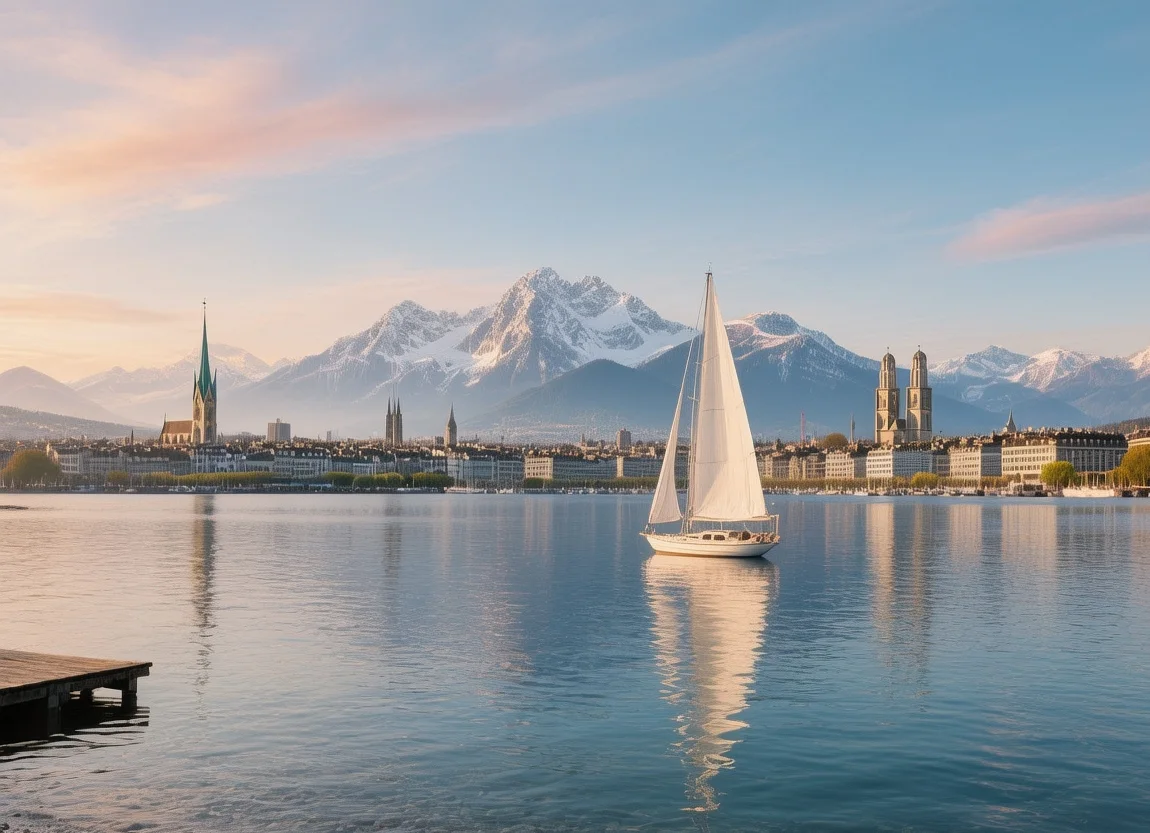
Lake Zurich: Where City Grace Meets Water Calm
I sit on a stone bench at the Bürkliplatz shore at 9:20 on a cloudless September morning. The water stretches deep and clear blue toward the hills. A white steamer glides past, its wake spreading slow and smooth behind it. I buy a warm croissant from a bakery just off the lakefront. It costs three francs. The city rises gently from the western shore — spires, rooftops, tree-lined avenues. On the eastern side villages cling to wooded slopes. You can walk from the busy financial district to quiet reed-fringed bays in twenty minutes. The lake feels close enough to touch, yet far enough to feel like a different world.
Why Lake Zurich Matters
For centuries this lake was a vital trade route linking communities along its shores. Fishing villages grew into towns, and by the 19th century wealthy merchants built villas and parks where the public walks today. The lake remains central to life here — a place of work, transport, and daily pleasure. That popularity brings pressure. The busiest promenades fill between midday and 4 PM. Waterfront cafés charge premium prices. Some stretches feel polished almost to the point of sameness. Step five minutes uphill or along quieter bays, though, and you find the lake as locals know it — unhurried, accessible, and genuinely shared.
The Best Time to Experience Lake Zurich
Late April through early July brings blooming trees and long evenings. Daytime temperatures sit between 16°C and 24°C, or 61°F and 75°F. Nights stay mild at 9°C to 15°C, or 48°F to 59°F. July and August are warmest — 22°C to 28°C, or 72°F to 82°F — and busiest. September offers perfect balance: still-swimmable water, thinner crowds, and readings of 18°C to 24°C, or 64°F to 75°F. This is widely considered the best month. Winter stays cool — 2°C to 7°C, or 36°F to 45°F — but paths remain open and the lake rarely freezes fully. Spring rain can be frequent in April and early May.
Approximate Budget for a 7-Day Trip
Prices are in Swiss francs per person.
- Accommodation: 190–390 francs per night. Lakefront hotels command top rates. Staying in districts like Wipkingen or Wiedikon saves 70 to 130 francs nightly and sits 10 to 15 minutes from the shore by tram. Smaller lakeside villages like Meilen or Horgen offer quieter stays.
- Food: 75–125 francs daily. Waterfront lunch averages 38–55 francs. Backstreet and neighbourhood spots serve fresh salads, soups, and local specialities for 18–28 francs. Espresso costs roughly 4 francs.
- Transport & Boats: 45–75 francs daily. Trams, buses, and most boats are covered by the same day pass. Round-trip to the peak of Uetliberg by train and back by boat costs roughly 24 francs.
- Attractions: 35–70 francs total. Boat rides start at 8 francs per stop. Uetliberg viewpoint is free. Museums near the lake range from 12 to 25 francs.
- Miscellaneous: 30–55 francs daily. This covers drinks, snacks, and small purchases.
Total estimated 7-day cost: 1,950–3,350 francs per person.
Organised lake cruises from the main pier charge 50–80 francs per person. Independent travel costs roughly 8 to 12 francs per leg. You hop off and explore villages at your own pace. The cafés directly beside the main piers charge 4 to 6 francs extra per drink. Walk two lanes inland and identical coffee costs standard prices.
Essential Lake Zurich Experiences
- Ride a vintage steamer across the water — The white paddle-wheelers have run here for generations. Wood panelling, brass fittings, and open decks make the journey feel special. Sit on the right side heading south. Arrive before 10 AM to have an outside table quiet. Skip if you are prone to seasickness — the lake stays calm but movement is real.
- Walk the promenade from Bürkliplatz to Tiefenbrunnen — Broad paths, old trees, and open water views stretch the whole way. Museums, parks, and villas line the shore. You see the city at its most elegant. Arrive early to avoid crowds.
- Climb Uetliberg — The forested hill rises 800 metres above the city. The train takes you straight to the top. The panorama unfolds across the lake, the city, and distant alpine peaks. Allow two hours round trip including time to take it in.
- Cross by ferry to Meilen — The short ride feels quicker than walking around the northern end. The village sits quiet and green. Shore paths run south along bays where reeds shelter birds and wildflowers. Return at sunset — the light hits the water beautifully.
- Swim at a public shore pool — Wooden structures extend over the water at several points. Locals have swum here for more than a century. Water stays cool and clear. The atmosphere feels relaxed and communal. Arrive early on warm days — they fill fast.
- Visit Rapperswil on the upper lake — The medieval town sits at the narrowest point. A wooden footbridge leads across to the other shore. Roses bloom in gardens beside the water from June through September. It feels like stepping into a quieter, slower century.
Hidden Gems Most Travelers Miss
- The shore path from Wollishofen toward Kilchberg runs through trees and past quiet bays. It sees almost no visitors compared with the central promenade. The water stays just as clear and blue. Walk 20 minutes south of the main tram stop and you find it.
- The small park behind the opera house has benches facing the water that stay empty even at midday. The view looks straight down the lake with no crowds in the frame. Sit 15 minutes and watch boats pass.
- The viewpoint on the minor path up Uetliberg, not the main tower, faces west across the lake at sunset. Trees frame the water perfectly. Most people stay near the restaurant at the top.
- The bakery in the village of Horgen, reached by short boat ride, makes pastries that sell out before 11 AM. The terrace overlooks the water at half the price of central Zurich spots.
Cultural & Practical Tips
- Buy a day pass. It covers trams, buses, and most boats. It costs less than buying individual tickets and removes the stress of checking fares at every stop.
- Swim only in designated areas. Currents can run strong even where the water looks calm. Observe flags and signs — locals respect them fully.
- Keep noise low after 10 PM. Many apartments sit directly beside the shore. Voices carry across water. The atmosphere stays peaceful when everyone contributes.
- Carry a reusable bottle. Tap water is clean and cold everywhere. Fountains line the promenade. Buying bottled water costs extra and creates unnecessary waste.
- Check boat times. Services run frequently but thin out after 8 PM. The last return boat leaves promptly — do not miss it.
- Respect the shoreline. Reeds and shallow areas protect fish and birds. Stay on paths and do not trample vegetation. The lake stays clear because people care for it.
Essential Visitor Information
Location & Access: Lake Zurich, north-central Switzerland. City of Zurich sits at the northern end. Approximately 10 to 90 minutes travel to shore points by public transport. Zurich Airport is 20 minutes by train to the city centre.
Tickets & Booking: Day pass covering city and most boats ~24 francs. Short boat rides from 8 francs. Uetliberg train return ~12 francs. Museum tickets 12–25 francs.
Operating Hours: Boats run year-round with reduced schedule in winter. Shore paths always open. Museums closed Mondays.
Visit Duration: Minimum 2 full days. Four to five days lets you explore both shores, climb Uetliberg, visit Rapperswil, and swim at quiet bays without rushing. One day suffices if you focus on the central promenade and one boat trip.
Family Suitability: Families welcome. Main paths are wide, flat, and stroller-friendly. Keep children close to the water edge — banks can be steep and currents fast. Restrooms exist near all main piers.
Timing: Mid-September balances warm days, thinner crowds, and fair prices. Arrive before 9:30 AM any day. Weekends draw regional visitors.
Highlights: Vintage steamer ride, west shore promenade, Uetliberg panorama, Meilen ferry and shore path, public lake swimming, Rapperswil medieval town and wooden bridge.
Nearby & Day Trip: Rhine Falls 1 hour by train. St. Gallen Abbey Library 1 hour 15 minutes. Lucerne and lake 2 hours. Zugersee 45 minutes. Returning here at dusk means watching light fade across water that has shaped every generation of people who live beside it.
Conclusion: Travel with Presence, Not Just Pace
Lake Zurich sits beside one of the world’s busiest financial centres. Yet the water moves at its own speed — steady, calm, unchanged by the rush nearby. When you visit somewhere that offers such quiet right beside so much activity, will you slow down enough to let it work?
Comments
Post a Comment