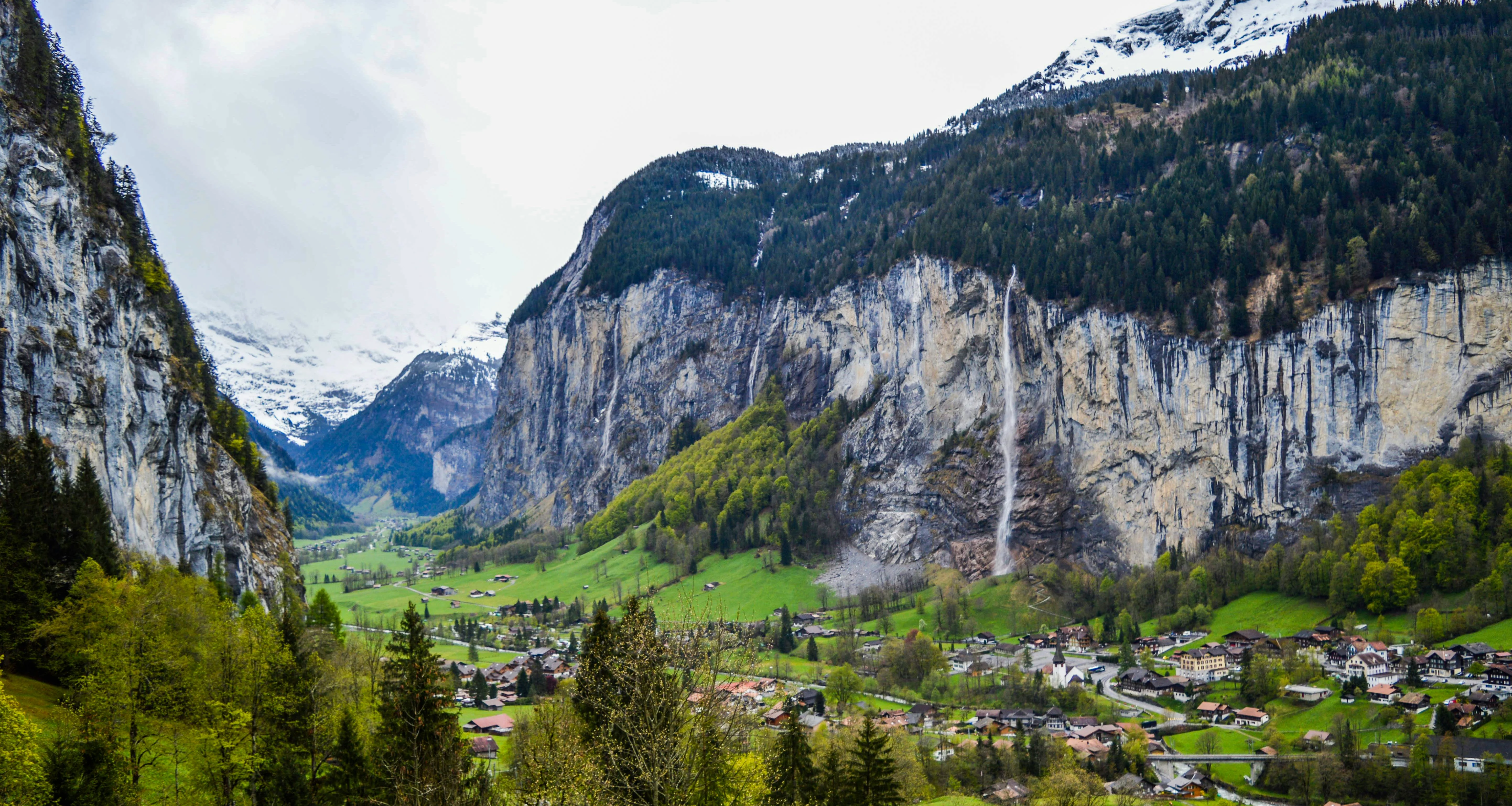
Lauterbrunnen Valley: Where Waterfalls Meet Rock and Pasture
I stood on the village green just after eight in the morning. Mist clung to the grass. The air felt soft and damp. Above me, Staubbach Fall spilled down the cliff face — thin, white, and drifting in the breeze. It looked like a ribbon loosened from the rock. Seventy-one other waterfalls drop into this valley. I could hear them everywhere — distant murmurs, closer rushes, one deep steady roar from the upper gorge. No one else stood beside me. The valley held its breath, quiet and green between immense walls.
Why Lauterbrunnen Valley Matters
Carved by glaciers and water over tens of thousands of years, this is one of the deepest and most dramatic U-shaped valleys in the Alps. Steep limestone walls rise as high as 1,000 metres on both sides, leaving a narrow green floor where meadows, farms, and the village of Lauterbrunnen sit together. For centuries the valley was remote and isolated — a place of mills, mountain farms, and legends. Writers and artists began arriving in the 18th century, drawn by the sheer scale and the waterfalls. Johann Wolfgang von Goethe wrote of Staubbach Fall; J.M.W. Turner painted the valley from the slopes above. Later, railways and cable cars opened routes to Mürren, Wengen, and the high peaks, turning it into a gateway to the Jungfrau region. That popularity brings real pressure. The narrow main road fills with cars and buses by mid-morning. The most famous viewpoints stay packed through summer. And while the valley floor remains green and beautiful, the upper slopes show signs of heavy foot traffic — eroded paths and crowded viewpoints that feel far from wild.
The Best Time to Experience Lauterbrunnen Valley
The valley stays accessible year-round. May through June brings highest water flow as mountain snow melts — the falls look fullest and loudest. Temperatures range 8°C to 18°C (46°F to 64°F). Wildflowers carpet the meadows. July and August see warmest weather, 12°C to 22°C (54°F to 72°F), but crowds arrive early and stay late. September through mid-October delivers golden light, thinner crowds, and still strong flow — 10°C to 18°C (50°F to 64°F). This is often the ideal window. December through February brings snow-covered walls and frozen waterfall edges. The valley feels quiet and magical, though some higher trails close. Arrive before 9:00 a.m. any day to walk without crowds. Late afternoon after 5:00 p.m. brings golden light and empty paths.
Approximate Budget for a 7-Day Trip
- Accommodation: 945 CHF — Guesthouse or chalet in Lauterbrunnen or nearby
- Food: 455 CHF — Village meals, mountain hut snacks, bakery stops
- Transport: 280 CHF — Local trains, Postbus, cable cars; Interlaken connection included
- Valley & Extras: 140 CHF — Trümmelbach Falls entry, small guided hike, souvenirs
- Miscellaneous: 105 CHF — Waterproof jacket, sturdy shoes, sunscreen
Total: 1,925 CHF
All-inclusive valley tours cost nearly double what you pay independently. The Postbus runs the full length of the valley for a few francs. Walk the lower trails — they are free — and save your budget for Trümmelbach and the cable cars up to Mürren or Wengen.
Essential Lauterbrunnen Valley Experiences
- Walk beneath Staubbach Fall — The path passes directly behind the thin drifting cascade. Mist brushes your face. It feels delicate and intimate, nothing like a heavy torrent. Skip this on very windy days; the spray spreads wide and soaks everything.
- Visit Trümmelbach Falls — Inside the mountain, ten cascades carve through rock. You climb alongside them, hearing the water roar and echo off the stone walls. This is the only place to see meltwater from the Eiger, Mönch, and Jungfrau rushing from deep inside the valley. It costs extra and sells out — arrive early.
- Walk the full valley floor — A paved path runs nearly the entire length. You pass farms, meadows, and a dozen smaller falls. Each one looks different — some thread thin, others pour broad and white. It takes roughly three hours one way.
- Look up from the valley mouth — Stand near the train station and gaze straight down the length. The walls rise sheer on both sides, narrowing toward the distant peaks. You see the true scale of the place — how small the floor is, how immense the rock above.
- Ride the cable car up to Mürren — The cabin climbs the western wall and looks back down. The valley stretches below you, green and patterned with fields, waterfalls shining silver against dark rock. The perspective shifts entirely.
- Return at dusk — Most visitors leave by late afternoon. The falls turn faint white lines in the gathering dark. The sound changes — closer, deeper, entirely yours. It feels peaceful and ancient.
Hidden Gems Most Travelers Miss
- The footpath from the church toward Stechelberg runs through meadows away from the road. You hear the waterfalls more clearly without traffic noise. Wildflowers line the edges. Almost no one walks this full stretch.
- Behind the schoolhouse, a narrow lane climbs gently to a small bench. It faces the Breithorn massif and several unnamed falls. You sit undisturbed and watch the light move across the rock.
- The viewpoint on the road to Stechelberg — just past the bridge — looks back toward the village with Staubbach centered perfectly. It appears in almost no photos and stays empty.
- The main path near the train station is overrated. Everyone stops in the same fifty metres. Walk ten minutes further toward the falls. The view opens up and the crowd vanishes.
Cultural & Practical Tips
- Wear waterproof outer layers. Mist from the falls hangs in the air and drifts across paths. You will get damp even if it is not raining.
- Keep to marked paths. The slopes are steep, unstable in places, and privately owned. Straying off-trail risks erosion and trespassins complaints.
- Visit Trümmelbach Falls early. By midday queues stretch long and the chambers feel crowded. The first entry slot at 9:00 a.m. is quietest.
- Respect quiet hours. Most guesthouses and farms request silence after 10:00 p.m. The valley carries sound far — voices from the road reach houses high on the slopes.
- Do not climb behind or beside the falls. The rock is slippery and unstable. Several people have fallen attempting photos from unauthorised spots.
- Use public transport. Parking in the valley is extremely limited and fills by 9:30 a.m. Trains and buses run frequently and connect every major point.
Essential Visitor Information
Location & Access: Lauterbrunnen Valley, 3822 Lauterbrunnen, Switzerland. GPS coordinates 46.5985° N, 7.9084° E. Train from Interlaken Ost takes roughly 20 minutes direct. Postbus connects all valley stops. Road from Interlaken follows the valley; parking available at Lauterbrunnen station but fills fast.
Tickets & Booking: Valley paths and Staubbach viewing: free. Trümmelbach Falls: 14 CHF adult. Cable car to Mürren: from 18 CHF one-way. Train to Wengen: from 12 CHF one-way. Swiss Travel Pass covers local trains and buses. Trümmelbach booking recommended in summer.
Operating Hours: Valley accessible 24 hours daily. Trümmelbach Falls: roughly 9:00 a.m.–5:00 p.m. extended hours in summer, shorter in winter. Cable cars and trains run roughly 6:00 a.m.–11:00 p.m.
Visit Duration: Minimum 1 day. Allow 2 to 3 days to explore the full length, visit Trümmelbach, and ride up to one mountain village without rushing.
Family Suitability: Excellent. Valley floor paths are flat and gentle. Restrooms at village and Trümmelbach. Keep children back from unrailed edges near fast water.
Timing: Visit late May through June for fullest water flow, or September for clear light and fewer people. Arrive before 9:00 a.m. to have the valley quiet.
Highlights: Staubbach Fall, Trümmelbach Falls, full valley floor walk, cable car to Mürren, sunset from the upper meadows, 72 waterfalls panorama.
Nearby & Day Trip: 15 minutes by train to Wengen. 20 minutes by cable car to Schilthorn. 45 minutes to Interlaken. 1 hour to Jungfraujoch. 2 hours to Bern Old Town.
Conclusion: Travel with Ears Open, Not Just Eyes Up
This valley has run with water for thousands of years. It has heard glaciers retreat, storms roar, and generations live quietly between the walls. You can see it all in a day and leave with photos. Or you can slow down. Listen to the different voices of the falls — some soft, some deep, some almost invisible until you walk right beneath them. Think about the people who lived here before tourists came. What will you remember — the number of falls you saw, or the sound of water everywhere, all the time?
Comments
Post a Comment