
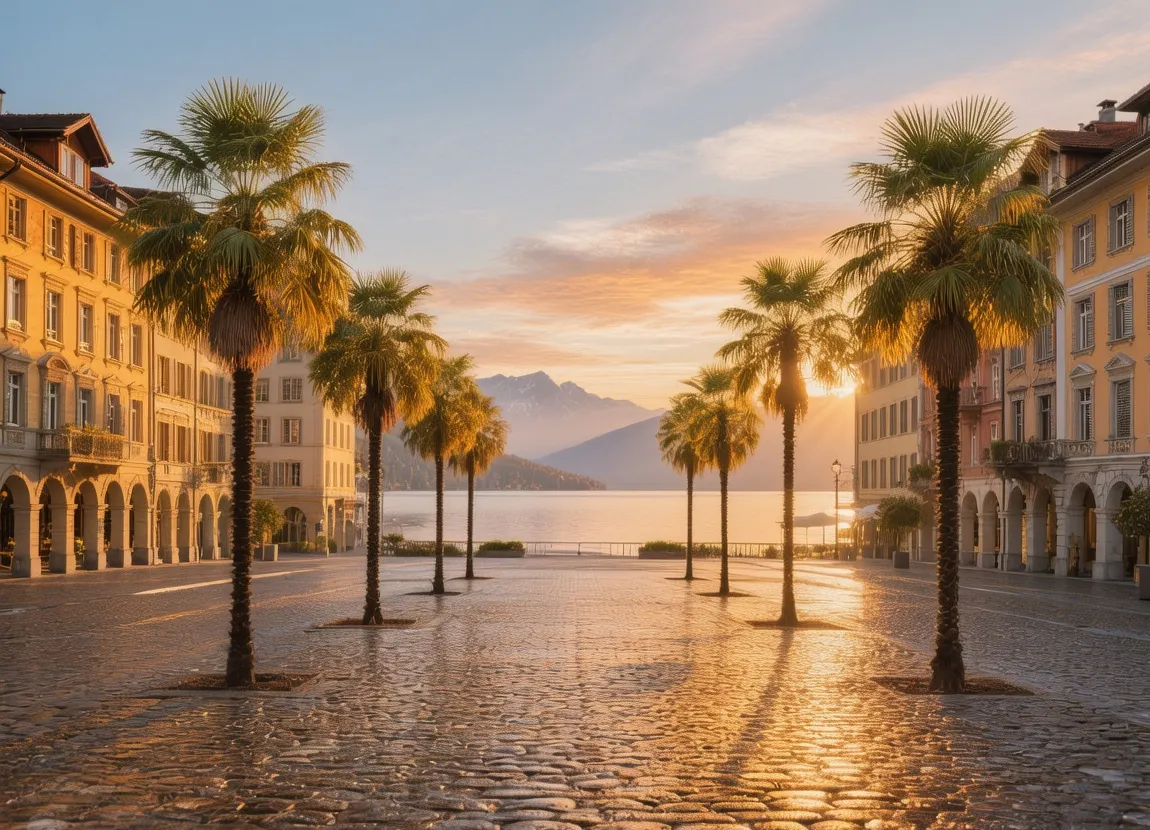
Locarno Palm Trees Mediterranean Fronds Meet Alpine Lakes
The fronds rustle softly in the evening breeze—a dry, whispering sound that contrasts sharply with the distant lap of Lake Maggiore against the stone quay. You stand in the center of Piazza Grande, surrounded by 150 Canary Island date palms that rise 12 meters into the air, their trunks textured like ancient armor against the backdrop of the Lepontine Alps. The air here is distinctively warm for Switzerland, carrying the scent of blooming jasmine and espresso from the surrounding cafés, a sensory paradox that defines this southernmost corner of the Swiss Confederation. Since the first palms were planted in the late 19th century to market Locarno as the "Riviera of the North," these trees have become the living symbol of a unique microclimate where Mediterranean flora thrives just 50 kilometers from the Gotthard Pass. In 2026, as travel often feels rushed and digitized, the Locarno palm trees offer a rare invitation to pause—a place where the slow growth of nature dictates the rhythm of life, reminding you that some beauties cannot be hurried, only witnessed.
Why Locarno Palm Trees Embody Ticino Microclimate
The Locarno palm trees represent a botanical anomaly, solving the historical challenge of cultivating subtropical species in a northern latitude through a unique geographical convergence. Protected by the Monte Ceneri pass to the south and the high Alps to the north, Locarno enjoys a microclimate where average winter temperatures rarely drop below 4°C (39°F), allowing Phoenix canariensis and Washingtonia robusta to flourish without frost protection. The first significant planting occurred in 1885 during the Belle Époque boom, when landscape architects designed the lakeside promenade to attract aristocratic tourists seeking winter sun. Today, over 300 mature palms line the 2-kilometer waterfront, their root systems stabilized by specialized irrigation that draws from the lake to maintain humidity during dry summer months.
Beyond aesthetics, the palms fulfill a cultural need for identity in a region that bridges German and Italian Europe. The trees distinguish Ticino from the rest of Switzerland, creating a visual language that signals relaxation and southern warmth. The Piazza Grande, paved with 3,500 granite slabs, serves as the central stage where the palms frame the annual Locarno Film Festival, blending natural heritage with cinematic culture. Maintenance is handled by the Comune di Locarno gardening department, which prunes the fronds twice annually to ensure safety and health. This living heritage proves that urban planning can integrate exotic botany into a Swiss context while maintaining the ecological balance required for long-term survival in a changing climate.
The Best Time to Experience Locarno Palm Trees
For optimal conditions combining mild weather, blooming gardens, and manageable tourist density, visit between May 18–June 12 or September 5–September 20. During these windows, daytime temperatures range from 20–26°C (68–79°F), while evenings cool to 14–18°C (57–64°F). The ideal time to photograph the palms is 8:00–9:30 AM, when the morning light illuminates the fronds without glare and the piazza is quiet before the café rush.
Winter visits (December–February) offer a stark beauty with snow-capped peaks contrasting the green palms, but temperatures drop to 4–10°C (39–50°F), and some lakeside services operate on reduced schedules. The Magical Christmas market in December brings local color, while summer peak season (July 20–August 15) brings temperatures up to 28°C (82°F) but also crowds that occupy every bench along the promenade. The lake breeze (la breva) provides relief, but restaurants require reservations weeks in advance.
Avoid these periods: August 1 (Swiss National Day creates fireworks congestion), November 1–15 (annual maintenance shutdowns for some boat lines), and late October (fog season reduces visibility to under 100 meters). For real-time weather and event schedules, verify conditions at locarno.ch or check the Ticino Tourism Office at ticino.ch for seasonal calendars.
Approximate Budget for a 7-Day Trip (2026)
This budget estimate reflects mid-range travel preferences for a solo traveler or couple, based on 2026 pricing adjusted for Switzerland's 2.5% annual inflation rate (Swiss Federal Statistical Office data). Locarno is moderately priced compared to Zurich, but lakeside accommodation commands a premium due to limited supply. Prices assume a 7-night stay with moderate dining, public transportation, and selective paid attractions.
Accommodation:
• Budget hostel (dorm bed): CHF 60–CHF 85 per night (Youth Hostel Locarno, 15-minute walk from Piazza Grande)
• Mid-range hotel (3-star, lakeside): CHF 220–CHF 310 per night (Hotel Eden or Hotel Locarno)
• Upscale boutique (4-star, panoramic views): CHF 400–CHF 600 per night (Villa Orselina or Grand Hotel Locarno)
Food: CHF 80–CHF 120 per day
• Breakfast: CHF 20–CHF 30 (hotel buffet with Swiss muesli and Italian pastries)
• Lunch: CHF 30–CHF 45 (piazza café risotto or pizza al taglio)
• Dinner: CHF 55–CHF 75 (traditional polenta e brasato or lake fish)
• Coffee/gelato: CHF 8–CHF 14
Transportation:
• Swiss Travel Pass (8 days, 2nd class): CHF 432 (covers trains, buses, boats, museums)
• Ticino Ticket (free with hotel): includes local buses and boat discounts
• Airport transfer (Milan Malpensa to Locarno): CHF 35 bus or CHF 50 train
• Local bus (Line 1, 2): CHF 3.80 per ride (free with Ticino Ticket)
Attractions:
• Locarno Palm Promenade Walk: Free
• Madonna del Sasso Funicular: CHF 18 (50% off with Swiss Travel Pass)
• Castello di Locarno: CHF 10 (free with Swiss Travel Pass)
• Lake Maggiore Boat Cruise: CHF 28 (free with Swiss Travel Pass)
• Guided Old Town Walking Tour: CHF 35
Miscellaneous:
• Souvenirs (Wine, ceramics, chestnuts): CHF 70–CHF 200
• Travel insurance (7 days): CHF 50–CHF 80
• SIM card/data (Swisscom 10GB): CHF 45
• Emergency fund: CHF 150
Total estimated cost (mid-range): CHF 2,500–CHF 3,200 for 7 days
Budget traveler option: CHF 1,300–CHF 1,600
Luxury experience: CHF 6,000–CHF 9,000+
7 Essential Locarno Palm Trees Experiences
1. Piazza Grande Morning Walk: Stroll the granite square at 8:30 AM. The 150 palms cast long shadows across the 11,000-square-meter piazza. Stop at a café for a cappuccino. The view of the lake is panoramic. Free access. Best photographed: Morning for soft light. Allow 60 minutes.
2. Lakeside Promenade Cycle: Rent a bike at 10:00 AM from the station. Ride the 2-kilometer path lined with palms towards Minusio. The path is flat and paved. You pass villas and gardens. Cost: CHF 25 per day. Best visited: Mid-morning for breeze.
3. Madonna del Sasso View: Take the funicular at 11:00 AM. The viewing platform overlooks the palms and lake. The church houses Renaissance art. Open daily 8:00 AM–6:00 PM. Cost: CHF 18. Allow 90 minutes. The descent offers different angles.
4. Castello di Locarno Tour: Enter the medieval castle at 2:00 PM. The courtyard features ancient trees and stone walls. The museum explains local history. Open Tuesday–Sunday 10:00 AM–5:00 PM. Entry: CHF 10. Best visited: Afternoon for light.
5. Lake Maggiore Boat Cruise: Board the boat at 3:00 PM for the journey to Ascona. The view of the palm-lined shore from the water is unique. The journey takes 30 minutes one-way. Cost: CHF 28 (free with Swiss Travel Pass). Sit on the upper deck.
6. Sunset Aperitivo: Return to the piazza at 6:30 PM. Order a Spritz and local cheese plate. Watch the sun set behind the western hills. The palms glow in the golden light. Prices: CHF 15–CHF 25. Reservations recommended.
7. Film Festival Site Visit: Visit the open-air cinema setup (July/August). The screen is erected among the palms. Even outside the festival, the structure remains. Open seasonally. Cost varies. Best visited: Evening for atmosphere.
3 Hidden Gems Most Travelers Miss
• Parco delle Camelie: Located above the town, this park features 850 camellia varieties and rare palms. Most tourists stay at the lake. Access: Bus 4 from Piazza Grande. Open March–May 10:00 AM–6:00 PM. Entry: CHF 12. Insider tip: Visit during the bloom festival for guided tours.
• Old Town Arcades: The covered walkways in Locarno's old town date to the 1400s. Most visitors rush to the palms without exploring above. Access: Enter from Via della Pace. Open 24 hours. Free access. Best visited: Rainy days. The shops sell local honey.
• Santuario della Madonna del Sasso Cloister: Behind the main church lies a quiet cloister with frescoed walls. Most visitors only see the nave. Access: Ask at the entrance for key access. Open daily 9:00 AM–5:00 PM. Free entry. Insider tip: The acoustic resonance in the cloister is remarkable; speak softly.
Cultural & Practical Tips
• Language etiquette: The region speaks Italian. Learn these phrases: "Buongiorno" (bwon-JOR-no) for hello, "Grazie mille" (GRAT-see MEE-leh) for thank you, "Palma" (PAL-ma) for palm. English is widely spoken in hotels but Italian is appreciated in shops.
• Photography guidelines: Tripods are permitted on public promenades but not inside churches without permission. Drone usage requires FOCA authorization. Respect privacy; do not photograph residents' windows or private gardens.
• Tipping customs: Service charges are included in prices. Rounding up is appreciated. For a CHF 47 meal, paying CHF 50 is appropriate. For tour guides, tip 5–10% if service was exceptional. Never tip excessively.
• Weather considerations: Locarno weather changes rapidly. Even in summer, evenings cool to 15°C (59°F). Carry a light jacket for evening walks. Winter visits require sturdy boots for icy paths on the mountain.
• Transportation passes: The Swiss Travel Pass is valid on Ticino buses. The Ticino Ticket provides free bus travel within the canton. Validate tickets before boarding if using paper tickets. Fines for fare evasion are CHF 100.
• Water safety: Swimming in the lake is allowed at designated lidos. Wear a bright swim cap. Never swim near the harbor entrances where currents are strong. Life rings are available at most public quays.
Conclusion: Travel with Presence, Not Just Checklists
The Locarno palm trees stand not merely as decoration, but as living witnesses to a century of cultural exchange—a rhythm that persisted through wars, economic shifts, and the evolution of tourism. As you walk beneath the fronds in 2026, listening to the rustle mingle with the lake waves, remember that these trees survive because visitors respect their environment. Responsible travel means staying on the marked paths, disposing of waste properly, and understanding that the microclimate allowing these palms to grow is a fragile resource worth protecting. Slow down. Touch the textured bark. Watch the light change on the leaves. Leave no trace on the promenade. This landscape will endure long after your visit ends, carrying the stories of future generations who seek connection with nature. Carry forward not just photographs, but a deeper appreciation for the balance between enjoying natural wonders and preserving them for those who will walk these shores in 2126.