
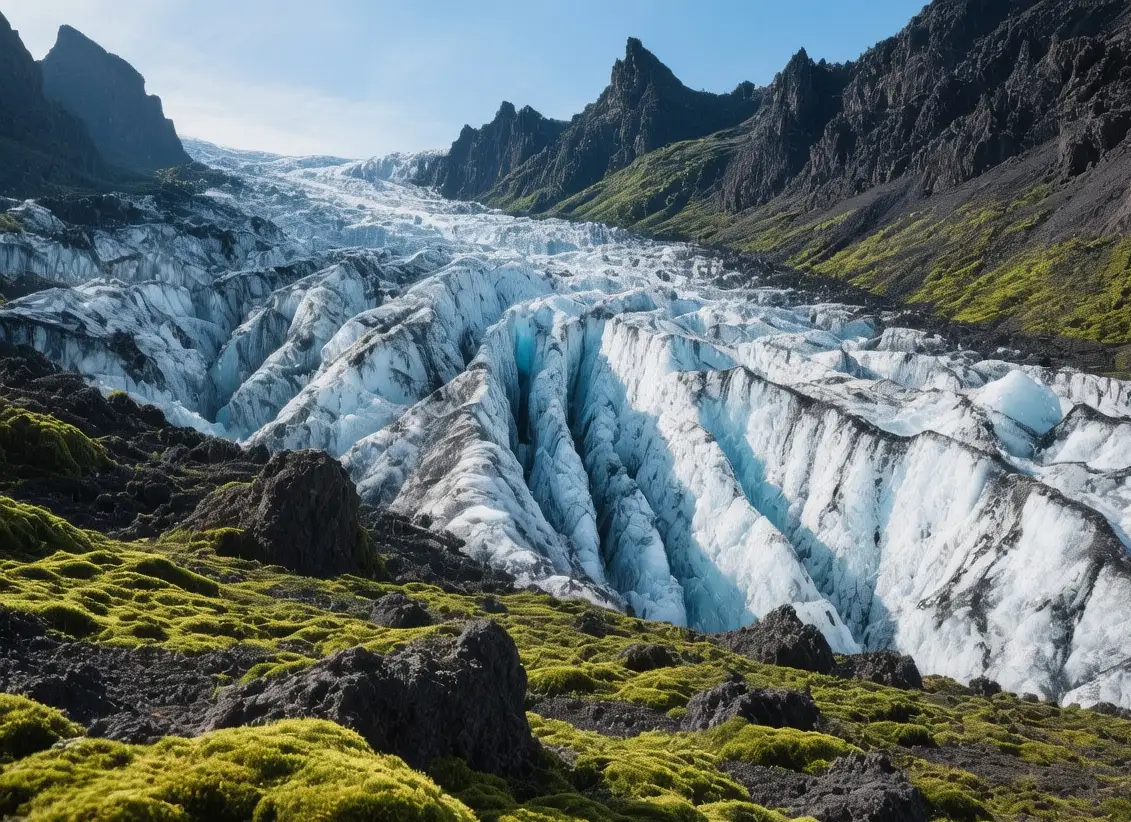
Skaftafell National Park Glacial Ice Meets Volcanic Fire
The wind whispers through ancient juniper trees, carrying the sharp scent of pine needles and the distant, resonant crack of shifting ice. You stand at the edge of the Skaftafellsjökull outlet glacier, where white blue ice presses against black volcanic sand, a stark boundary between frozen time and living earth. The air bites at 5°C (41°F), crisp and clean, while the sun hangs low on the horizon, casting long shadows across the 4,807 square kilometers of protected wilderness. This isn't just a landscape; it's a dynamic arena where the Vatnajökull ice cap—the largest in Europe by volume—slowly retreats, revealing secrets buried for millennia. In 2026, as climate change accelerates glacial melt globally, Skaftafell National Park matters now more than ever—a fragile sanctuary where the delicate balance between fire and ice demands witness before the glaciers that define it vanish into history.
Why Skaftafell National Park Embodies Icelandic Wilderness
The Skaftafell National Park represents far more than a hiking destination—it is Iceland's most accessible classroom for understanding the elemental conflict between volcanic activity and glacial erosion. Established as a national park in 1967 and merged into the greater Vatnajökull National Park in 2008, the site protects a unique ecosystem where subarctic flora thrives alongside active outlet glaciers. The park covers 4,807 square kilometers (1,856 square miles), ranging from sea level to the 2,110-meter (6,923-foot) summit of Hvannadalshnúkur, Iceland's highest peak. This vertical diversity solves a critical conservation need: preserving a complete cross-section of Icelandic geology, from coastal plains to highland ice.
Technical specifications highlight the engineering of nature itself. The Skaftafellsjökull glacier moves at a rate of 1–2 meters per day, carving U-shaped valleys and depositing moraines that date back to the Little Ice Age. The Svartifoss waterfall, anchored within the park, features basalt columns formed by rapid cooling of lava 10,000 years ago, inspiring the architecture of Reykjavík's Hallgrímskirkja. Designated a UNESCO World Heritage Site as part of Vatnajökull in 2019, the area draws 400,000+ visitors annually. The Skaftafell National Park fulfills a human need for connection to deep time, offering a tangible link to the last Ice Age while demonstrating the fragility of frozen landscapes in a warming world. It proves that preservation and exploration can coexist when managed with scientific rigor.
The Best Time to Experience Skaftafell National Park
Timing your visit to Skaftafell National Park requires balancing trail accessibility, glacier safety, and photographic conditions. For optimal hiking with maximum daylight, target June 15–August 31. During these summer months, temperatures range from 10–18°C (50–64°F), and trails are free of snow and ice. Daylight stretches 20–24 hours, allowing visits between 8:00–10:00 PM when the light is soft and crowds thin. The glacier flows strongest during this period due to melt. However, this is peak season; arrive before 9:00 AM to avoid tour buses.
For ice cave exploration and winter photography, visit between November 1 and March 31. Temperatures drop to -5–5°C (23–41°F), and the ice caves stabilize for safe entry. Guided tours operate daily between 11:00 AM–3:00 PM when light penetrates the caves best. However, avoid December 20–January 10 unless prepared for extreme weather; storms can close Route 1 temporarily, and daylight shrinks to 4–5 hours. Also skip July 10–August 10 if you dislike congestion; this peak window brings 2,000+ daily visitors. For real-time trail conditions and weather, verify at www.vedur.is and www.ust.is (Environment Agency).
Approximate Budget for a 7-Day Trip (2026)
Exploring Skaftafell National Park anchors a week-long Southeast Iceland adventure. This budget assumes a 7-day trip based in Höfn or Skaftafell with day trips to the park. Prices reflect 2026 rates, accounting for Iceland's average 3.8% annual inflation from 2024–2026 (source: Statistics Iceland). All amounts shown in euros; multiply by 1.08 for USD equivalents. Note that Iceland uses ISK, but € is provided for international comparison.
Accommodation: €160–€340 per night
• Budget guesthouse in Höfn (near park): €160–€210
• Mid-range hotel (Skaftafell area): €240–€300
• Luxury (Hotel Fossmóti or similar): €400–€550
• Camping (seasonal, Skaftafell): €30 per person
Food: €60–€100 per day
• Breakfast: €15–€20 (hotel buffet or bakery pastry + coffee)
• Lunch: €20–€30 (lobster soup, fish of the day, or hot dog)
• Dinner: €35–€50 (pan-fried Arctic char or traditional lamb)
• Groceries (self-catering): €40/day
Transportation:
• Keflavík Airport to Reykjavík Flybus: €35 round-trip
• Rental car (4x4 SUV, 7 days): €450 + €180 fuel
• Southeast Iceland day tour: €110
• Reykjavík city bus (Strætó): €3.50 per ride
• Skaftafell parking: €10 per vehicle
Attractions:
• Glacier hike: €95
• Ice cave tour: €120
• Svartifoss hike: Free (parking €10)
• Perlan Museum: €30
• Blue Lagoon day trip: €110
• Golden Circle tour: €95
• Jökulsárlón boat tour: €65
Miscellaneous:
• Icelandic wool sweater (lopapeysa): €120–€190
• Thermal base layers: €90
• Travel insurance: €60
• Souvenirs (lava rock, handicrafts): €50
• Tips (not expected but appreciated): €30
Total for 7 days (mid-range): €2,500–€2,850 per person
Total (budget-conscious): €1,650–€1,900 per person
6 Essential Skaftafell National Park Experiences
1. Hike to Svartifoss Waterfall: Start at the Visitor Center and follow the signposted path. The hike is 1.5 kilometers (0.9 miles) one-way and takes 45–60 minutes. The trail gains 100 meters in elevation over gravel and stone steps. Visit at 8:00–9:00 AM to avoid crowds. Wear sturdy hiking boots; the path can be slippery. This approach builds anticipation before the reveal of the basalt columns.
2. Guided Glacier Walk: Book a 3-hour guided hike on Skaftafellsjökull outlet glacier. Walk across crevasses and ice ridges with an axe in hand. The guide explains glacial formation and safety techniques. Visit at 9:00–10:00 AM for stable ice conditions. Wear sturdy boots; crampons are mandatory. This experience reveals the texture and movement of the ice firsthand.
3. Climb Kristínartindar Peaks: For panoramic views, hike to these peaks within the park. Access requires a 4-hour hike round-trip. Why overlooked: Requires physical effort; tour buses skip it. Coordinates: 64.0333° N, 16.9500° W. Best visited at 7:00–8:00 AM for sunrise. The summit reveals the full expanse of the valley and glacier tongue.
4. Visit the Visitor Center: Located at the trailhead, this center offers exhibits on park geology. Open 8:00 AM–8:00 PM (summer), 9:00 AM–4:00 PM (winter). Entry: Free. Use the restrooms and buy snacks here. The staff provide updates on trail conditions. This context transforms the visit from tourism to education about Skaftafell National Park.
5. Explore the Glacier Garden: Located near the visitor center, this area features ancient juniper trees protected from grazing. Open 24/7; entry is free. Why overlooked: Tourists focus on the waterfall and miss the botanical heritage. Insider tip: Walk the loop trail to see trees dating back to the settlement era. It offers a quiet contrast to the dramatic geology.
6. Watch Sunset from the Trail: Return to the trail between 8:00–10:00 PM in summer. The low sun casts golden light on the basalt columns. The crowds thin dramatically after 6:00 PM. The warm light creates a completely different atmosphere than midday visits. This is the most peaceful time to experience the park's power without the danger of midday crowds.
3 Hidden Gems Most Travelers Miss
• Magnúsarfótar Waterfall: Located 2 kilometers east of Svartifoss on a side trail. This smaller cascade features similar basalt columns but sees 90% fewer visitors. Access requires a 45-minute hike from the main path. Why overlooked: Unmarked on basic maps; requires asking rangers for directions. Best visited at 9:00–10:00 AM. Insider tip: Bring a map; the trail is less maintained than the main route.
• Skaftafell Glacier Garden: Located near the visitor center, this area features ancient juniper trees protected from grazing. Open 24/7; entry is free. Why overlooked: Tourists focus on the waterfall and miss the botanical heritage. Insider tip: Walk the loop trail to see trees dating back to the settlement era. It offers a quiet contrast to the dramatic geology.
• Hvannadalshnúkur Viewpoint: While climbing the peak requires a full day, the lower viewpoints offer stunning vistas. Access via the Morsárdalur trail. Why overlooked: Requires longer hiking time; most visitors stick to Svartifoss. Coordinates: 64.0167° N, 16.9833° W. Best visited at 6:00–7:00 AM for clear skies. The view encompasses the highest point in Iceland.
Cultural & Practical Tips
• Stay on marked trails: The soil around Svartifoss is fragile and erodes easily. Straying from the path damages vegetation and destabilizes slopes. Fines apply for off-trail hiking. This ensures the Skaftafell National Park remains accessible for future visitors.
• Weather preparation: Southeast Iceland experiences rapid weather changes. Even in summer, bring waterproof layers and windproof jackets. Temperatures at the falls average 3–5°C cooler than lowlands. Check www.vedur.is for forecasts before hiking.
• Learn these Icelandic phrases:
— Takk (tahk): Thank you
— Góðan daginn (go-than dy-in): Good day
— Skaftafell (skaf-ta-fetl): The park's name
— Fallegt (fah-lekt): Beautiful
Icelanders appreciate effort; pronunciation matters less than attempting the language.
• Photography guidelines: Tripods permitted on viewing platforms but cannot block paths. Drone use strictly prohibited within National Park boundaries without special permit. Best light: Morning (8:00–10:00 AM) or evening (8:00–10:00 PM). Respect other visitors; don't monopolize the railing.
• Footwear requirements: The trail is gravel and stone. Wear sturdy hiking boots with ankle support. Avoid sneakers or flip-flops. In winter, crampons are mandatory; the path freezes and becomes dangerously slick. Rent gear at the visitor center if needed.
• Parking fees: The Skaftafell parking lot costs €10 per vehicle. Payment is via automated machines or app. Display the ticket clearly. Parking is free for campers staying at the Skaftafell campground. Arrive early; the lot fills by 10:00 AM in peak season.
Conclusion: Travel with Reverence, Not Just Photography
The Skaftafell National Park demands more than a perfect Instagram shot—it asks for reverence. As you stand before those black basalt columns and shifting glaciers, recognize that you're not just visiting a landmark; you're entering a zone where volcanic history is written in stone and ice. In 2026, as climate change alters glacial flows, Skaftafell offers both wonder and warning: that nature's beauty is finite, that respect outweighs curiosity, and that future generations deserve to experience this landscape safely. Slow down. Listen to the roar that carved this canyon. Feel the mist that carries glacial silt. Understand that this park exists as both masterpiece and victim. When you visit Skaftafell National Park in 2026, don't just capture the columns for social media—contemplate the forces that created them. Don't just check a box—honor the fragility of this ecosystem. Iceland preserves this site not as a playground, but as a teacher. Learn. Reflect. Carry this reverence home. The world needs more guardians of wild places, not just conquerors of views.