
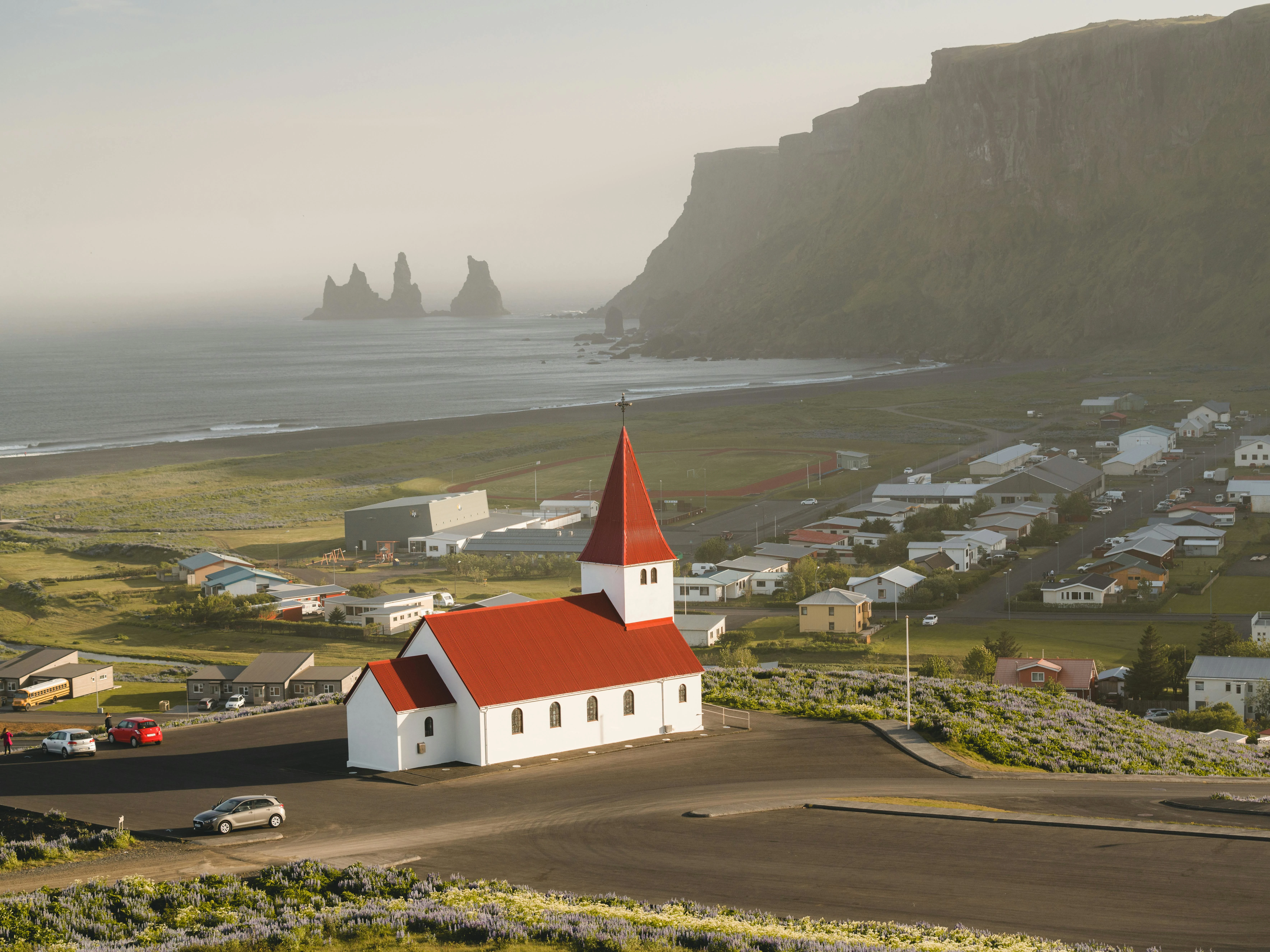
Vik Church Sacred White Walls Meet Volcanic Horizon
The wind howls across the hilltop, carrying the salt spray of the North Atlantic and the distant rumble of glaciers. You stand before the Vik church, a stark white structure with a rust-red roof that cuts through the gray Icelandic sky like a beacon. The bell tolls—a deep, resonant boom that vibrates through the grassy cemetery and settles over the village of Vík í Mýrdal below. From this vantage point, 110 meters (361 feet) above sea level, the view is breathtaking: black sand beaches stretch east and west, while the jagged Reynisdrangar sea stacks pierce the ocean horizon. This isn't just a place of worship; it's a landmark consecrated in 1937, replacing earlier wooden structures lost to fire and time. The church stands as a testament to resilience in a land defined by volcanic volatility, where the Katla volcano slumbers just kilometers away. In 2026, as travelers seek authenticity amidst overtourism, the Vik church matters now more than ever—a spiritual anchor on the South Coast that reminds visitors to pause, reflect, and respect the fragile beauty of a landscape shaped by fire and ice.
Why Vik Church Embodies Icelandic Resilience
The Vik church represents far more than a photographic subject—it is a symbol of community endurance in one of Iceland's most isolated villages. The current structure, built of concrete and wood, was consecrated on September 12, 1937, replacing a wooden church from 1831 that had succumbed to the harsh coastal elements. Designed in a neoclassical style common to Icelandic rural churches, it seats approximately 250 worshippers and serves as the spiritual heart of the Mýrdalur region. The church's location on a hill was strategic: visible from the sea, it guided sailors and travelers to safety long before GPS existed. This solves a critical historical need: providing a navigational landmark in an era when the South Coast was treacherous to traverse.
Technical specifications highlight the engineering required to withstand Atlantic gales. The building's reinforced concrete foundation anchors it against winds exceeding 100 km/h (62 mph), while the steep red roof sheds heavy snow and rain efficiently. The altar features a painting by Icelandic artist Hákon Sigurðsson, depicting Christ blessing the children, a piece that survived from the previous church. The cemetery surrounding the structure contains graves dating back to the 19th century, including the final resting place of shipwreck victims washed ashore. Today, the Vik church draws 300,000+ visitors annually, functioning as both an active Lutheran parish and a cultural monument. It proves that architecture can honor tradition while adapting to modern tourism, creating a legacy that outlasts generations.
The Best Time to Experience Vik Church
Timing your visit to the Vik church requires balancing light conditions, weather safety, and crowd density. For optimal photography with the midnight sun, target May 20–June 15 or September 10–October 5. During these shoulder seasons, temperatures range from 6–12°C (43–54°F), and daylight stretches 18–20 hours, allowing evening visits when the low-angle sun casts golden light on the white façade. The grass is green, and the contrast between the red roof and blue sky is vivid. Crowds are 40% lower than peak July, giving you space to appreciate the view without shoulder-to-shoulder congestion.
For winter photographers seeking dramatic storm clouds, visit between November 20 and March 1. Temperatures drop to -3–4°C (27–39°F), but the dark skies offer aurora opportunities visible from the hill. Plan your visit between 11:00 AM–3:00 PM for maximum daylight and safety. However, avoid December 20–January 10 unless prepared for extreme weather; storms can close Route 1 temporarily, and daylight shrinks to four hours. Also skip July 15–August 10 if you dislike queues; this peak tourist window brings 2,000+ daily visitors to Vík, creating bottlenecks at the church parking lot.
For real-time weather and road conditions, verify at www.vedur.is and www.road.is. The church grounds are open 24/7, but the interior is accessible only during service hours or by appointment (contact: +354 487 1304).
Approximate Budget for a 7-Day Trip (2026)
Exploring the Vik church anchors a week-long South Coast adventure. This budget assumes a 7-day trip based in Reykjavík or Vík with day trips along the Ring Road. Prices reflect 2026 rates, accounting for Iceland's average 3.8% annual inflation from 2024–2026 (source: Statistics Iceland). All amounts shown in euros; multiply by 1.08 for USD equivalents. Note that Iceland uses ISK, but € is provided for international comparison.
Accommodation: €150–€320 per night
• Budget guesthouse in Vík (near church): €150–€200
• Mid-range hotel (Selfoss area): €220–€280
• Luxury (Hotel Ranga or similar): €380–€550
• Camping (seasonal, Vík): €25 per person
Food: €55–€95 per day
• Breakfast: €12–€18 (hotel buffet or bakery pastry + coffee)
• Lunch: €18–€28 (Icelandic lamb soup, fish of the day, or hot dog)
• Dinner: €25–€49 (pan-fried Arctic char or traditional lamb)
• Groceries (self-catering): €35/day
Transportation:
• Keflavík Airport to Reykjavík Flybus: €32 round-trip
• Rental car (4x4 SUV, 7 days): €420 + €160 fuel
• South Coast day tour: €95
• Reykjavík city bus (Strætó): €3.20 per ride
• Vik parking: Free
Attractions:
• Vik church visit: Free
• Reynisfjara black sand beach: Free
• Dyrhólaey viewpoint: Free
• Sólheimajökull glacier tour: €85
• Perlan Museum: €30
• Blue Lagoon day trip: €110
• Golden Circle tour: €95
Miscellaneous:
• Icelandic wool sweater (lopapeysa): €110–€180
• Waterproof jacket: €120
• Travel insurance: €55
• Souvenirs (lava rock, handicrafts): €40
• Tips (not expected but appreciated): €25
Total for 7 days (mid-range): €2,250–€2,600 per person
Total (budget-conscious): €1,500–€1,750 per person
6 Essential Vik Church Experiences
1. Photograph the Iconic Façade: Position yourself on the road leading up to the church for the classic shot. The white walls and red roof contrast sharply against the green grass and gray sky. Visit at 10:00 AM–12:00 PM when sunlight illuminates the front. Use a polarizing filter to enhance the blue sky. Include the Reynisdrangar sea stacks in the background for context. This is the most recognizable image of the South Coast.
2. Explore the Cemetery Grounds: Walk quietly among the graves surrounding the church. Many headstones date back to the 1800s, telling stories of fishermen and farmers. Look for the grave of the "Unknown Sailor," a victim of shipwrecks common in these waters. Visit at 2:00–4:00 PM when light is soft. This experience offers a somber connection to the region's maritime history.
3. View the Interior Altar: If visiting during open hours (typically Sundays 1:00 PM or by appointment), step inside the nave. The wooden pews are simple and polished; the altar painting by Hákon Sigurðsson is the focal point. The acoustics are resonant; speak quietly. Photography is permitted without flash. This space reveals the spiritual function beyond the tourist exterior.
4. Watch Sunset from the Hill: Return to the church between 8:00–10:00 PM in summer (earlier in winter). The low sun casts long shadows across the cemetery and lights up the village below. The wind often dies down at this hour, creating peaceful conditions. Bring a warm jacket; temperatures drop rapidly after sunset. This is the most contemplative time to experience the site.
5. Panoramic View of Vík Village: Stand at the back of the church (east side) to look down on the red-roofed houses of Vík í Mýrdal. The view extends to the black sand beaches and the Mýrdalsjökull glacier in the distance. Use binoculars to spot the Katla volcano caldera on clear days. This perspective emphasizes the church's role as a guardian over the community.
6. Attend a Sunday Service: If your schedule aligns, attend a Lutheran service (typically Sundays at 1:00 PM). The hymns are sung in Icelandic, accompanied by the organ. Visitors are welcome to sit in the back rows. Dress modestly; remove hats upon entry. This experience offers authentic cultural immersion beyond sightseeing.
3 Hidden Gems Most Travelers Miss
• Vik Blacksmith Shop (Smíðjan): Located 500 meters down the hill from the church. This historic workshop still operates, forging iron using traditional methods. Open Monday–Friday, 9:00 AM–5:00 PM. Entry: Free (donations welcome). Why overlooked: Tourists focus on the church and miss the industrial heritage nearby. Insider tip: Watch the blacksmith work; he often demonstrates techniques to visitors.
• Vik Wool Center (Ístex): Situated 1 kilometer west on Route 1. This factory store sells authentic Icelandic wool sweaters directly from the source. Open 9:00 AM–6:00 PM daily. Entry: Free. Why overlooked: Tour buses skip it for larger souvenir shops. Insider tip: Ask to see the knitting machines; staff offer mini-tours on wool processing.
• Hjörleifshöfði Hiking Trail: Located 12 kilometers east on Route 218. This volcanic plug offers panoramic views of the church from a distance. Access requires a 2-hour hike round-trip. Why overlooked: Requires physical effort; tour buses skip it. Coordinates: 63.4167° N, 19.2333° W. Best visited at 7:00–8:00 AM for sunrise. The summit reveals the church's strategic placement.
Cultural & Practical Tips
• Respect the sacred space: The Vik church is an active place of worship, not just a photo studio. Speak quietly, remove hats, and avoid walking in front of the altar during prayers. Services occur Sundays at 1:00 PM; tourism pauses during these times. Dress modestly; shorts and sleeveless tops are discouraged inside the nave.
• Wind preparation: The hilltop is fully exposed to Atlantic gales. Even in summer, wind speeds reach 60 km/h (37 mph). Bring a windproof jacket and secure loose items. Temperatures at the church average 2–3°C cooler than the village below. Check www.vedur.is for wind forecasts before visiting.
• Learn these Icelandic phrases:
— Takk (tahk): Thank you
— Góðan daginn (go-than dy-in): Good day
— Víkurkirkja (vee-kur-kirk-ya): The church's name
— Fallegt (fah-lekt): Beautiful
Icelanders appreciate effort; pronunciation matters less than attempting the language.
• Photography guidelines: Tripods permitted on the grounds but cannot block paths or graves. Flash photography prohibited inside to protect the altar painting. Drone use strictly prohibited within 2 kilometers without special permit from the Icelandic Transport Authority. Best light: Morning (10:00 AM–12:00 PM) or evening (8:00–10:00 PM).
• Parking etiquette: The parking lot is small and fills quickly. Park only in designated spaces; do not block the road or neighboring driveways. The lot is free, but respect is expected. In winter, ensure your vehicle is secured against wind; doors can slam shut violently.
• Accessibility: The path to the church is gravel and steep. Wheelchair access is limited due to the terrain. The entrance has steps; no ramp is available. Service animals permitted. The cemetery ground is uneven; wear sturdy shoes. Visitors with mobility issues may prefer viewing from the road below.
Conclusion: Travel with Reverence, Not Just Photography
The Vik church demands more than a quick photo stop—it asks for reverence. As you stand on that windswept hill, looking out at the ocean and the glacier, recognize that you're not just visiting a landmark; you're entering a space where community and faith have anchored a village for nearly two centuries. In 2026, as tourism pressures grow on Iceland's South Coast, Víkurkirkja offers both beauty and boundary: that some places are sacred, that silence is valuable, and that future generations deserve to experience this landscape with respect. Slow down. Listen to the bell that has tolled for sailors and farmers alike. Feel the wind that shaped this hill. Understand that this church exists because people chose to build hope in a volatile land. When you visit the Vik church in 2026, don't just capture the red roof for Instagram—contemplate the lives it has served. Don't just check a box—honor the community that worships here. Iceland preserves this site not as a museum, but as a home. Learn. Reflect. Carry this reverence home. The world needs more pilgrims to beauty, not just tourists seeking views.
/p>