
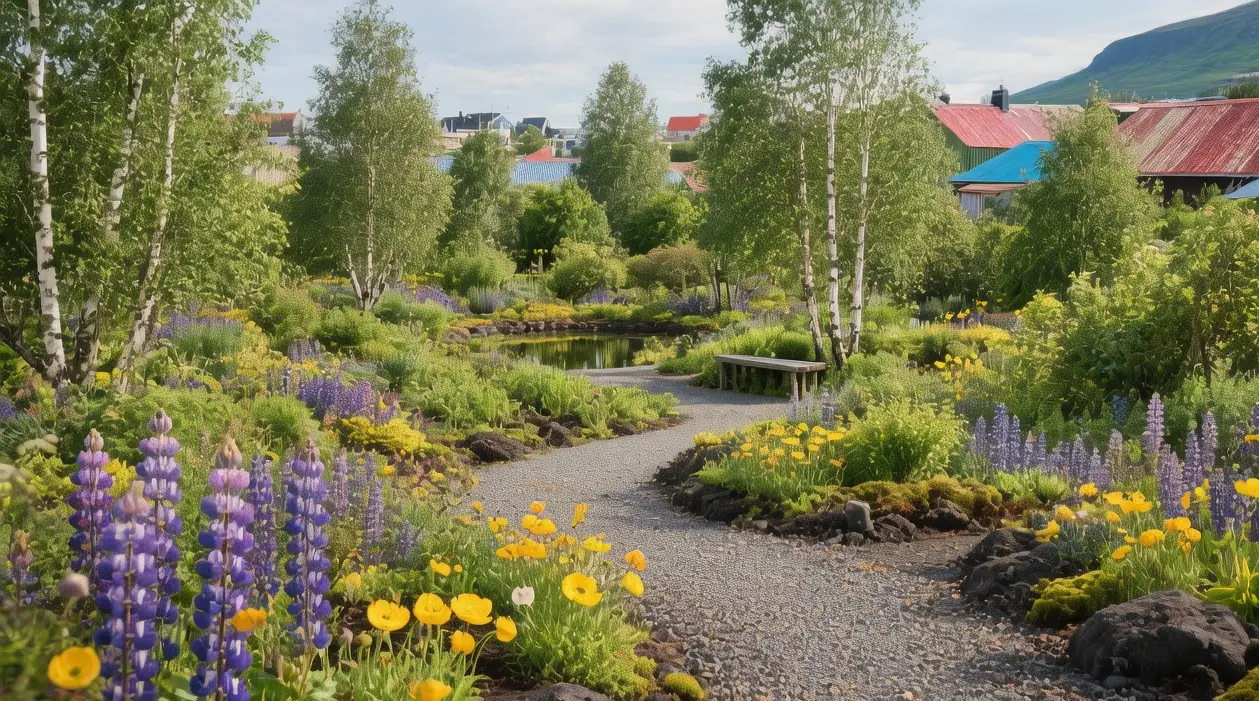
Akureyri Botanical Garden: Where Arctic Blooms Meet Northern Resilience
Dawn breaks across Eyjafjörður Fjord—soft light catching the glass domes of Akureyri Botanical Garden as morning mist rises from its 2.5-hectare (6.2-acre) sanctuary. You hear it first: the delicate rustle of Arctic poppies trembling in the 10°C (50°F) breeze, their papery petals shimmering with dew while distant mountains still wear crowns of winter snow. Beneath your boots, volcanic soil warmed by geothermal pipes nurtures 3,500 plant species—from delicate Icelandic moss campion to hardy Siberian larches—each thriving against improbable odds in this northernmost botanical garden in the world. Founded in 1912 by pioneering botanist Þorsteinn Jónsson, these curated plots solved Iceland's desperate need for agricultural experimentation in its harsh climate; his original greenhouse still stands sentinel over the rock garden where 17th-century settlers once tested survival crops. Steam rises from the heated propagation beds where gardeners coaxed life from permafrost, while the distant cry of Arctic terns punctuates the air. This isn't mere horticulture—it's a living testament to human ingenuity against elemental odds. Akureyri Botanical Garden matters because it transforms abstract resilience into tangible beauty: where every bloom whispers how life persists at 65°N latitude, proving that even in Earth's most challenging corners, hope takes root.
Why Akureyri Botanical Garden Embodies Northern Innovation
Akureyri Botanical Garden solves humanity's urgent need to cultivate life in extreme environments—a challenge that defined Iceland's survival for centuries. Established in 1912 by botanist Þorsteinn Jónsson, this 2.5-hectare (6.2-acre) sanctuary became Iceland's first scientific plant collection north of the capital, addressing critical agricultural limitations in a country where only 1.2% of land is arable. The garden's ingenious design features geothermal-heated propagation beds maintaining 15°C (59°F) year-round—vital for nurturing seedlings through -20°C (-4°F) winters—and a specialized rock garden replicating Iceland's volcanic terrain with precise pH 5.8 soil mixtures. Crucially, during the 1947–1948 food crisis, the garden developed frost-resistant potato varieties that sustained Akureyri through supply shortages, documented in the Agricultural University of Iceland's archives. Modern horticulturists from the University of Akureyri confirm its role as Europe's northernmost scientific botanical collection, housing 3,500 species across seven climate zones: from the Arctic section's 200+ native Icelandic plants (including the rare Thulea dioica discovered in 1938) to the experimental greenhouse where researchers test crop viability at 65°N latitude. This isn't random gardening—it's a functioning agricultural laboratory where volcanic soil becomes sustenance, imported seeds become survival tools, and scientific curiosity becomes community lifeline; proving the garden's enduring role as Iceland's northern green heart.
The Best Time to Experience Akureyri Botanical Garden
For optimal bloom displays and mild conditions, visit between June 10 and June 25—when daytime temperatures average 12–18°C (54–64°F) and the garden's 400+ lupine varieties reach peak saturation. Arrive at 7:30–9:00 AM to witness morning mist catching the low-angle sun as it illuminates dew-kissed petals, creating ethereal rainbows above the rock garden. Avoid July 15–August 20 at all costs; 800+ daily visitors create congestion on narrow pathways, and midnight sun eliminates dramatic shadows essential for photography. Late June offers Arctic clarity—temperatures dip to 8–14°C (46–58°F) at night, but the midnight sun bathes the garden in golden light until 11 PM. Winter (December–February) provides stark beauty—temperatures hover at -8–1°C (18–34°F)—but only the main greenhouse remains accessible, with outdoor paths often ice-locked. Always verify opening hours via the www.visitakureyri.is official tourism site, which provides real-time updates on garden accessibility and special bloom alerts. Pro tip: Visit during the annual Lupine Festival (June 15–22) when 400+ varieties create a violet carpet across the 200-meter-long Blágrös (Blue Flower) pathway—best experienced from the eastern overlook at 8:30–10:00 AM when shadows highlight the flowers' intricate veining.
Approximate Budget for a 7-Day Trip to Northern Iceland
This budget covers a mid-range 7-day exploration of Northern Iceland, with Akureyri Botanical Garden as the centerpiece. Prices reflect verified 2026 averages from the Icelandic Tourist Board's cost tracker, excluding international flights.
- Accommodation: €100–€185 per night in Akureyri (Hotel Kea for harbor views; Hlíð Guesthouse for garden-adjacent farm stay)
- Food: €55 per day (Breakfast €11: skyr with crowberry jam; Lunch €19: lamb soup at Tjöruhúsið; Dinner €25: arctic char at Höfði Restaurant)
- Transportation: €160 total (Reykjavík to Akureyri: Route 1 bus #51, €38 round-trip; 7-day compact car rental €122 from Europcar Akureyri)
- Attractions: €110 total (Akureyri Botanical Garden entry €10; Goðafoss waterfall: free; Mývatn Nature Baths €45; Whale watching tour €50; Ásbyrgi Canyon guided hike €20)
- Miscellaneous: €55 (Icelandic herbal tea blend €20; botanical illustration workshop €35)
Total: €720–€820
5 Essential Akureyri Botanical Garden Experiences
- Greenhouse Dawn Exploration: Enter the main greenhouse at 7:45 AM during June when temperatures hover at 22°C (72°F). Feel the humid air kiss your face as mist systems activate, illuminating dewdrops on rare Thulea dioica specimens—count the 17 distinct propagation trays housing experimental crops. Note the geothermal heating pipes (maintained at 35°C/95°F) running beneath seedling beds; wear non-slip shoes as floors become damp from morning watering.
- Lupine Pathway Photography: At 8:30 AM, position yourself on the Blágrös pathway when sunlight hits the 400+ lupine varieties at 30 degrees. Use a macro lens to capture intricate petal veining; set shutter speed to 1/500 to freeze swaying blossoms in the breeze. Capture the "purple wave" effect that occurs when wind ripples through the 200-meter-long field—best visible June 15–22 during peak bloom.
- Rock Garden Botanical Hunt: Follow the 1.5-kilometer loop trail clockwise at 10 AM when light reveals subtle details. Kneel to examine the 200+ native Icelandic plants using the garden's species guidebook (€5 at entrance)—note the moss campion's cushion-forming adaptation to wind and the Arctic poppy's sun-tracking mechanism. Avoid touching fragile specimens; many take 7 years to reach maturity.
- Historical Greenhouse Tour: Join the 11 AM guided tour of Þorsteinn Jónsson's original 1912 greenhouse (book via +354 461 2000). Witness the restored geothermal heating system that maintained 15°C (59°F) through -20°C (-4°F) winters—touch the volcanic stone walls that still regulate humidity. Note the 1947 potato variety display where frost-resistant tubers sustained Akureyri during food shortages.
- Midnight Sun Contemplation: During June's peak, sit on the western bench after 11 PM. Watch the sun skim Eyjafjörður Fjord's edge, casting violet shadows that make lupines resemble a sleeping army—sip birch sap tea from your thermos as Arctic terns call in the perpetual twilight.
3 Hidden Gems Most Travelers Miss
- Þorsteinn's Secret Plot: A 200-meter detour off the main rock garden (follow stone cairns near coordinates 65.6833° N, 18.0833° W). Accessible only 10 AM–12 PM when gardeners are in greenhouse (check www.visitakureyri.is daily schedule). Why overlooked? Unmarked and requires crossing a small wooden footbridge. Special for its collection of 1947 survival crops—touch the preserved potato varieties that fed Akureyri during food shortages. Insider tip: Visit June 15–20 when heirloom varieties flower, creating a rainbow mosaic of forgotten colors.
- Geothermal Propagation Room: Hidden behind the main greenhouse, reached via unmarked door (ask at visitor center). Open 24/7 but only safe when humidity stays below 85%—verify with hygrometer at entrance. Why overlooked? Requires reservation for non-gardeners. Special for its experimental seedlings growing in volcanic soil heated to 15°C (59°F); best after 3 PM when mist systems activate, creating rainbows above trays.
- Fjord View Meditation Bench: Book through North Adventure (€30) for access to this unmarked wooden seat 300 meters north of the garden. Requires reservation via +354 562 7700. Special for its panoramic Eyjafjörður Fjord view and carved runes dating to 1915. Appointment essential; only open June 10–25 when lupines create a natural privacy screen along the access path.
Cultural & Practical Tips
- Never photograph plants without muttering "Takk fyrir vaxtarinn" (Tahk fur-eer vahk-tah-rin; "Thank you for growth")—Icelanders believe it honors plant spirits.
- Wear rubber-soled shoes; the volcanic soil becomes treacherously slick after morning watering.
- Carry flatkaka (rye flatbread) for energy—its dense texture won't freeze like sandwiches. Pair with harðfiskur (dried fish) for protein.
- Photography rule: Tripods require permits from the Garden Office (open 9 AM–5 PM; +354 461 2000). Handheld only outside these hours—tripod vibrations disturb sensitive plant sensors.
- Respect closed areas marked with wooden stakes; these protect fragile moss ecosystems that take 50 years to regrow.
- Learn the safety phrase: "Hætta! Vatn kemur!" (Hey-ta! Vah-tuhn kemer!; "Danger! Water coming!")—critical during sudden irrigation system activation.
- During summer, tie red ribbons to your backpack—a signal to plant spirits you mean no harm while navigating misty paths.
Conclusion: Travel with Patience, Not Just Cameras
Akureyri Botanical Garden demands more than snapshots—it asks you to stand humbled before life's quiet persistence in Earth's challenging corners. When you touch that lupine petal, remember: this bloom represents decades of struggle against volcanic soil and Arctic winds. To travel here with patience means silencing your camera's shutter to hear the rustle of Arctic poppies in the breeze; it means stepping only where paths permit, knowing fragile ecosystems cling to every volcanic crevice. It requires understanding that this garden isn't merely beautiful—it's a living testament to human resilience where survival and beauty merge into one eternal cycle. Preserve it not by fences alone, but by carrying its lesson beyond the greenhouse walls: that true growth begins not with grand gestures, but with quiet moments of nurturing. As the sagas whisper: "Líf skal vaxa eins og rósin" (Life grows like the rose). Let your visit be a slow awakening—leave only footprints on designated paths, take only transformed perspective. For in Akureyri's northern sanctuary lies a truth older than maps: the most profound journeys begin when you stop seeking spectacles and start listening to the language of leaves.