
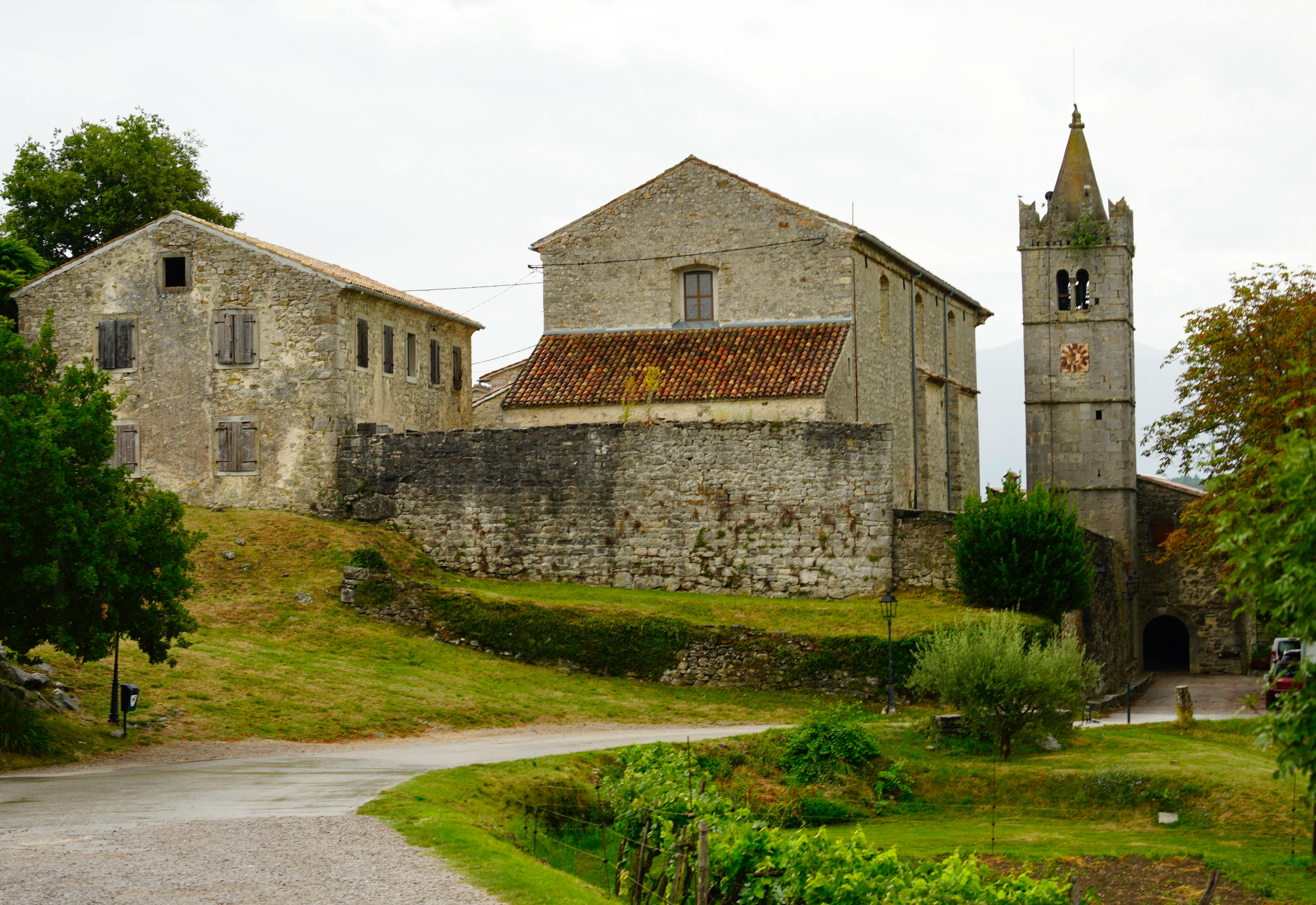
Hum: Where Medieval Whispers Meet Istrian Hills
Dawn breaks over limestone walls no taller than a two-story house, casting long shadows across cobblestones worn smooth by eight centuries of footsteps. You stand at the entrance to Hum—the world's smallest town, a place so compact you could walk its entire perimeter in under ten minutes, yet so rich in history that every stone seems to breathe stories of Venetian merchants, Habsburg soldiers, and Glagolitic scribes who once walked these same narrow passages. The air carries the scent of wild sage and truffles from nearby forests, while the distant tolling of the bell tower marks hours that seem to move slower here than anywhere else in Croatia. Within these fortified walls, measuring barely 100 meters long and 30 meters wide, reside fewer than thirty permanent souls who guard a legacy that stretches back to 1102, when Hum first appeared in historical records as a fortified settlement protecting the approaches to the Istrian interior. This is not merely a tourist attraction or a curious footnote in geography books—it is a testament to human resilience, a living museum where medieval architecture survives not behind glass barriers but as functioning homes, galleries, and gathering spaces that pulse with contemporary life while honoring ancient traditions.
Why Hum Embodies Medieval Preservation
Hum's claim to fame extends far beyond its diminutive size—this fortified settlement represents one of the most perfectly preserved examples of medieval urban planning in the entire Adriatic region. The town's compact dimensions tell a story of defensive necessity: built atop a 349-meter hill overlooking the Mirna River valley, Hum's entire layout was engineered for protection rather than expansion. The rectangular fortress walls, constructed from local limestone blocks averaging 40 centimeters in thickness, enclose exactly two parallel streets connected by stone staircases, creating a defensive labyrinth that could be secured by a handful of guards. Within these boundaries stand twelve residential buildings, two churches, a bell tower, and a single tavern—all contained within an area smaller than most modern city blocks.
The town's historical significance centers on its role as a center of Glagolitic scholarship, the ancient Slavic script that predates the Latin alphabet by centuries. From the twelfth through the eighteenth century, Hum served as a crucial waypoint on the "Glagolitic Alley"—a network of towns where monks and scribes preserved Slavic literacy against pressures from Latin and Venetian cultural dominance. The Parish Church of the Assumption, built in 1156 and renovated in baroque style during the 1600s, houses Glagolitic inscriptions that document everything from property transactions to religious texts, providing historians with invaluable insights into medieval Istrian life. These stone-carved documents, some still visible on church walls and public buildings, represent a cultural resistance movement written in angular characters that look more like geometric puzzles than letters.
Architecturally, Hum demonstrates remarkable engineering efficiency: the town's water cistern, carved directly into the limestone bedrock beneath the main square, could store up to 50,000 liters of rainwater, ensuring survival during sieges and droughts. The defensive tower, rising 15 meters above the city gate, featured murder holes and arrow slits positioned to cover all approach angles. Even today, the original stone paving remains intact in sections, with drainage channels cut at precise angles to channel rainwater away from building foundations—a medieval solution that still functions perfectly after 600 years. This meticulous preservation, combined with Hum's continuous habitation since the twelfth century, creates an authentic medieval experience unmatched by reconstructed theme parks or abandoned ruins.
The Best Time to Experience Hum
Hum reveals different personalities throughout the year, and timing your visit determines whether you encounter an intimate village or a bustling cultural destination. For the ideal balance of pleasant weather, active local life, and manageable tourist numbers, plan your arrival between May 15 and June 20 or September 5 and October 15. During these shoulder seasons, daytime temperatures range from 20–26°C (68–79°F), with cool evenings dropping to 12–16°C (54–61°F)—perfect conditions for exploring the stone streets without summer's intense heat or winter's damp chill. The morning light between 8:00–10:00 AM casts dramatic shadows across the fortress walls, creating exceptional photography opportunities while most day-trippers haven't yet arrived from coastal resorts.
Summer brings vibrant energy but also crowds: from June 21 through September 4, temperatures climb to 27–32°C (81–90°F), and tour buses from Rovinj, Poreč, and Pula deposit hundreds of visitors daily between 11:00 AM and 4:00 PM. However, this period features special cultural events, including the annual "Hum Summer Evenings" festival with traditional music performances and Glagolitic script workshops held in the town square at 7:00 PM. If you visit during peak season, arrive before 10:00 AM or after 5:00 PM to experience Hum's tranquility.
Avoid November through March unless you specifically seek solitude and don't mind temperatures of 4–11°C (39–52°F) with frequent rain and fog. Many facilities reduce hours, and the tavern may close entirely on weekdays. However, winter mornings offer ethereal beauty when mist swirls through the valley below, creating the impression that Hum floats above the clouds.
For current event schedules, accommodation listings, and guided tour bookings, visit the www.tz-buzet.hr official tourism website, which covers Hum as part of the Buzet municipality and updates regularly with festival dates and special exhibitions.
Approximate Budget for a 7-Day Trip
Hum itself offers limited accommodation, so most visitors base themselves in nearby towns like Buzet (8 km away) or Motovun (12 km away), making day trips to Hum while exploring central Istria. The following budget assumes a week-long Istrian adventure with Hum as a focal point, using mid-range accommodations and dining preferences.
- Accommodation: €70–€130 per night for a double room in a restored stone house in Buzet or Motovun. Budget apartments start at €50/night but may lack character; upscale agritourism estates with vineyard views and pools run €110–€180/night. Booking directly with owners often yields 10–15% discounts compared to platform rates.
- Food: €30–€50 per day per person
- Breakfast: €5–€9 (coffee €1.50, pastry €2, or full breakfast €7 at konoba)
- Lunch: €10–€16 (pasta with truffles €13, grilled meat platter €14, local cheese and prosciutto board €12)
- Dinner: €15–€25 (three-course traditional Istrian meal with wine at family restaurant)
- Transportation:
- Car rental: €30–€45/day (essential for exploring Istria's hill towns; automatic transmission adds €10/day)
- Fuel: €30 total for week (Hum is 35 km from coast, 15 km from Buzet)
- Pula Airport transfers: €70 one-way taxi or €15 bus to Buzet + €15 taxi to accommodation
- Attractions:
- Hum town entry: Free (donations appreciated for church maintenance)
- Glagolitic Alley guided tour: €12 per person (2-hour walking tour)
- Church of the Assumption entry: €2 donation suggested
- Truffle hunting experience (nearby Motovun): €65 per person (3 hours with trained dogs)
- Wine tasting at local vineyards: €8–€15
- Miscellaneous:
- Souvenirs: €10–€40 (Glagolitic script prints, local olive oil, truffle products)
- Tourist tax: €1.33 per person per night (paid at accommodation)
- Parking in Hum: Free (limited spaces at town entrance)
Total estimated cost for 7 days: €750–€1,200 per person (based on double occupancy; solo travelers should add 25–35% for single-room supplements)
7 Essential Hum Experiences
- Enter through the city gate at sunrise: Arrive at Hum's main entrance by 7:30–8:30 AM, when the morning light illuminates the Glagolitic alphabet carved above the arched gateway. This is the only time you'll have the entire town to yourself, allowing you to photograph the stone buildings without crowds and hear the church bells ring the hour in perfect solitude. Walk clockwise around the perimeter walls first to understand the town's layout before exploring the interior streets.
- Decipher the Glagolitic inscriptions: Visit the Church of the Assumption (open 9:00 AM–6:00 PM daily) and examine the stone plaques bearing Glagolitic script dating from the 1400s. Look for the angular characters that resemble geometric shapes—this ancient alphabet was used by Slavic priests to translate religious texts. The town's small museum (entry €3, open 10:00 AM–5:00 PM) provides translation keys and historical context, helping you understand inscriptions that mark everything from property boundaries to prayers for the dead.
- Climb the bell tower for valley views: The campanile adjacent to the parish church offers the best vantage point in central Istria. Climb the 47 stone steps (€2 entry, 9:00 AM–7:00 PM) to reach a viewing platform at 15 meters elevation. From here, you can see the entire Mirna River valley, the hilltop towns of Motovun and Oprtalj, and on clear days, the Adriatic Sea shimmering 30 kilometers to the southwest. The best light for photography occurs between 5:00–7:00 PM in summer, when the setting sun turns the terracotta rooftops copper-red.
- Taste rakija at the town tavern: Konoba Hum, the only restaurant within the town walls, serves traditional Istrian spirits distilled from local fruits. Order a tasting flight (€8 for three 30ml samples) featuring medovača (honey rakija), travarica (herb-infused brandy), and loza (grape spirit). The tavern opens at 11:00 AM and stays open until late evening; the owner often shares stories about Hum's history while explaining the distillation process. Pair your drinks with a plate of pršut (Istrian prosciutto) and local cheese (€12) for an authentic aperitivo experience.
- Attend an evening Glagolitic workshop: During summer months (June–September), local artisans offer hands-on workshops teaching visitors to write the Glagolitic alphabet using traditional quill pens and ink. These 90-minute sessions (€15, held Tuesdays and Thursdays at 6:00 PM in the town square) provide insight into medieval scribal techniques and allow you to create your own illuminated manuscript page as a souvenir. Advance booking recommended via the tourism office (+385 52 661 111).
- Walk the Glagolitic Alley: Hum serves as the terminus of the 7-kilometer "Aleja Glagoljaša" (Glagolitic Alley), a scenic hiking route connecting eight Istrian towns through forest paths and olive groves. The trail begins in Roč and features stone monuments at each kilometer marker, each carved with Glagolitic inscriptions honoring historical figures. Allow 2.5–3 hours for the moderate-difficulty hike, which gains 150 meters in elevation. Bring water and wear sturdy shoes—the limestone path can be slippery after rain.
- Photograph the town from the western approach: For the iconic postcard view of Hum, park at the pullout 400 meters west of town on the road to Buzet. From this vantage point, you can capture the entire fortified settlement framed by cypress trees and rolling vineyards. The golden hour between 6:30–8:00 PM in summer provides the most dramatic lighting, with the setting sun casting long shadows that emphasize the texture of ancient stone walls. This spot also offers excellent night photography opportunities when the town's street lamps create pools of amber light against the dark Istrian landscape.
3 Hidden Gems Most Travelers Miss
- The votive chapel of St. Jerome: Located 600 meters outside the town walls on the eastern approach, this tiny 14th-century chapel sits alone in a meadow surrounded by olive trees. Built in 1326, it contains remarkably preserved frescoes depicting biblical scenes in both Glagolitic and Latin inscriptions. The chapel is unlocked daily from 8:00 AM–7:00 PM; look for the key hanging under a flowerpot beside the door if the entrance appears locked. Most tour groups skip this site, so you'll likely have it to yourself. The morning light streaming through the single window illuminates the frescoes beautifully around 9:00–10:00 AM.
- Private rakija cellar at OPG Kraljić: Three kilometers south of Hum on the road to Buzet, the Kraljić family maintains a traditional distillery that produces small-batch fruit brandies using recipes unchanged since the 1800s. Unlike commercial operations, they welcome visitors by appointment only (call +385 98 765 432 or email kraljic.rakija@gmail.com at least 24 hours ahead). The 90-minute tour (€12 per person, includes tasting of six different spirits) takes you through the aging cellar where oak barrels rest in cool limestone caves, followed by a tasting session on their terrace overlooking the valley. They speak English, German, and Italian; cash only.
- The forgotten Roman quarry: Hidden in the forest 1.2 kilometers northwest of Hum lies an abandoned limestone quarry dating to the 2nd century CE, where Roman engineers extracted the pale stone used to build nearby Tergeste (modern Trieste). The site features partially carved stone blocks still embedded in the cliff face, along with tool marks that reveal ancient extraction techniques. Access requires a 20-minute hike from the Hum-Buzet road (look for the unmarked trail at GPS coordinates 45.3847°N, 13.6658°E). Bring a flashlight to explore the quarry's interior chambers, which maintain a constant 14°C (57°F) year-round. This site appears on no tourist maps and receives perhaps a dozen visitors annually.
Cultural & Practical Tips
- Language essentials: Croatian is the official language, though many residents in Istria also speak Italian due to the region's complex history. Essential phrases: Dobar dan (DOH-bar dahn) for "Good day," Hvala lijepa (HVAH-lah LYEH-pah) for "Thank you very much," Oprostite (oh-PROH-stee-teh) for "Excuse me," and Živjeli (ZHEE-vyeh-lee) for "Cheers." Italian phrases like Buongiorno and Grazie are also widely understood.
- Photography etiquette: Hum is a living community, not a museum. Always ask permission before photographing residents, especially elderly locals who may consider it intrusive. A simple "Mogu li vas fotografirati?" (MOH-goo lee vas fo-toh-grah-fee-rah-tee?) shows respect. Inside churches, flash photography is prohibited, and you should remain silent during prayer times (typically 7:00–8:00 AM and 6:00–7:00 PM).
- Footwear requirements: Hum's medieval cobblestones are uneven, polished smooth by centuries of foot traffic, and can be extremely slippery when wet. Wear sturdy walking shoes with good grip—sandals and heels are impractical and potentially dangerous. The stones also retain heat in summer, so closed-toe shoes protect against burns during midday.
- Currency and payments: Croatia adopted the Euro (€) in January 2023. While the tavern and museum accept credit cards, smaller vendors and parking donations require cash. ATMs are available in Buzet (8 km away); bring €50–€100 in small denominations (€5, €10, €20 notes) for purchases and tips.
- Respect quiet hours: Hum maintains a peaceful atmosphere, and residents value their tranquility. Keep voices low, especially between 1:00–4:00 PM (traditional siesta time) and after 9:00 PM. Vehicle access to the town center is restricted; park at the designated area at the entrance and walk the final 50 meters.
- Seasonal weather preparation: Summer temperatures can exceed 30°C (86°F), but the elevation provides cooling breezes. Bring sun protection (hat, sunglasses, SPF 30+ sunscreen) and a refillable water bottle—public fountains throughout the region provide free, potable water. In spring and fall, pack layers; morning fog can make temperatures feel 5–8°C cooler than midday. Winter brings high humidity that penetrates stone buildings, so dress warmly even for short visits.
- Truffle season timing: If visiting between October and December, inquire about white truffle hunting experiences in nearby Motovun Forest. The season peaks in late October, when prices for fresh truffles drop to €800–€1,200 per kilogram (still expensive, but half the peak prices). Many restaurants offer truffle-focused menus during this period, featuring fresh shavings over pasta, eggs, and even ice cream.
Conclusion: Travel with Reverence, Not Just Curiosity
Hum teaches us that size does not determine significance—that a place measuring less than a football field can hold more history, culture, and meaning than entire modern cities. To visit Hum merely to check off "world's smallest town" from a bucket list is to miss the profound lesson this settlement offers about preservation, community, and the enduring power of human creativity. The Glagolitic scribes who carved their angular alphabet into these stones chose cultural identity over convenience, preserving their language and traditions against overwhelming pressure to assimilate. Their legacy challenges us to consider what we choose to protect in our own lives, what we refuse to let disappear despite the relentless march of progress.
Your presence in Hum carries responsibility: support the local economy by purchasing directly from artisans and dining at the town tavern; respect the residential nature of this community by observing quiet hours and asking permission before photographing; and recognize that Hum's survival depends on balancing tourism with authenticity. Leave space in your itinerary for unplanned moments—the conversation with an elderly resident who remembers when Hum had no electricity, the discovery of a Glagolitic inscription that speaks to you across six centuries, the realization that sometimes the smallest places contain the largest truths.
Travel to Hum not as a tourist collecting destinations, but as a guest honored to witness a living testament to human resilience. Slow down. Listen to the stones. Let this tiny town expand your understanding of what matters, what endures, and what we owe to future generations.