
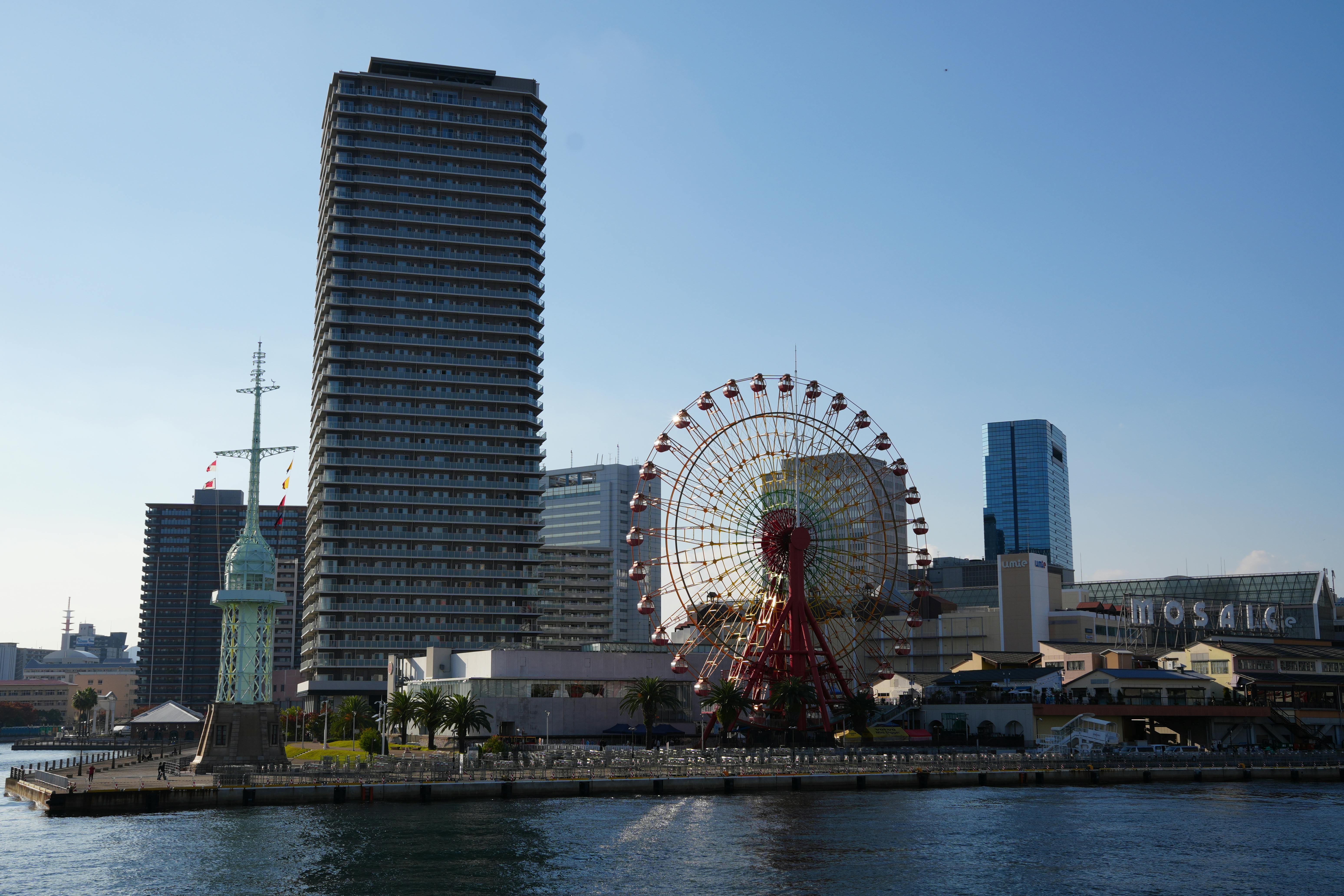
Kobe Harborland: Where Retro Brick Warehouses Meet Neon Seaside Romance
Twilight descends on Kobe’s waterfront, and the air shifts—from the salty bite of the Seto Inland Sea to the buttery sizzle of Kobe beef grilling on teppanyaki irons. At 5:30 PM, the 50-meter Ferris wheel ignites, its neon rings tracing perfect circles against the indigo sky as gas lamps flicker to life along the historic brick promenades. You stand at the edge of Kobe Harborland, a district reborn from the ruins of the 1995 Great Hanshin earthquake, where the past doesn’t just survive—it dazzles. Opened officially in October 1992 on the site of the former JR Minatogawa cargo yard, this 250,000-square-meter entertainment hub didn’t just revitalize the city’s port; it gave Kobe a new rhythmic pulse . Here, 19th-century red brick warehouses, once used for foreign trade, now house chic boutiques and craft beer halls, proving that in this international port city, memory and modernity are not adversaries but dance partners.
Why Kobe Harborland Embodies Japan’s Coastal Renaissance
To walk through Renga Soko, the collection of century-old red brick warehouses, is to touch the very essence of Japan’s Meiji-era industrialization. Built in the late 19th century, these 12-meter-tall structures solved a logistical problem for a nation rapidly opening to the West: how to store and sort goods arriving from Europe and America. Fast forward to the post-bubble era of 1992, and local architects faced a new challenge—how to heal a city that felt disconnected from its own waterfront. Their answer was Harborland. By preserving the 47-meter-long warehouse facades while inserting modern seismic isolation bearings beneath them, engineers created a space that honors the past but lives firmly in the present. This is not a museum; it is a living district. The addition of the 108-meter Kobe Port Tower across the bay in 1963 (and its recent 2021 renovation) and the Gaslight Street in 1992—where 65 gas lamps blend with electric LEDs every evening—turned a functional port into a cinematic stage . This district embodies the Japanese philosophy of *kaizen* (continuous improvement), constantly evolving while keeping its soul intact.
The Best Time to Experience Kobe Harborland
While the illuminations run year-round, the most magical window is October 15th through November 30th. During these six weeks, Kobe’s temperatures hover at a sublime high of 23°C (73°F) and a low of 16°C (61°F), trading the oppressive humidity of August (31°C / 88°F) for crisp, golden light . April 1st to April 15th offers a second peak, where the cherry blossoms along the waterfront path frame the Ferris wheel in pale pink flurries. The golden hour for photographers is strictly 5:00 PM to 6:00 PM (November) or 6:00 PM to 7:00 PM (April), when the "blue hour" paints the sky. Avoid late July and August, when typhoon season brings 85% humidity and sudden downpours, making the open-air decks sticky. For official event calendars and seasonal illumination schedules, visit: www.harborland.co.jp .
Approximate Budget for a 7-Day Trip (Based on a 2-night stay in Kobe)
Harborland itself is free to enter, but the shopping and dining are decadent. This budget reflects a luxury-meets-midrange style, specific to the Kobe bayside area.
- Accommodation: ¥15,000–¥35,000 per night ($100–$235 USD). Stay at the Kobe Meriken Park Oriental Hotel for direct harbor views or the Daiwa Roynet Hotel Kobe Sannomiya for budget efficiency.
- Food: ¥6,500–¥15,000 ($45–$100) per day. Breakfast: ¥800 (coffee and pastry at Mori no Takarabako). Lunch: ¥1,500 (Kobe ramen). Dinner: ¥5,000–¥10,000 (A 150g A5 Kobe beef course at Steakland or a seafood feast at Fisherman's Market).
- Transportation: ¥1,000 ($7) total within Kobe. Use the JR Kobe Line from Osaka to Kobe Station (¥410), then walk. A 1-day Subway pass covering the Kaigan Line to Harborland is ¥830.
- Attractions: ¥3,100 ($21). Kobe Anpanman Children’s Museum (¥2,200-¥2,500) , Ferris wheel (¥800), Kobe Port Tower observatory (¥700).
- Miscellaneous: ¥5,000 ($35). Includes a box of Kobe Frantz chocolate strawberries (¥1,500) and a "Kobe Love" T-shirt from Umie Mall.
- Total for 2 days/7 days mixed: ¥61,400 – ¥128,000 ($410 – $855 USD) for the Kobe leg of your trip.
6 Essential Kobe Harborland Experiences
- Ride the Giant Ferris Wheel at Dusk: Queue up at the Mosaic Garden deck precisely at 4:45 PM. The 12-minute rotation lifts you 50 meters (164 feet) above the bay. Watch as the sun bleeds into the Akashi Kaikyō Bridge and the 600,000 LEDs of the city flicker to life. It is the only place to see the geometry of the red brick warehouses from above.
- Sink Your Teeth into Melting A5 Wagyu: Do not leave without tasting Kobe beef. Book a counter seat at Ishida or Mouriya near the station. For ¥8,000 ($55), watch the chef sear a cut of Tajima cattle—marbled like a pink galaxy. It dissolves on your tongue with a buttery richness that defies meat logic.
- Channel Your Inner Child at Anpanman Museum: Even if you don't have kids, step into the Kobe Anpanman Children’s Museum & Mall (open 10:00 AM – 6:00 PM) . The singing bread-head hero is a Japanese icon. Buy a "Melonpan" mask or watch the 30-minute live show; the sheer joy here is infectious and quintessentially Japanese.
- Sunset Cocktails at the Meriken Park Pier: Skip the crowded Mosaic balconies. Walk five minutes north to the wooden decks of Meriken Park. Grab a ¥700 highball from the vending machine and sit facing the Kobe Port Tower. The reflection of the tower in the black glass of the Maritime Museum is the city’s best free art installation.
- Boutique Hunting in Umie’s North Mall: Forget Tokyo’s chaos. The Umie North Mall houses 230 shops . Hunt for Japanese denim at Hare, minimalist ceramics at MUJI, and vintage band T-shirts at Village Vanguard. It is curated chaos, far less crowded than Osaka’s Shinsaibashi.
- Stroll Gaslight Street after 9:00 PM: Most tourists leave by 8 PM. Wait until 9 PM. The 200-meter pedestrian street, lined with 19th-century gas lamps (now electric), becomes nearly empty. Your footsteps echo off the bricks; the only sounds are the lapping waves and the distant chime of the Anpanman clock tower. This is the silent heartbeat of old Kobe.
3 Hidden Gems Most Travelers Miss
- Kobe Maritime Museum’s "Rooftop" View: Everyone sees the white lattice structure of the Maritime Museum from the ground, but few pay the ¥700 entry to go inside. Once there, take the external staircase to the unmarked rear deck. This spot offers a flawless, unobstructed view of the Kobe Port Tower and the Ferris wheel together. Access: Open 10 AM–5 PM, closed Wednesdays.
- The 7th Floor Manyo Club Foot Bath: Located in the Promena complex (connected to Umie), the Manyo Club is a hot spring spa. You don't need to pay the full ¥3,000 entry fee to enjoy it. There is a free foot bath (Ashiyu) on the 7th-floor outdoor terrace overlooking the harbor . Insider tip: Bring your own small towel; it's BYOT here.
- Duo Dome Underground: Literally hidden underground between JR Kobe Station and Harborland, the Duo Kobe dome is a strange, retro-futuristic event space. By day, it's a passageway. But on weekend evenings, local indie bands or taiko drummers often hold free, impromptu performances inside this echo-friendly concrete cylinder. It’s loud, raw, and deeply local.
Cultural & Practical Tips
- The "Arigato" Taxi Trick: Don't fight for a taxi at Mosaic at 9 PM. Instead, walk 5 minutes to the Hotel Crown Palais Kobe taxi stand. There is zero queue, and it costs the same ¥1,200 to Sannomiya.
- Photography Etiquette: The red brick warehouses are prime real estate for pre-wedding photos. Locals appreciate if you wait for the couple to finish before stepping into their shot. A nod and "Sumimasen" (Sorry) go a long way.
- Vending Machine Secrets: Look for the hot drink vending machines (red button, not blue) in February. A can of "Hot Corn Soup" (¥160) is the ultimate cold-weather harbor companion.
- Cash is Still King: While Umie Mall takes cards, the tiny standing izakayas (bars) in the Renga Soko warehouses are cash-only for the ¥500 grilled squid.
- Watch the Wind: The harbor creates a wind tunnel effect. Even if Kobe city feels calm, the Mosaic deck can gust up to 30 kph. In winter (Dec-Feb), the "feels like" temperature can drop to -2°C (28°F) despite actual 6°C.
- Local Phrase: When clinking glasses of local Nada Sake (Kobe is famous for its sake breweries), say "Kanpai!" (Cheers!). To thank a shopkeeper, a slight bow with "Arigato gozaimasu" is standard.
Conclusion: Travel with Presence, Not Just Passport Stamps
You could race through Kobe Harborland, snapping the Ferris wheel through a phone screen and checking "Japanese port city" off a list. But that would be to miss the point. This is a district that rebuilt itself from literal rubble—the 1995 earthquake toppled many of these brick walls, and the citizens placed them back, brick by brick. When you sit on that dock at midnight, watching the red light of the tower pulse like a heartbeat, you aren't just a tourist; you are a witness to resilience. Slow down. Buy the ridiculously expensive strawberry chocolate. Let the sea air tangle your hair. In a country famous for speed trains and neon chaos, Harborland offers a rare commodity: a quiet five minutes by the water. Travel with the intention to feel the history beneath your feet, not just capture it on your camera roll. That is where the real Japan lives.