
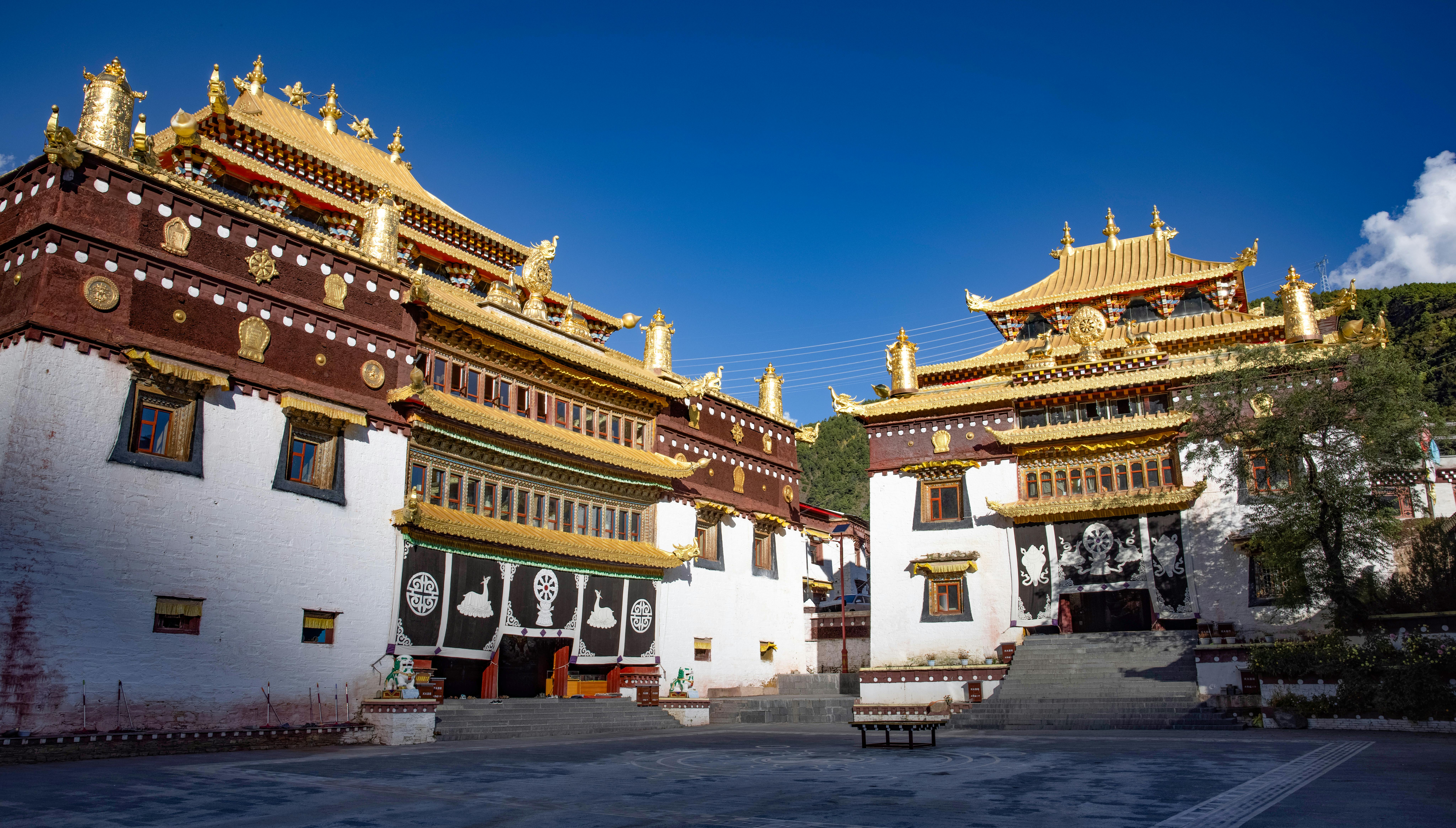
Shigatse Tashilhunpo: Where Golden Spires Meet Tibetan Devotion
The first light of dawn gilds the whitewashed walls of Tashilhunpo Monastery—3,836 meters (12,585 feet) above sea level—where the scent of juniper incense mingles with the crisp, thin air of the Tibetan Plateau. You stand before the 26.2-meter (86-foot) bronze Maitreya Buddha, the world's largest seated statue of the Future Buddha, its surface gleaming with 279 kilograms of gold and 150,000 grams of copper, cast in 1914 under the Ninth Panchen Lama's patronage. Prayer wheels spin with a soft metallic whisper as monks in crimson robes chant morning sutras, their voices echoing through courtyards paved with flagstones worn smooth by six centuries of pilgrims. Beyond the monastery walls, the Nyang River glints silver against the arid landscape, while the distant silhouette of Mount Everest anchors the horizon. This is not merely a monument; it is a living mandala where faith becomes architecture, where every gilded spire and whispered mantra binds past to present. Tashilhunpo matters because it preserves a spiritual lineage that has weathered centuries of change—a sanctuary where devotion is measured not in stone, but in silence.
Why Shigatse Tashilhunpo Embodies Spiritual Legacy
Founded in 1447 by Gendun Drup—the First Dalai Lama—Tashilhunpo Monastery ("Heap of Glory" in Classical Tibetan) solved a profound need: to anchor the Gelugpa school's teachings in a permanent seat of learning and pilgrimage. For over 577 years, it has served as the traditional residence of the Panchen Lama, Tibetan Buddhism's second-highest spiritual authority, preserving intricate thangka painting, butter sculpture, and philosophical debate traditions. The monastery complex spans 70,000 square meters (17.3 acres), with 57 chapels, 260 monastic residences, and a library housing over 10,000 ancient texts. Engineering marvels include the Maitreya Chapel's reinforced timber framework—designed to withstand seismic activity—and the original irrigation system that channels glacial runoff to monastery gardens. The 1960s restoration, completed in 1985 with state funding, meticulously preserved original murals depicting the life of Tsongkhapa, founder of the Gelugpa tradition. Today, over 600 resident monks maintain daily rituals, ensuring that Tashilhunpo remains not a museum, but a living vessel of wisdom—where every prostration, every turned prayer wheel, continues a conversation between earth and enlightenment.
The Best Time to Experience Shigatse Tashilhunpo
For optimal conditions, target two precise windows: May 15–July 10 or September 5–October 20. During late spring and early summer, daytime temperatures in Shigatse range from 14°C to 24°C (57°F to 75°F), with nights averaging 4°C to 10°C (39°F to 50°F); autumn offers crisp days (12°C–20°C / 54°F–68°F) and colder nights (–2°C to 6°C / 28°F–43°F). Aim to arrive at the monastery between 8:00–10:00 AM to witness morning prayers and avoid afternoon crowds. Avoid November 1–March 31 (extreme cold, –18°C/0°F nights, and potential road closures due to snow) and July 15–August 31 (monsoon season brings afternoon clouds that obscure mountain views and muddy trails).. Note: All foreign travelers must obtain a Tibet Travel Permit and be accompanied by a licensed guide—a regulation that supports cultural preservation and visitor safety.
Approximate Budget for a 7-Day Trip
Pricing reflects mid-range independent travel with a licensed Tibetan guide, based on 2026 rates from Lhasa-based operators and guesthouse associations. Costs assume shared accommodation, three daily meals, and standard permit fees; private tours or luxury upgrades increase expenses by 50–80%.
-
• Accommodation: $30–$70 per night (guesthouse in Shigatse city center; prices rise for monastery-view rooms)
• Food: $22 per day (breakfast $5: tsampa porridge, butter tea, fried bread; lunch $8: momos, thukpa noodle soup; dinner $9: yak stew, Tibetan barley wine, apple fritters)
• Transportation: Lhasa–Shigatse round-trip private vehicle $160; permit processing fees $45; guide tips $20/day recommended
• Attractions: Tibet Travel Permit $50; Tashilhunpo Monastery entry $12; Thangka painting workshop $25
• Miscellaneous: Oxygen canister rental $15/day; souvenir prayer wheel $20–50; thermal gloves $25
Total estimated budget: $920–$1,280 USD
7 Essential Shigatse Tashilhunpo Experiences
- Witness morning prayers in the Great Assembly Hall: Arrive by 7:30 AM; the resonant chant of 600 monks, the flicker of 1,000 butter lamps, and the scent of juniper create a transcendent atmosphere—photography permitted without flash.
- Circumambulate the Maitreya Buddha: Walk clockwise around the 26.2-meter bronze statue; the intricate gold detailing and serene expression reward quiet contemplation—allow 20 minutes for full appreciation.
- Attend a thangka painting demonstration: Request access to the monastery's art studio (advance notice via guide); watch masters grind mineral pigments and apply gold leaf using techniques unchanged since the 15th century.
- Climb to the rooftop prayer flag viewpoint: Ascend the western stairwell at 4:00 PM; the panoramic vista of Shigatse city, the Nyang River, and distant snow peaks is ideal for golden-hour photography.
- Share butter tea with a resident monk: With guide permission, accept an invitation for po cha in a monastic courtyard; learn about daily rituals while warming your hands around a clay cup.
- Explore the Tomb of the Panchen Lamas: Visit the sacred stupa complex housing relics of past Panchen Lamas; the intricate woodcarvings and silk banners reflect centuries of devotional artistry.
- Attend the evening butter lamp ceremony: Return at 6:00 PM to witness monks lighting 108 butter lamps; the soft glow against gilded statues creates a meditative ambiance perfect for reflection.
3 Hidden Gems Most Travelers Miss
-
• Sherab Ling Monastery's Meditation Caves: A 30-minute drive north of Shigatse, these 8th-century caves carved into cliff faces offer secluded meditation spots with panoramic valley views. Access: Request permission from the abbot via your guide; best visited 9:00–11:00 AM for soft light. Insider tip: Bring a small offering of juniper branches; locals believe it invites blessings for your journey.
• Nyang River Valley Sunrise Walk: A quiet riverside trail 2 km east of Tashilhunpo, where wild barley sways and black-necked cranes nest in reeds. Access: Follow the path behind the monastery's eastern gate; no permit required. Insider tip: Visit in late September when barley turns golden and migratory birds arrive—bring binoculars and a 70–200mm lens.
• Shigatse Old Town's Traditional Craft Quarter: A network of alleyways near the monastery where artisans practice metalworking, woodcarving, and wool weaving using ancestral techniques. Access: Enter via the southern monastery gate; follow the sound of hammers. Insider tip: Visit Tuesday or Thursday mornings when master craftsmen demonstrate techniques; purchase directly to support local livelihoods.
Cultural & Practical Tips
-
• Greet locals with "Tashi delek" (tah-shee deh-lek), meaning "auspicious blessings"; press palms together at chest level for added respect.
• Always walk clockwise around stupas, mani stones, and prayer wheels; never step over offerings or point feet at sacred objects.
• Photography etiquette: Ask permission before photographing monks or rituals; a small tip (¥5–10) is appreciated for portraits.
• Altitude preparedness: Spend two nights in Lhasa (3,650 m) before visiting Shigatse; drink 3–4 liters of water daily and recognize AMS symptoms (headache, dizziness).
• Dress modestly: Cover shoulders and knees when entering monastery halls; remove hats and sunglasses indoors as a sign of respect.
• Permit compliance: Carry your Tibet Travel Permit and passport at all times; random checkpoints verify documentation along the G318.
• Leave no trace: Pack out all non-biodegradable waste; use designated monastery toilets, and avoid single-use plastics to protect the plateau's fragile ecosystem.
Conclusion: Travel with Reverence, Not Just Records
Tashilhunpo Monastery is not a backdrop for selfies—it is a living scripture of faith and stone. When you stand where golden spires pierce the Tibetan sky and centuries of whispered mantras echo through whitewashed courtyards, the impulse to rush dissolves; what remains is the quiet discipline of presence. Choose to tread lightly: support community-run guesthouses, hire local Tibetan guides, and carry out more than you bring in. Let your footprints be temporary, but your respect enduring. For in the silence between prayer wheel and mountain, you discover that the greatest journey is not measured in kilometers, but in moments of humility, connection, and awe. Slow down. Breathe the thin, sacred air. Let the monastery change you.