
Zhangjiajie National Forest Park: Where Quartzite Pillars Meet Ancient Forest
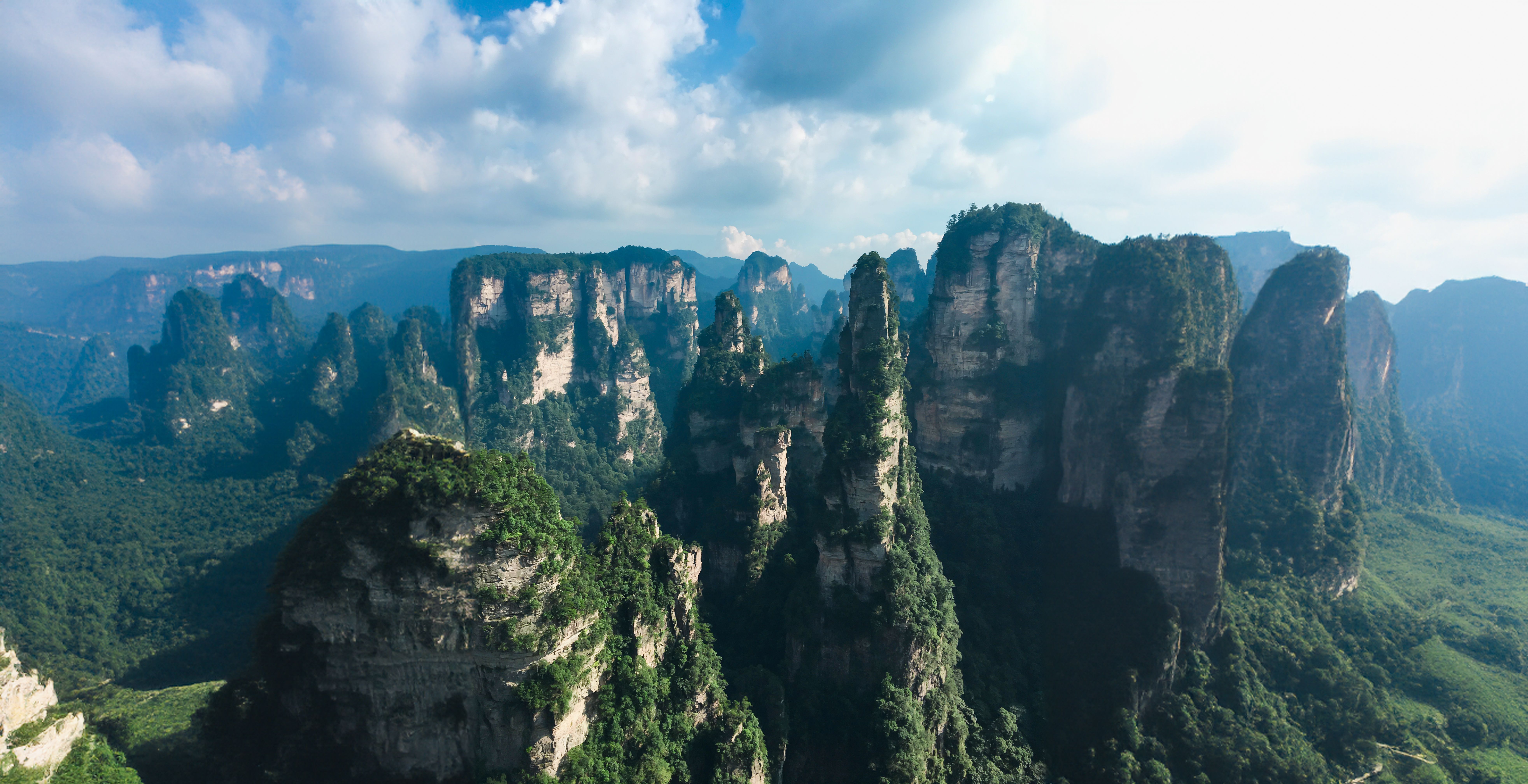
The first light of dawn fractures through a sea of clouds—painting the quartz sandstone pillars in strokes of amber and rose. You stand at the edge of Yuanjiajie, 1,080 meters (3,543 feet) above the forest floor, and the silence is absolute except for the wind threading through Wuling pines. Below you, more than 3,000 jagged peaks pierce the mist like the vertebrae of some primordial dragon, their surfaces glistening with dew that has condensed overnight in the humid subtropical air. This is not merely a view; it is a geological sermon delivered across 380 million years—an ongoing act of creation and erosion that has produced one of Earth’s most singular landscapes. James Cameron’s team wandered these same pathways in 2009, searching for visual inspiration for Pandora’s floating mountains in Avatar, but no cinematic magic can replicate the visceral reality of standing here: the damp stone under your palms, the scent of pine resin and rain-soaked earth, the vertiginous sense that the ground itself is breathing. Zhangjiajie National Forest Park matters because it reminds us that the planet still holds cathedrals built without human hands—monuments to patience, pressure, and the patient chisel of water and time.
Why Zhangjiajie National Forest Park Embodies Geological Singularity
To understand Zhangjiajie is to understand the rare Zhangjiajie Landform—a category so unique that geologists named it after this very place. Unlike the rounded karst hills of Guilin, which dissolve through chemical weathering of limestone, these pillars are forged from quartz sandstone with a silica purity of 75% to 95% . This extraordinary hardness allows them to stand vertical and slender—some soaring over 300 meters (984 feet)—without collapsing under their own weight.
The narrative unfolds in three acts. Act I begins 380 million years ago in the Devonian Period, when this region lay beneath a shallow sea; rivers deposited sediment rich in quartz, creating layers of exceptional density. Act II commenced roughly 100 million years ago, when the collision of the Indian and Eurasian plates thrust the ancient seabed upward, forming a high plateau fractured by vertical joint sets—nature’s blueprint for the pillars . Act III is the present: subtropical rains, freeze-thaw cycles, and the relentless roots of the Wuling Pine (Pinus henryi) slowly wedge open cracks, expanding the stone’s fractures over centuries. The result is an evolutionary sequence visible across the park: from intact plateau at Huangshi Village, to peak walls in Yangjiajie, to peak forests at Tianzi Mountain, and finally to the solitary pillars of Yuanjiajie—the “Avatar” mountains that appear to float when mist obscures their bases .
Designated as China’s first UNESCO World Heritage Site and covering 243 square miles (391 square kilometers), the park also preserves over 500 tree species—including the dawn redwood—and serves as sanctuary for giant salamanders, rhesus monkeys, and countless avian species . It is a living museum where biology and geology conduct an endless, slow-motion duet.
The Best Time to Experience Zhangjiajie National Forest Park
Precision matters when planning your pilgrimage to these peaks. The optimal windows are April 18–May 22 and September 15–November 5 . During the spring window, temperatures average 13°C–27°C (55°F–81°F), wildflowers carpet the understory, and morning mist weaves between the pillars with photographic regularity. The autumn window delivers 15°C–28°C (59°F–82°F), crisp air, and forests ignited in gold and crimson—arguably the most visually dramatic season .
For photographers seeking the ethereal “floating mountain” effect, arrive at viewpoints between 6:30–8:30 AM, when valley fog is thickest and the rising sun backlighting the pillars creates silhouettes of impossible delicacy. The sea of clouds is most reliable after overnight rain, particularly at Tianzi Mountain’s Monarch of the Peak Forest viewpoint .
Periods to avoid: The May Day Holiday (May 1–5), summer vacation (July 1–August 25), and National Day Golden Week (October 1–7) transform the park into a congested labyrinth. During these surges, waits for the Bailong Elevator can exceed two hours, and shuttle buses operate at crush capacity . Winter (December–February) offers snow-dusted solitude and discounted rates, though some cableways operate on reduced schedules and icy trails demand caution .
.
Approximate Budget for a 7-Day Trip
Zhangjiajie operates on a dual-currency economy: the park itself uses Chinese Yuan (CNY), while international travelers should budget in USD or EUR equivalents. The following estimates reflect mid-range travel during shoulder season, excluding international flights.
- Accommodation: ¥180–¥420 per night ($25–$58 USD). Budget guesthouses in Wulingyuan District start at ¥70 ($10), while 4-star properties like Wulingyuan Hotel average ¥350 ($48) . The Pullman Zhangjiajie commands ¥600+ ($83+) for luxury mountain-view suites .
- Food: ¥120–¥180 per day ($17–$25 USD). Breakfast: ¥15–¥25 for Cili rice noodles with beef and pickled vegetables at local chains . Lunch: ¥40–¥60 for Sanxiaguo (Three-in-One Mixed Pot) or Yan’er stewed chicken at Master Tang’s Restaurant . Dinner: ¥50–¥90 for Tujia-style preserved pork with dried green beans and local vegetables .
- Transportation: Airport to Wulingyuan shuttle: ¥20 ($3). Park entry (4-day pass): ¥240 ($33), including eco-buses . Bailong Elevator: ¥65 one-way . Tianzi Mountain cableway: ¥72 one-way . Yangjiajie cableway: ¥76 one-way . Ten-mile Gallery train: ¥38 one-way . Local Didi/taxi between gates: ¥20–¥30 per ride .
- Attractions: Zhangjiajie National Forest Park (4-day): ¥240. Tianmen Mountain (separate ticket): ¥288 . Grand Canyon + Glass Bridge: ¥178 . Yellow Dragon Cave: ¥125 . Baofeng Lake: ¥121 .
- Miscellaneous: Tujia silver jewelry souvenirs: ¥80–¥200. Pueraria lobata starch packets: ¥5 each . Photography permits (commercial): ¥300. Travel insurance: ¥50–¥100.
Total estimated budget for 7 days: ¥3,800–¥5,500 ($525–$760 USD) per person.
Six Essential Zhangjiajie National Forest Park Experiences
- Witness the First Light from Yuanjiajie’s Hallelujah Mountain: Arrive at the Avatar pillar viewpoint by 6:15 AM. As dawn breaks, the 1,080-meter (3,543-foot) monolith emerges from darkness, its summit crowned with Wuling pines that have rooted in stone cracks for centuries. The mist moves like a living thing—pouring into valleys, retreating, then surging again. Bring a wide-angle lens; the vertical scale defies standard framing.
- Ride the Bailong Elevator at Twilight: The world’s tallest outdoor lift ascends 326 meters (1,070 feet) in under two minutes, clinging to a cliff face in Yuanjiajie . Time your ascent for 5:30 PM, when the setting sun ignites the western faces of the pillars in molten gold. The glass-walled cabin accommodates 50 passengers; stand at the front for unobstructed views.
- Hike the Full Length of Golden Whip Stream: This 5.7-kilometer (3.5-mile) valley walk follows a crystalline river flanked by peaks that rise 300 meters (984 feet) on either side . The trail begins 300 meters from the park’s south entrance and passes the Golden Whip Rock itself—a slender spire named for its resemblance to a military weapon. Macaques frequent the path; keep food sealed and maintain respectful distance.
- Stand on the Natural Bridge at Yuanjiajie: Spanning a chasm at 350 meters (1,148 feet) above the forest floor, this stone arch measures more than 20 meters (65 feet) in length with a walkway width of roughly two meters . Peer through the gaps in the railings—if you dare—to witness the dizzying void beneath. Morning clouds often obscure the depths, creating the illusion of walking on sky.
- Take the Tianzi Mountain Cable Car at Dawn: The 2,084-meter (6,837-foot) ascent from the valley to Tianzi Mountain’s summit reveals the park’s most expansive peak forest views . In autumn, the cable car passes through canopies of flaming maple. At the summit, the Imperial Writing Brush Peaks stand like petrified calligraphy against the horizon.
- Walk the Ten-Mile Gallery at Golden Hour: This level trail at the valley floor winds past the Three Sisters Peaks and other formations named for their resemblance to human and animal figures. The late-afternoon light rakes across the sandstone, revealing strata lines in ochre, rust, and cream. A miniature train offers transport for ¥38 one-way, but walking allows you to pause at the artisans’ stalls near the trail’s end .
Three Hidden Gems Most Travelers Miss
- Laowuchang (Old House Area) — The Fields in the Sky: This undeveloped plateau requires effort to reach, which is precisely why it remains empty. From the junction between Yuanjiajie and Tianzi Mountain, board the shuttle bus and request the stop for Laowuchang. Switch to an electric golf cart for a 15-minute ride through terraced rice paddies clinging to cliff edges . Two viewpoints await: Military Parade Platform (Yuebing Tai), offering a direct sightline to the Bailong Elevator across the valley, and Divine Soldiers Gathering (Shenbing Juhui), where dozens of stone towers cluster like petrified sentinels. You will encounter perhaps a handful of other travelers. No ticket booth exists; the cart driver collects ¥50 round-trip in cash.
- Huangshi Village (Yellow Stone Village) at Sunrise: While tour groups swarm Yuanjiajie, Huangshi Village—accessible via cable car from the south gate—offers comparable pillar vistas with fraction of the crowds . The “village” is actually a plateau named for the yellowish oxidized iron in its sandstone. A 3-kilometer loop trail passes the Five Fingers Peak and Star Gathering Platform. Arrive before 8:00 AM to walk the stone paths in near-solitude; by 10:00 AM, the first tour buses arrive.
- Yangjiajie’s One Step to Heaven: In the park’s northwest quadrant, Yangjiajie remains rugged and partially undeveloped—a realm of fortress-like walls rather than solitary pillars . The One Step to Heaven viewpoint requires climbing a narrow iron staircase barely wide enough for one person, ascending through clouds that cling to the 1,130-meter (3,707-foot) peak . The Natural Great Wall formation—a continuous ridge of vertical peaks—stretches across the horizon like a geological fortification. Access via the Yangjiajie cableway (¥76 one-way) from the west.
Cultural & Practical Tips
- Reserve tickets 7–15 days in advance: The park enforces strict time-divided admission with slots from 7:00 AM to 5:30 PM. Your passport serves as your ticket; facial recognition activates on first entry . Miss your slot, and rebooking may delay entry by hours.
- Learn basic Mandarin phrases: Bù hǎo yìsi (不好意思, “excuse me”) and Duōshǎo qián? (多少钱, “how much?”) bridge gaps in rural areas where English is scarce. The Tujia people—one of China’s 56 recognized ethnic minorities—populate the region; their language belongs to the Tibeto-Burman family, though most speak Mandarin.
- Pack for vertical weather: Temperatures drop 8°C–12°C (14°F–22°F) between valley floors and summit viewpoints. A waterproof shell is essential even in dry season; mountain microclimates generate sudden afternoon showers . Non-slip hiking shoes with aggressive tread are mandatory—stone steps become slick with moss and rain.
- Photography etiquette: Drones are prohibited without special permits from the Wulingyuan District Tourism Bureau. Tripods are allowed at designated viewpoints but obstruct narrow pathways during peak hours. The golden hour window (6:00–7:30 AM and 5:30–7:00 PM) offers the most dramatic sidelighting on the pillars.
- Monkey protocol: Rhesus macaques along Golden Whip Stream and Huangshi Village are habituated but wild. Do not feed them—aggressive begging behavior has resulted in injuries. Secure zippers on backpacks; these primates are adept at unfastening Velcro and clasps.
- Cash and payment: While China is increasingly cashless, rural vendors and the Laowuchang cart driver prefer yuan notes. Download Alipay and link it to an international credit card before arrival; WeChat Pay requires a Chinese bank account for full functionality .
- Physical preparation: The park’s verticality is relentless. The main trail from the south gate to Huangshi Village gains 892 meters (2,929 feet) over 8.2 kilometers (5.1 miles) . Train with stair-climbing in the weeks before your trip; your knees will thank you.
Conclusion: Travel with Reverence, Not Just a Camera
Zhangjiajie National Forest Park is not a backdrop for social media performance—it is a 380-million-year-old scripture written in stone and mist. When you stand on the Natural Bridge, feeling the wind press against your chest at 350 meters above the void, you are participating in a moment of geological time that dwarfs human civilization. The Wuling Pines clinging to vertical cracks do not care about your itinerary; the mist that reveals and conceals the pillars follows no schedule but its own.
Travel here with the patience these mountains demand. Walk slowly enough to notice the lichen colonizing every crevice; pause long enough to hear the river threading through valleys you cannot see. The Tujia people who have called these valleys home for millennia understood what modern tourism often forgets: some landscapes are not meant to be conquered, but contemplated. Leave the selfie stick in your bag. Sit on a stone bench at Laowuchang as the clouds rearrange themselves into new cathedrals. Let the silence teach you what 380 million years of erosion has to say about permanence and change. Zhangjiajie will still be here, slowly becoming something new, long after our footprints have vanished from its trails.