
Zhangye Danxia Rainbow Mountains: Where Mineral Stripes Meet Gansu Sky
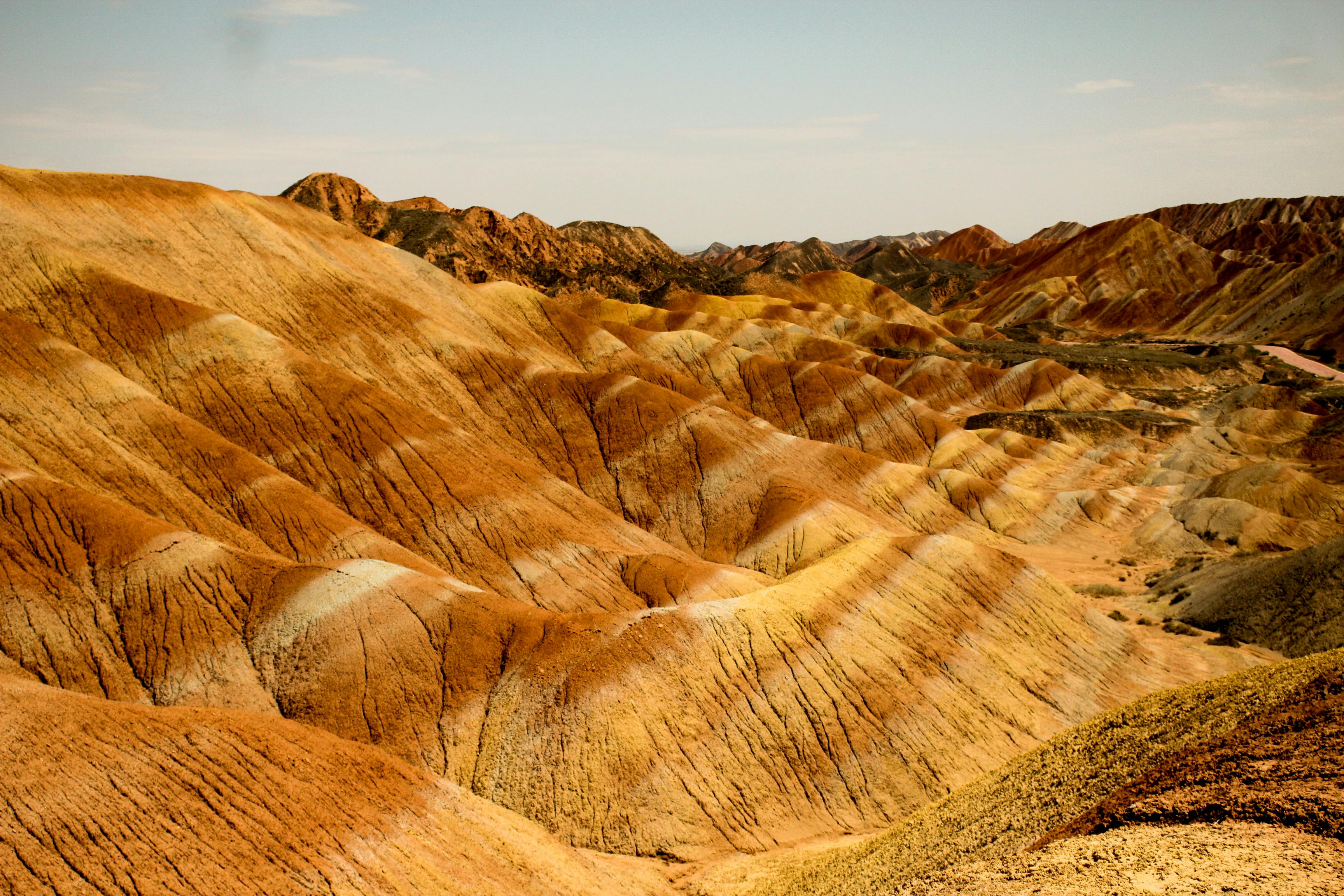
The sun begins its slow descent behind the Qilian Mountains—casting long shadows across a landscape that resembles nothing else on earth. Before you, ridges of rock ripple across the horizon in bands of crimson, ochre, amber, and jade—as if a giant's paintbrush swept across the Gansu steppe in strokes 50 million years in the making. This is the Zhangye Danxia National Geological Park, a 200-square-mile (510-square-kilometer) expanse of Cretaceous-era sandstone and mineral deposits that earned UNESCO World Heritage status in 2009 . The air is dry and thin at 1,800 meters elevation; dust motes float in the golden light as you ascend the wooden boardwalks toward Viewing Platform No. 4, known locally as "Rainbow Terrace" . Below, the "Colorful Screen" unfurls—layers of iron oxide (burning red), limonite (mustard yellow), chlorite (forest green), and magnetite (obsidian black) folded like a geological layer cake . This is not a painting. It is the earth's crust, exposed and glorious, formed when the Indian tectonic plate collided with Eurasia 55 million years ago, crumpling flat sedimentary beds into the folded masterpieces you now walk upon .
Why Zhangye Danxia Embodies Tectonic Color Theory
The Rainbow Mountains solve a geological puzzle visible nowhere else on earth at this scale: how do you preserve the vivid signature of ancient environments across 100 million years? The story begins in the Cretaceous Period (145–66 million years ago), when this region was a vast basin flanked by mountains. Rivers carried sand, silt, and iron-rich clays into the depression, depositing them in horizontal layers—each stratum capturing a different geological era. The red layers owe their hue to hematite (Fe₂O₃), formed when iron minerals oxidized in contact with ancient oxygen-rich waters; the yellows and browns come from limonite or goethite; the greens from chlorite or iron silicates; the blacks from magnetite . Then came the tectonic cataclysm: between 55 and 40 million years ago, the Indian Plate slammed into Eurasia at roughly 27 feet per century, crumpling the flat sedimentary "layer cake" into folds and fault blocks, then uplifting the entire region . Wind, rain, and freeze-thaw cycles stripped away the softer overlying rock, exposing these tilted, eroded strata as the rainbow ridges you see today. Chinese geologists first mapped the formation in the 1920s and 1930s, but the area remained little known outside the region until the 2000s . Today, it stands as a 5A-rated scenic area, the highest classification in China's tourism system .
The Best Time to Experience the Rainbow Mountains
The ideal windows for visiting Zhangye Danxia are April 1–May 31 and September 1–October 31. April and May offer daytime temperatures of 12–22°C (54–72°F) with minimal wind—the colors appear most saturated in the dry spring air, and the surrounding Qilian Mountains still carry snow on their peaks, creating a dramatic backdrop . September brings cooler conditions (10–20°C / 50–68°F) and thinner crowds after the summer peak . For photographers, sunrise (6:00–7:30 AM) and sunset (6:30–8:00 PM, varying by season) are non-negotiable: the low-angle light rakes across the folded strata, maximizing color saturation and shadow depth . Viewing Platform No. 4 is universally recommended for sunset, while Platform No. 1 excels at sunrise. Avoid July 1–August 15, when temperatures exceed 30°C (86°F), crowds swell along the Qinghai-Gansu Grand Loop, and the harsh midday sun bleaches the colors . Winter (November–February) brings temperatures as low as -10°C (14°F) and occasional snow, which can create striking monochrome contrasts—but some facilities operate on reduced hours. For current opening times and ticket reservations, consult: www.zydanxia.com .
Approximate Budget for a 7-Day Trip
This budget assumes a solo traveler or couple sharing accommodations, basing themselves in Zhangye City (40 km from the park) or at the park entrance village (Danxia Kou). Prices reflect the 2026 season in Chinese Yuan (CNY); 1 CNY ≈ 0.14 USD ≈ 0.13 EUR. The Qinghai-Gansu region offers excellent value compared to eastern China.
- Accommodation: 150–600 CNY per night — Budget guesthouses in Zhangye City (150–250 CNY), mid-range hotels near the park entrance (250–450 CNY), or premium options like Rainbow Danxia Hotel at the park gate (500–600 CNY) for sunrise access .
- Food: 60–150 CNY per day — Breakfast 10–20 CNY (beef rice noodles or steamed buns), lunch 20–40 CNY (picnic supplies or park food stalls), dinner 30–90 CNY (hand-grabbed lamb at Qilian Pastoral, fried pao noodles at Sunji, lamb skewers at Ganzhou Alley night market) .
- Transportation: 200–800 CNY one-way — High-speed train from Lanzhou to Zhangye West (~150 CNY, 3 hours) or regular train (~100 CNY, 6 hours). Zhangye West Bus Station to Danxia Scenic Area shuttle one-way (10–15 CNY, 40–50 minutes) or taxi/Didi (100–200 CNY one-way) .
- Attractions: 75–400 CNY — Zhangye Danxia entrance + mandatory shuttle bus: 75–95 CNY (75 CNY standard as of 2020; expect slight increases) . Optional: Hot air balloon ride at Platform No. 4 (200–400 CNY depending on season, weather permitting). Binggou Danxia (window palace formations): ~60 CNY. Mati Temple grottoes: 35–74 CNY.
- Miscellaneous: 50–300 CNY — Local souvenirs: hand-painted Danxia postcards (10–20 CNY), Qilian yak jerky (30–60 CNY), Zhangye apricot peel water (5–10 CNY per bottle), Tibetan prayer flag set (15–40 CNY).
- Total (7 days including transport from Lanzhou): 1,500–3,500 CNY (approximately 210–490 USD) per person excluding international flights.
7 Essential Zhangye Danxia Experiences
- Watch the sunset from Viewing Platform No. 4 (Rainbow Terrace): Arrive at the platform by 5:30 PM (summer) or 4:30 PM (winter) to secure a position facing west. As the sun dips behind the Qilian Mountains, the mineral stripes ignite in sequence: the hematite bands deepen to burgundy, the limonite flares gold, and shadows carve the folded strata into a three-dimensional topographic map. This is the most photographed view in the park—for good reason. The last shuttle bus departs approximately one hour after sunset; confirm the time with staff upon arrival .
- Catch the first light at Viewing Platform No. 1 (Colorful Screen): The park opens at 6:30 AM in peak season. From the entrance, take the first shuttle directly to Platform No. 1. The morning light arrives soft and diffuse, illuminating the "Colorful Screen"—the widest continuous exposure of rainbow strata in the park. Use a wide-angle lens to capture the full sweep; a telephoto lens isolates sinuous wave patterns in the rock. By 8:30 AM, the tour groups begin arriving; arrive at least two hours before .
- Ride the mandatory shuttle bus loop to all four platforms: The park operates a one-way circuit: Platform No. 1 → Platform No. 2 → Platform No. 3 (rest stop) → Platform No. 4 → exit. The bus system is efficient but inflexible: if you miss a stop, you must complete the loop before returning. Allocate at least three hours for the full circuit with short stops; four to five hours if you linger for photography. The last bus departs Platform No. 4 one hour before the park closes .
- Explore Binggou Danxia's window palace formations: Located 20 minutes from the main park, this complementary site features "window palace" Danxia—vertical rock towers with horizontal striping, contrasting with the main park's folded "rainbow" style. Binggou receives perhaps 10% of the main park's visitors. The entry fee (~60 CNY) is not included in the main ticket; combine both in a single day if you start early. Allow two to three hours.
- Climb the grottoes of Mati Temple (Horse Hoof Temple): Combine Danxia with a cultural site 1.5 hours from Zhangye City. This cliff-side Buddhist complex, founded during the Northern Liang dynasty (397–439 CE), features the "Thirty-Three Heavens" grottoes—a precarious staircase of wooden walkways hugging a vertical sandstone face. The name derives from a legend: the celestial horse of the Heavenly Emperor left a hoof print on a rock here. Entry: 35–74 CNY. Allow three to four hours for exploration and the 1.5-hour drive each way.
- Photograph the "Frozen in Time" textures at Platform No. 5 (Knife Mountain and Fire Sea): Most tourists skip Platform No. 5, accessible via a short path branching from the main shuttle route. Here, the Danxia takes on sharper, more angular forms—eroded into knife-edge ridges (Knife Mountain) and undulating red-and-orange bands (Fire Sea). The lack of crowds allows tripod use without obstruction. The platform faces northeast, making it ideal for late-afternoon rather than sunset photography.
- Soar above the rainbow via hot air balloon (May–October only): At Platform No. 4, weather permitting (wind speed below 3 m/s), you can book a tethered hot air balloon ride. The balloon rises approximately 50 meters (164 feet) above the platform, offering 10–15 minutes of aerial perspective over the folded strata. The cost ranges from 200–400 CNY depending on the season and demand. Rides operate only during calm morning (7:00–9:00 AM) and late afternoon (4:00–6:00 PM) windows. Book immediately upon arrival at the park, as slots fill quickly .
3 Hidden Gems Most Travelers Miss
- The unmarked fossil beds behind Platform No. 3: Platform No. 3 functions primarily as a rest stop with food vendors and restrooms. However, a 200-meter unpaved path leading east from the platform's back edge (no signs, no guardrails) arrives at a small exposure of fossilized Cretaceous clam shells embedded in the sandstone. These are the remains of the ancient lake that once filled this basin—proof that this rainbow desert was once an aquatic ecosystem. Do not remove any fossils; touching is permitted, but the site is unprotected and fragile. Most visitors walk past without ever knowing these fossils exist.
- Sunan Grassland yak yogurt stand at the park exit: After exiting the park, most visitors board their buses immediately. But the small parking lot vendors include a single stand (look for the handwritten sign in Mandarin: 酸奶) selling Sunan County yak yogurt—fermented yak milk with a consistency like thick Greek yogurt and a slightly sour, almost alcoholic tang. The yogurt is served cold in small clay bowls (8 CNY). The same family has sold yogurt here for three generations; they speak little Mandarin but will smile when you say "Hǎo chī" (delicious). This is not on any tour itinerary.
- The Eastern Route's forgotten prayer flags: The main park shuttle serves only the four Western Route platforms. The Eastern Route—accessible only by foot from the main entrance, requiring a 6-kilometer (3.7-mile) round-trip hike—sees perhaps two dozen visitors daily. Halfway along this route, a small stone cairn topped with faded Tibetan prayer flags (wind-worn to pale blues and whites) marks a local pilgrimage site. No plaque explains it. No map marks it. Local guides say workers building the park paths erected it as a blessing for safety; now it stands as a quiet testament to the spiritual layer beneath the geological spectacle. To find it: from the main entrance, take the service road east past the employee parking lot; after 1.5 kilometers, look for a low stone mound on your left. Return before the park closes; staff may not know you are out there.
Cultural & Practical Tips
- Never step off the boardwalks onto the Danxia rock: The sandstone is soft, crumbly, and takes millions of years to form—but only one careless footstep to damage. Fines for walking on restricted areas start at 500 CNY. The color layers are measured in millimeters; a single footprint can erase thousands of years of geological history. Stay on designated paths and boardwalks at all times.
- Check the weather forecast obsessively: The Danxia colors appear most vivid under three conditions: 1) After recent rain (wet rock increases color saturation dramatically), 2) During low-angle sunlight (sunrise or sunset), and 3) Under partly cloudy skies (clouds diffuse harsh light while maintaining shadows). On completely overcast days, the colors flatten into muted browns and grays—many visitors leave disappointed because they arrived at noon under a gray sky. If rain is forecast, go anyway; the post-rain saturation can produce the best photos of your trip.
- Drones are prohibited without advance permits: The park strictly prohibits private drones due to wildlife disturbance and safety concerns near the shuttle bus routes. You may apply for a commercial photography permit through the park website (www.zydanxia.com) at least two weeks in advance; approval is not guaranteed. For aerial perspectives, book the hot air balloon instead.
- Photography clothing strategy: Solid, saturated colors photograph best against the rainbow strata. White, red, or royal blue create contrast; earth tones (brown, olive, beige) cause you to vanish into the rock. Avoid busy patterns or neon colors. A circular polarizing filter helps cut atmospheric haze and deepen the blue of the Gansu sky.
- Altitude awareness and hydration: The park sits at 1,800–2,200 meters (5,900–7,200 feet) elevation. Even fit travelers may experience mild shortness of breath on the staircases to viewing platforms. Drink at least two liters of water during your visit; the dry air and sun exposure cause rapid dehydration. Sunscreen, wide-brimmed hats, and sunglasses are essential even in spring and autumn.
- Essential Mandarin phrases: While the ticket office has English signage, vendors and shuttle drivers rarely speak English. Learn: "Nǐ hǎo" (Nee Haow - Hello), "Duōshǎo qián?" (Dwo-shao Chyen - How much money?), "Píngtái sì zěnme zǒu?" (Ping-tie sir zum-uh dzoe - How do I get to Platform No. 4?), "Xièxie nǐ" (Shieh-shieh nee - Thank you). For the Tibetan vendors at the exit, a simple "Tashi delek" (Tah-shee day-lek - Good luck/auspicious greetings) earns genuine smiles.
Conclusion: Travel with Wonder, Not Just Megapixels
You could visit Zhangye Danxia in two hours—ride the shuttle, snap the mandatory sunset shot at Platform No. 4, and check another wonder off your list. But these mountains deserve more than a drive-by. They are the product of 100 million years of sedimentary patience, followed by 50 million years of tectonic violence—then stripped bare by wind and water over eons. The red in that ridge is iron that oxidized when dinosaurs still walked the earth. The yellow is limonite that settled on an ancient lakebed when the Himalayas had not yet been born. When you stand before these colors, you are not observing a landscape. You are reading the autobiography of the planet—written in mineral layers, folded by continental collisions, and exposed for an audience that has arrived only in the last blink of geological time. Stay until the last light leaves the Knife Mountain ridge. Walk the boardwalks without your camera pressed to your face. Let the silence of this place remind you: some masterpieces take 100 million years to complete. You are lucky to arrive while the colors still burn.