
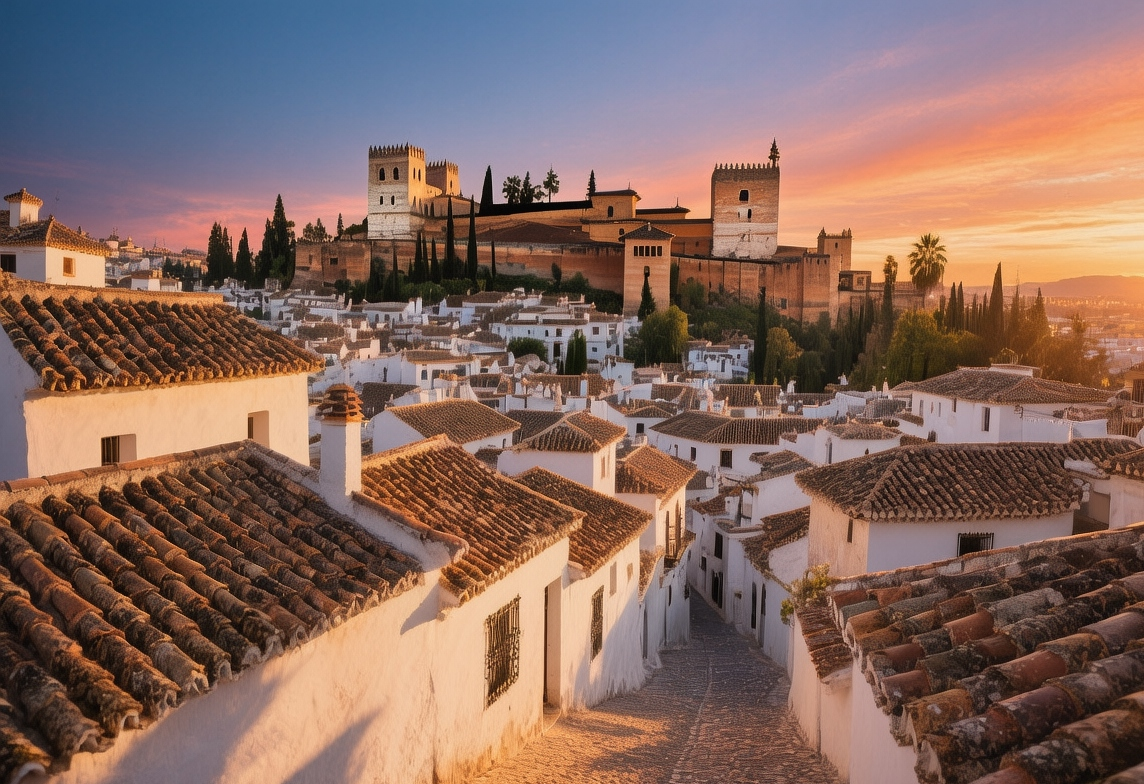
Albaicín Quarter, Granada Moorish Alleys Meet Andalusian Twilight
The call to prayer no longer echoes across the Albaicín, yet the spirit of Al-Andalus persists in every whitewashed wall and jasmine-scented courtyard. As the sun dips behind the Sierra Nevada, casting the Alhambra's ramparts in rose-gold light, you navigate a labyrinth of streets so narrow that two people cannot pass abreast—some measuring barely 1.5 meters wide. The cobblestones, worn smooth by eight centuries of footsteps, slope unpredictably beneath your feet while the distant strum of a flamenco guitar drifts from a Sacromonte cave dwelling. This is Granada's oldest quarter, a UNESCO World Heritage Site since 1984, where 11th-century Moorish urban planning survives intact amid 1,200 whitewashed houses and hidden cármenes (walled gardens with water features). The Mirador de San Nicolás, perched 760 meters above sea level, draws crowds at dusk, but wander deeper into the Albaicín's 43 hectares and you discover silent plazas where orange trees heavy with bitter fruit shade centuries-old fountains. In 2026, as overtourism threatens Europe's historic centers, the Albaicín quarter remains a testament to cultural layering—where Islamic architecture, Christian reconstruction, and Gitano flamenco tradition coexist in fragile, beautiful tension.
Why Albaicín Embodies Moorish-Andalusian Synthesis
The Albaicín quarter represents one of Europe's most intact examples of medieval Moorish urbanism, preserving the irregular street patterns and defensive architecture established when Granada served as the capital of the Nasrid Kingdom from 1238 to 1492. The quarter's name derives from the Berber al-Bayyazīn (the falconers), though some scholars trace it to al-Bayyāzīn (the silkworm traders), reflecting the area's commercial heritage. After the Catholic Monarchs completed the Reconquista on January 2, 1492, the neighborhood housed up to 50,000 Muslims before forced conversions and expulsions reduced the population dramatically by 1609.
The quarter's distinctive architecture solves a fundamental problem: how to create privacy and climate control in a dense hillside settlement. The solution: cármenes, traditional Granadine houses featuring high walls, interior patios with water features, and north-facing orientations to maximize cooling. These structures employ thick rammed-earth walls (up to 60 centimeters) and small windows to maintain interior temperatures 8–10°C cooler than exterior summer heat. The narrow, winding streets—designed to confuse invaders and provide shade—create natural wind tunnels that channel cool air from the Darro River valley below.
Archaeological excavations reveal that the Albaicín sits atop earlier Roman and Visigothic settlements, with the 11th-century Zirid dynasty establishing the first fortified walls in 1013. The remaining sections of these walls, particularly near the Puerta Monaita and Puerta de Elvira, display the characteristic tapial (rammed earth) construction technique using local clay and lime. The quarter's 14 parish churches, built atop former mosques after 1492, create a palimpsest of religious architecture—most notably the Church of El Salvador, which incorporates the original mosque's minaret as its bell tower. This architectural layering makes the Albaicín quarter not merely a tourist attraction but a living document of Spain's complex cultural inheritance.
The Best Time to Experience Albaicín
For optimal exploration of the Albaicín quarter, target April 15–June 10 or September 15–October 25, when temperatures range between 16–26°C (61–79°F) and the jasmine and orange blossoms perfume the air. The quarter reveals its most magical character during la hora azul (blue hour)—specifically 8:30–10:00 PM in summer months—when the Alhambra illuminates against the darkening sky and the narrow streets fill with the gentle murmur of evening strollers. Spring offers the added enchantment of Semana Santa (Holy Week) processions, though accommodation prices increase 50–70% during this period and should be booked 8–10 months in advance.
Avoid July 20–August 31 unless you're prepared for intense heat (temperatures regularly exceed 38°C/100°F) and overwhelming tourist numbers. The Albaicín's steep, sun-baked streets become physically demanding, and many smaller shops close for the traditional afternoon siesta. Winter months (December–February) bring their own challenges: while the quarter looks atmospheric in occasional snow, with the Sierra Nevada creating a stunning backdrop, many cármenes restaurants reduce hours and evening temperatures drop to 2–8°C (36–46°F). For photographers, sunrise at the Mirador de San Cristóbal (7:15–8:30 AM in spring) offers empty viewpoints Approximate Budget for a 7-Day Trip
Granada remains one of Spain's most affordable destinations, particularly regarding food and culture. The following budget assumes mid-range comfort with authentic local experiences, based on 2026 pricing with approximately 3.8% inflation from 2025 figures. Note that Granada maintains Spain's famous tapeo culture, where many bars serve free tapas with drinks.
- Accommodation: €65–€110 per night for a double room in a carmen hotel or casa rural within the Albaicín; boutique cave hotels in Sacromonte command €120–€180 per night
- Food: €35–€50 per day—breakfast €4–€6 (café con leche and tostada), lunch €12–€18 (menú del día including three courses and wine), dinner €18–€25 (tapas crawl with 4–5 stops including jamón ibérico, gazpacho, and plato alpujarreño)
- Transportation: Train from Madrid Atocha to Granada: €45–€65 high-speed AVE (3.5 hours); local bus within Granada: €1.40 per ride or €5 daily pass; taxi from airport: €35 fixed rate; parking at Parking Albaicín: €18 per day
- Attractions: Alhambra general ticket: €16 (book 3 months in advance); Albaicín walking tour: €15; flamenco show in Sacromonte cave: €25–€35; Hammam Al Ándalus: €38; Cathedral entry: €6
- Miscellaneous: Ceramic souvenirs from €8; local wine €6–€12 per bottle; horchata drink €2.50; artisan leather goods €25–€60; guided Moorish heritage tour €20
Total estimated cost for 7 days: €850–€1,200 per person (based on double occupancy; solo travelers should add 35–45% for single supplements)
6 Essential Albaicín Experiences
- Watch Sunset at Mirador de San Nicolás: Arrive by 7:00 PM (earlier in summer) to secure a spot along the stone wall facing the Alhambra. As the sun sets behind you, the Nasrid Palace's red walls transform through shades of amber, rose, and finally deep crimson against the snow-capped Sierra Nevada. Street musicians often perform flamenco guitar here, creating an impromptu soundtrack. Bring a light jacket—even in summer, temperatures drop 5–7°C after sunset. The viewpoint sits at Calle Nicolás María de Olmo, 1, accessible via Cuesta del Chapiz.
- Explore the Bañuelo (Arab Baths): Descend into one of Spain's best-preserved 11th-century bathhouses, built around 1060 during the Zirid dynasty. The hypocaust heating system, star-shaped skylights, and three temperature rooms (cold, warm, hot) demonstrate sophisticated Islamic engineering. Entry: €2.50; open Tuesday–Saturday 10:00 AM–2:30 PM and 5:00–8:00 PM (summer). Located at Carrera del Darro, 31, these baths reveal the daily life and hygiene practices of medieval Granada's Muslim population.
- Wander the Carrera del Darro: This pedestrian street, following the Darro River between the Albaicín and Alhambra hill, represents one of Europe's most beautiful urban corridors. The 450-meter walk takes you past the 16th-century Puente del Cadí bridge, ornate stone mansions, and the Museo Arqueológico. Visit at 9:00–10:00 AM when soft light filters through the plane trees and the river gurgles beneath your feet. Stop at the ancient Acequia Real irrigation channel, still carrying water from the Sierra Nevada as it has since the 13th century.
- Experience Flamenco in a Sacromonte Cave: Cross into the adjacent Sacromonte neighborhood, where Gitano communities have lived in whitewashed cave dwellings since the 15th century. Book an intimate performance at Zambra María la Canastera (Calle Vereda de Enmedio, 59; +34 958 224 540) or Venta El Gallo. Shows typically run 9:00–10:30 PM, featuring cante jondo (deep song), intricate footwork, and passionate guitar. The caves maintain constant 18–20°C (64–68°F) year-round, making them comfortable even in summer.
- Discover Hidden Cármenes: Book a guided tour of traditional cármenes—walled estates combining house, garden, and orchard. These properties, numbering over 200 in the Albaicín, feature irrigation systems derived from Roman and Islamic engineering, with water channels (acequias) feeding fountains and citrus groves. The Carmen de los Mártires opens to the public (free entry; open 10:00 AM–sunset), while private cármenes like Carmen de la Victoria require advance booking. Look for the distinctive aljibes (cisterns) that store rainwater—a necessity in Granada's dry climate.
- Climb to the Murallas Ziríes: Ascend to the highest point of the Albaicín quarter to walk along the 11th-century Zirid walls, which stretch 1,200 meters and originally featured 10 towers and 5 gates. The restored section near the Puerta de Monaita offers panoramic views across the Darro valley and reveals the tapial construction technique using layers of rammed earth, lime, and stones. Free access; best visited 5:00–7:00 PM in summer. The climb involves steep, uneven cobblestones—wear sturdy shoes.
3 Hidden Gems Most Travelers Miss
- Mirador de la Placeta de Carvajales: While San Nicolás draws crowds, this smaller viewpoint at the end of Cuesta de Marañas offers equally stunning Alhambra views with a fraction of the tourists. The intimate plaza features a 16th-century fountain and benches shaded by cypress trees. Locals gather here for evening tertulias (conversations), making it perfect for authentic cultural observation. Access: From Plaza Nueva, follow Cuesta de Gomérez uphill, then turn left onto Cuesta de Marañas. Best time: 7:30–9:00 PM. Bring your own wine and snacks to enjoy the sunset.
- Iglesia de San Cristóbal's Mudéjar Tower: This 16th-century church, built atop a former mosque, houses a remarkable Mudéjar bell tower featuring intricate brickwork patterns and horseshoe arches that blend Islamic and Christian architectural traditions. The interior contains a 17th-century retablo (altarpiece) and the tomb of Gonzalo Fernández de Córdoba, the "Great Captain." Free entry; open Monday–Saturday 10:30 AM–1:30 PM and 6:00–8:00 PM. Located at Plaza de San Cristóbal, the church receives fewer than 100 visitors daily despite its artistic significance. Ask the sacristan to show you the original mosque's mihrab niche, still visible behind the altar.
- Huerto del Carlos: Secret Garden Restaurant: Tucked behind high walls at Cuesta del Chapiz, 52, this restored carmen operates as both a restaurant and cultural space. The terraced garden features orange trees, pomegranates, and a central fountain fed by an original Nasrid-era water channel. Unlike touristy rooftop bars, this space prioritizes local ingredients and traditional recipes. Menu highlights include habas a la granadina (broad beans with ham) and leche frita (fried milk dessert). Reservations essential: +34 958 222 262. Open Tuesday–Sunday 1:00–4:00 PM and 8:00–11:00 PM. Average meal: €28–€35. The garden's microclimate keeps temperatures 4–5°C cooler than the surrounding streets.
Cultural & Practical Tips
- Respect residential privacy: The Albaicín remains a living neighborhood with approximately 3,500 residents. Keep voices low after 10:00 PM, avoid photographing people without permission, and never peer into private cármenes or courtyards. Many streets are only 2 meters wide—step aside to let residents pass.
- Master these phrases: "Buenas tardes" (BWEH-nas TAR-des) for good afternoon; "Por favor" (por fah-BOR) for please; "Una caña, por favor" (OO-nah KAH-nyah) to order a small beer with free tapa; "¿Dónde está...?" (DON-deh es-TAH) to ask where something is located.
- Wear appropriate footwear: The Albaicín's steep, uneven cobblestone streets (adoquines) and frequent steps make walking challenging. Sturdy shoes with good grip are essential—avoid flip-flops or smooth-soled sneakers. The climb from Plaza Nueva to San Nicolás involves 250+ meters of elevation gain.
- Photography guidelines: Golden hour (7:00–9:00 PM in summer) provides the best light for Alhambra views from the Albaicín. Tripods require permission from Granada's cultural heritage office for commercial shoots. Flash photography is prohibited inside churches and the Bañuelo. Respect "no fotos" signs in residential areas.
- Stay hydrated: Granada's altitude (738 meters/2,421 feet) and dry climate cause dehydration faster than coastal areas. Carry a refillable water bottle and use the public fountains (fuentes) throughout the Albaicín—the water is potable and sourced from the Sierra Nevada. You'll find fountains at Plaza de San Nicolás, Carrera del Darro, and Placeta de Carvajales.
- Understand the tapeo culture: In Granada, ordering a drink (€2.50–€3.50) typically includes a free tapa—unlike Barcelona or Madrid. Stand at the bar rather than sitting at tables to access this tradition. Popular tapeo spots in the Albaicín include Bodegas Castaneda (Calle Elvira, 72) and Los Diamantes (multiple locations).
- Weather considerations: The Albaicín's hilltop location means temperatures drop rapidly after sunset—always carry a light jacket even in July and August. Spring and autumn bring occasional rain; pack a compact umbrella. Winter mornings can be foggy, obscuring Alhambra views until 10:00–11:00 AM.
Conclusion: Travel with Reverence, Not Just Reverie
The Albaicín quarter demands more than casual observation—it asks for contemplation of the layers of history embedded in every stone, every courtyard fountain, every narrow alley that has witnessed eight centuries of cultural convergence. When you wander these whitewashed streets in 2026, you're not simply touring a picturesque neighborhood; you're walking through a fragile ecosystem of memory where Moorish, Christian, and Gitano traditions intersect in delicate balance.
Choose to engage deeply: linger over coffee at a family-run bar where the owner remembers your name; hire a local guide from the Albaicín itself rather than a large tour company; purchase ceramics directly from artisans rather than mass-produced souvenirs. Support the residents who maintain these ancient structures against the pressures of gentrification and overtourism. The Albaicín quarter survives not as a museum exhibit but as a living community—and its preservation depends on visitors who recognize the difference between appreciation and consumption.
Slow down. Sit on the steps of San Nicolás after the tour buses depart. Listen to the water flowing through centuries-old acequias. Taste the bitterness of an orange picked from a tree that has fruited for fifty years. The Albaicín rewards those who approach it not as a checklist item but as a conversation across time—a dialogue between past and present that continues, like the Darro River below, in perpetual motion.