
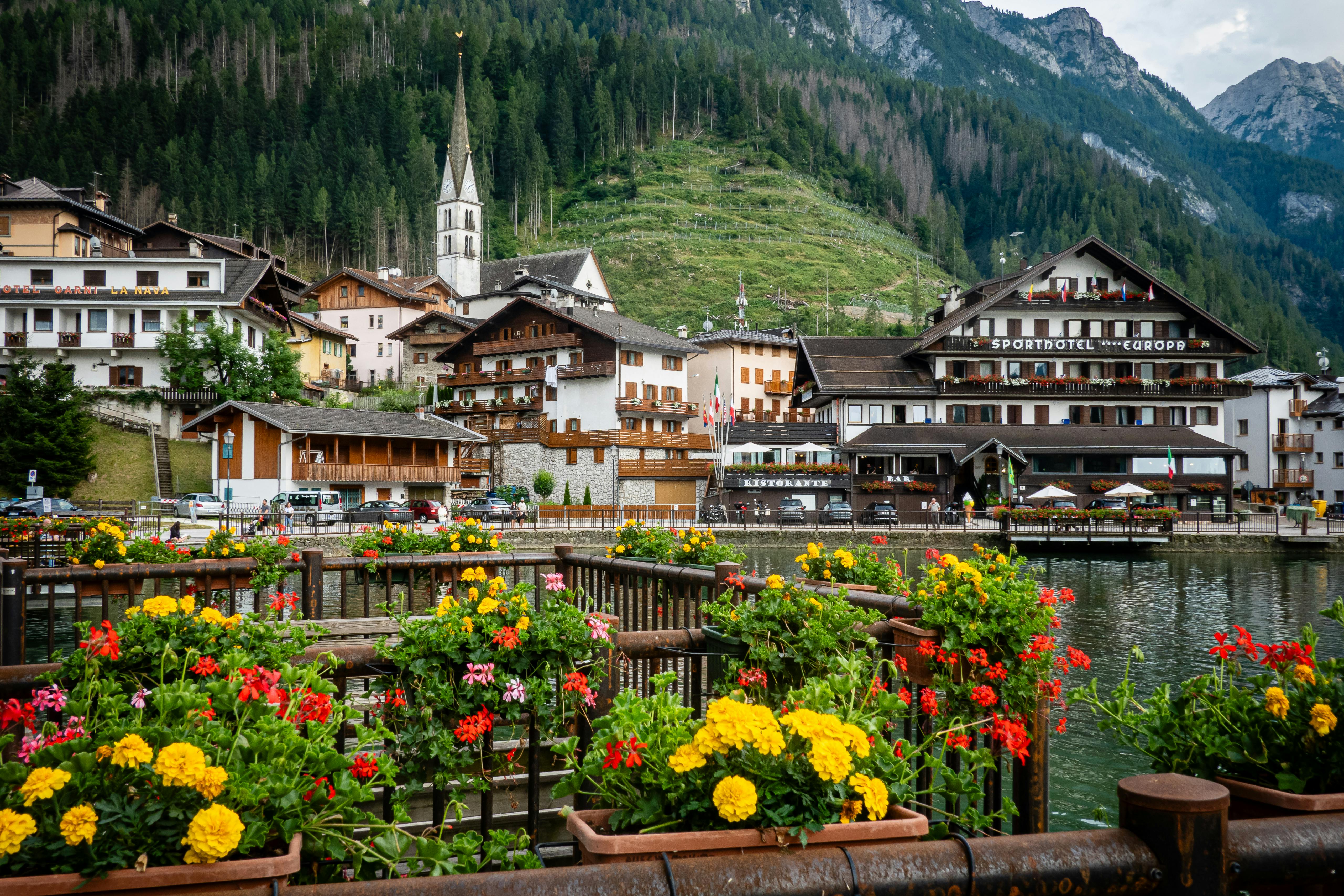
Alleghe Lake Mountain Mirror Meets Venetian Legacy
Dawn breaks over the Civetta massif as mist rises from Alleghe’s glassy surface—its 1.3-kilometer length perfectly mirroring the 3,220-meter peaks that cradle it like a jewel in nature’s palm. You stand where Venetian merchants once traded timber for salt in the 15th century, the scent of larch pine mingling with the crisp 3°C (37°F) air while your breath forms clouds that dissolve into morning haze. At 1,220 meters in the heart of the Veneto Dolomites—part of the UNESCO World Heritage Site since 2009—this glacial lake solves a fundamental paradox: how human tragedy created natural beauty. Formed catastrophically in 1771 when a landslide from Monte Piz blocked the Cordevole River, its creation buried the original village of Riete under 50 meters of water and debris. Today, the submerged church bell still rings during storms according to local legend, while scientifically, its clarity comes from pure meltwater filtered through ancient dolomite. Strict conservation protocols preserve its magic—wooden boardwalks prevent shoreline erosion, motorboats are limited to electric vessels, and visitor numbers are managed through timed access. In 2026, as overtourism threatens Alpine ecosystems, Alleghe matters precisely because it proves that resilience and wonder can emerge from disaster.
Why Alleghe Lake Embodies Resilient Beauty
Alleghe solves a fundamental geological paradox: how catastrophe can create enduring beauty. Its existence stems from the 1771 landslide when 15 million cubic meters of rock from Monte Piz crashed into the Cordevole Valley, burying the village of Riete and damming the river to form this 1.3-kilometer-long lake. The technical management is precise: water clarity is monitored weekly for turbidity (maintained below 2 NTU); the 4-kilometer perimeter trail uses elevated wooden boardwalks to prevent shoreline erosion; and strict regulations limit boats to electric motors under 5 horsepower to maintain surface stillness critical for reflections. Historically, the lake fulfilled dual roles—as economic resource (powering sawmills until 1900) and spiritual symbol (the submerged church of Riete became a pilgrimage site). The 2009 UNESCO Dolomites designation formalized protection protocols: private vehicles restricted within 300 meters; all waste removed by electric carts; and seasonal visitor caps (max 1,200 daily) enforced through timed parking reservations. Critically, the lake balances accessibility with preservation—the main viewing platform accommodates crowds while hidden trails like the Civetta Panorama route offer solitude, ensuring everyone experiences its reflective magic without compromising its fragile ecosystem.
The Best Time to Experience Alleghe Lake
For optimal reflection quality and manageable crowds, visit between June 10–July 15 or August 25–September 20, 2026—when daytime temperatures average 12–18°C (54–64°F) with minimal rainfall and stable atmospheric conditions [[60]]. Arrive by 6:00 AM to experience the lake in perfect stillness before winds develop; morning calm creates flawless mirror reflections while temperatures remain cool enough for comfortable exploration. Avoid July 16–August 24 when temperatures exceed 20°C (68°F), visitor numbers regularly hit the 1,200-person cap by 9:00 AM, and afternoon winds disrupt the lake’s reflective surface. Winter visits (December–March) offer snow-dusted serenity but present challenges: shorter daylight hours (sunset at 16:30), icy boardwalks requiring crampons, and limited facilities. For real-time updates on parking reservations and trail conditions, verify with the Alleghe Tourism Board’s portal at 72 hours before departure, as weather occasionally triggers temporary closures.
Approximate Budget for a 7-Day Trip
This budget reflects mid-range nature-focused travel based in Alleghe with day excursions to surrounding Dolomite sites, using 2026 projected pricing with 3.8% inflation adjustment from 2024 baseline figures per ISTAT regional data. All costs in euros (€).
- Accommodation: €95–€140 per night for traditional B&B or 3-star hotel in Alleghe (e.g., Hotel Miralago or B&B Al Lach); includes lake views and breakfast featuring local cheeses and speck
- Food: €48 per day average—breakfast €11 (fresh ricotta and speck), lunch €15 (polenta with venison stew at lakeside kiosk), dinner €22 (primo of canederli dumplings, secondo of Alpine trout at family-run trattoria)
- Transportation: €230 total—Venice Marco Polo Airport to Alleghe via Dolomiti Bus line 340 (€12 round-trip, 2h 15m); daily car rental €45 including fuel; parking at lake €10/day (free before 8:00 AM with reservation)
- Attractions: Guided landslide history tour €20; electric boat rental €25/hour; cable car to Monte Civetta €28; Museum of the Landslide €8
- Miscellaneous: €70—handwoven wool souvenir €30, Veneto wine tasting €20, donation to lake conservation program €20
Total estimated cost: €1,050–€1,280 for seven days
6 Essential Alleghe Lake Experiences
- Witness Dawn’s Perfect Mirror: Arrive by 5:30 AM to photograph the lake’s flawless reflections before winds develop. The stillness creates perfect mirror images of the Civetta peaks—use a polarizing filter to enhance clarity and reduce glare on the water surface.
- Rent an Electric Rowboat: Secure one of the 8 wooden boats by 8:00 AM before crowds arrive. Row toward the eastern shore where the submerged village of Riete lies beneath 50 meters of water—local legend says the church bell still rings during storms.
- Walk the Elevated Boardwalk Circuit: Take the 4-kilometer loop at 7:00 AM when trails are empty. The wooden walkway prevents erosion while offering multiple vantage points—note how reflections shift from sapphire (north shore) to silver (south shore) based on light angles.
- Attend a Landslide Science Demonstration: Join the “Voices of the Mountain” session (Wednesdays/Saturdays at 10:00 AM) where geologists explain the 1771 catastrophe. Handle rock samples from Monte Piz—observe how the limestone composition contributed to the massive slide.
- Photograph the Golden Hour Glow: Position yourself at the western overlook at 18:30 for sunset shots. The low-angle light transforms the Civetta peaks pink while the lake deepens to cobalt—use a telephoto lens (70-200mm) to compress the dramatic scale.
- Explore the Museum of the Landslide: Visit the town museum (open 9:00–17:00) to see artifacts recovered from submerged Riete. Focus on the 1771 church bell replica—note how its bronze composition was designed to carry sound across the valley.
3 Hidden Gems Most Travelers Miss
- Lago di Coldai Secret Access: A 2.5-hour hike from Passo Giau leads to this hidden glacial tarn surrounded by sheer cliffs. Visit at dawn (6:00–8:00 AM) when mist clings to the water—summer access only (June–September).
- Archivio Storico del Disastro: In Alleghe’s town hall basement, unpublished records from 1771–1800 document the landslide aftermath. Email archivio@comune.alleghe.bl.it 72 hours ahead specifying interest in “Documenti Frana 1771–1800”; bring ID.
- Rifugio Tissi Hidden Hut: Accessible via the unmarked Val di Zoldo trail, this 2,200m refuge serves the original “smacafam” (Ladin polenta cake). Visit Tuesday–Thursday when chef Maria prepares her secret recipe—call +39 0437 789122 ahead.
Cultural & Practical Tips
- Wear proper hiking boots with grip soles—even “flat” boardwalks become slippery when dew-covered; sandals risk ankle injuries on uneven terrain.
- Greet locals with "Bon dì" (BON DEE)—Ladin for "good day"—a traditional courtesy that shows respect for indigenous heritage.
- Carry layers—even summer mornings require thermal base layers; temperatures drop 6°C per 1,000m elevation gain in surrounding peaks.
- Respect wildlife corridors—ibex and chamois frequent lower slopes at dawn/dusk; maintain 50-meter distance and never feed animals.
- Photography drones prohibited without authorization (+39 0437 789000); handheld cameras permitted but avoid blocking trails during peak hours (11:00–15:00).
- Support conservation by purchasing the official lake guidebook (€9)—proceeds fund anti-erosion projects protecting the fragile shoreline.
- Book parking early—Online reservations recommended May–October at comune.alleghe.bl.it/parking; arrive before 8:00 AM for free access.
Conclusion: Travel with Reverence, Not Just Reflections
To experience Alleghe is to witness nature’s resilience—a place where every ripple carries the memory of catastrophe transformed into beauty, and every reflection demands mindfulness. In 2026, as overtourism strains Alpine ecosystems, this sanctuary stands as both model and message: proving that accessibility need not sacrifice authenticity. Your presence here carries consequence—the €20 guided tour funds geological monitoring programs, yet your footsteps simultaneously risk disturbing fragile shoreline vegetation. True engagement means slowing beyond photography: sitting silently as dawn light transforms mirror waters, understanding that preservation requires both financial support and mindful movement. Leave no trace beyond footprints; take no fragment beyond memories. For Alleghe endures not as a mere backdrop, but as a testament to what happens when communities choose harmony over conquest—a covenant written in water and stone that asks only this: that we remember why some places must be experienced with all our senses, not just our eyes.